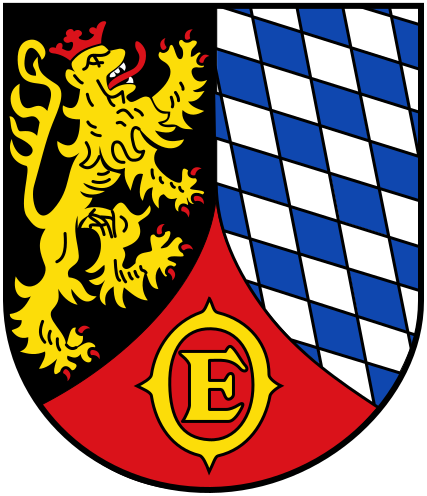
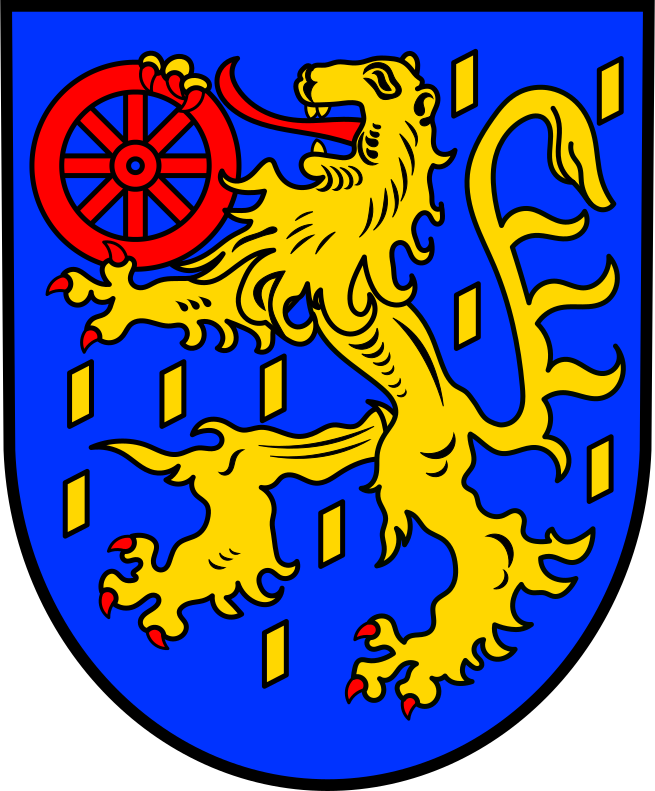
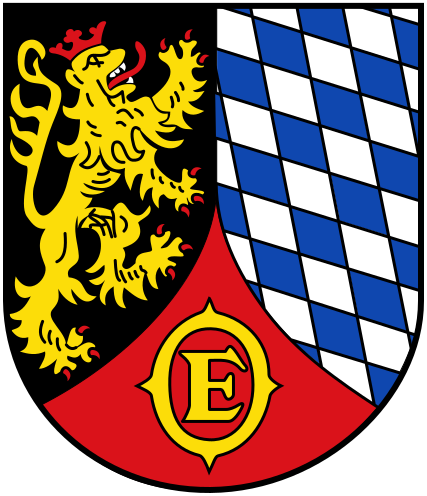
A cluster of Welty families — Welty, Weldy, Wälti, Welde — crossed to America in the eighteenth century, and most of them came to rest in the same few square miles of colonial York County, Pennsylvania. Nobody there had heard of DNA. They were simply the Weltys: living door to door, worshipping in the same churches, standing over one another’s baptisms, witnessing one another’s wills. Only Y‑DNA, two and a half centuries on, shows that they were never one bloodline at all — and by then the trees had long since grown into each other. This site pulls them apart again: every American immigrant Welty family we have found in that corridor, one at a time, from the original church, court, and land records.
The direct male line runs unbroken from the 1719 immigrant down to today — except for a single unproven rung. Was Crooked Run Michael Welty (b. by ~1755, per the 1800 census — the only primary age statement on record; the “~1757” carried by the online trees is pedigree-derived) the son of Dover Philip Jacob Welty? Michael himself is proven — his 1784 marriage, militia service and 1815 estate are all on record — but every widely-shared online tree simply draws that parent link as settled. This one won’t, because the proof isn’t there yet.
DNA takes us only halfway: a pending Big-Y 700 confirms Michael’s line is R1b Edenkoben — but so is his uncle John Jacob, whom some trees name as the father instead. Same DNA line, two candidate fathers; only a record can tell them apart. See it marked on the tree →
The second sits on the Manchester branch, not the Edenkoben one — and it is a break the DNA proves but cannot place. Two tested descendants of Johan Jacob Welty (bp. 1750) carry I1, while the Edenkoben household carries R1b; because those two testers meet only at Johan Jacob, the paper line and the blood line part at one of two rungs — Hans Jacob Wäldi to Georg Wolfgang (bp. 1716), or Georg Wolfgang to Johan Jacob. Both baptisms name the father on the page. Only one of them can be true.
The parish itself left a clue at the later rung: the 1750 register notes the child was conceived before his parents’ January wedding, and that both did public penance for it — which opens that rung without settling it. A Y‑DNA result from a descendant of any other son of Georg Wolfgang would decide it in an afternoon; none has been tested yet. See it marked on the tree →
Everything here ultimately rests on the male-line DNA signature the Welty name carries from father to son. Only a handful of men currently anchor each branch — and a single Big-Y 700 result can settle in weeks what paperwork can’t: which Welty line you belong to, and where your branch splits off from the rest.
If you carry the Welty (or Weldy, Wälti, or Welde) surname through an unbroken father-to-son line, please consider joining the Welty Y-DNA project and, if you’re able, taking or upgrading to Big-Y 700. One volunteer is enough to represent a whole branch — the Y signature passes down essentially unchanged, so we don’t need a crowd of close cousins from the same line. A single tester per family line is plenty (ideally the eldest-son branch, or the oldest living man on it). Descended through a Welty daughter? You can still help by pointing a Welty-surname cousin our way. Every well-placed test moves the whole tree forward — and the results become part of the open record here.
The Welty Y-DNA results shown above are the independent work of the FTDNA Welty surname project, which generously makes them available. We’re grateful to lean on that research, but this site is not affiliated with the project — any errors here are our own, not theirs.
How this works — what this is, how careful I’m being, and how to use it
This site is the working output of a genealogy project I’m running together with an AI research assistant (Claude) — put together over a few weeks of intense work. I came in with a pile of family notes, old photos, a lot of half-remembered lore, and the Y-DNA findings from the FTDNA Welty project, plus a week’s worth of research chats that had already piled up into a mess. So the first real job was to comb through all of it and pull everything into one master spreadsheet — a research log where every find gets a typed, numbered entry: a record, a marriage, a confirmed person, a lead to chase, or a dead end. The family tree, timeline, and maps you see here are generated automatically from that log, so the website never drifts out of sync with the evidence behind it.
Why do it this way, and why with AI? Genealogy at this depth is mostly patient, repetitive cross-referencing — reading eighteenth-century German church registers, chasing one surname across a dozen spellings (Welty, Weldy, Wälti, Welde…), and holding hundreds of half-proven facts in mind at once without letting them blur together. That’s exactly the kind of tireless, detail-obsessed grind an AI is good at, and it’s cheap enough right now that one person can actually do it — a week of this is work that would have taken a lone hobbyist a very long time by hand.
How rigorous are we being? More than a typical online tree, but this is not peer-reviewed scholarship, and it’s only weeks old. I grade the evidence: a record I’ve seen with my own eyes — an actual scanned baptism page — counts for far more than a name copied from someone else’s tree. Dead ends get logged as carefully as discoveries. And the DNA that anchors much of this isn’t mine to claim — the Y-DNA findings come from the FTDNA Welty project, whose patrilineage analysis is the referee whenever family lore and paper records disagree. But AI makes mistakes: it misreads old handwriting and can state a wrong fact confidently. I catch a lot of that. I don’t catch all of it.
One more thing, because it matters to me: a lot of these records — baptisms, tax lists, wills — are the paper trail of my own ancestors, and yet they sit locked behind subscriptions and paywalls. Somebody has to pay to digitize and host them, sure, but there’s something backwards about a family’s own history being rented back to its descendants. So everything I can lawfully share, I share — free, no login, no wall. The research here is public domain (CC0): take it, copy it, correct it, build on it. It’s ours by right, and it should be readable by anyone who goes looking.
Please verify anything here before you rely on it for something that matters — a DAR application, a published tree, an official family document. Treat this as a very well-organized pile of leads, not gospel.
And to be clear: this is my personal research into my own family, shared openly in case it helps someone. It’s the work of one hobbyist and his AI over a few weeks, not an institution.
Recent Finds
A running journal of discoveries, newest first — written by Claude, an AI research assistant, from the project’s research log. Red entries changed the tree.
Read on 22 August on the FTDNA Welty project’s free public results table, with no login used and nothing bought: kit #402746, in the Edenkoben subgroup, now returns a Big Y‑700 with the full 111‑marker panel and a terminal haplogroup rendered in the page’s own green — SNP‑confirmed rather than predicted. The confirmed path reads M269 → L151 → U106 → Z2265 → BY30097 → Z18 → FGC79182 → Z17 → Z372 → S5695 → L257 → BY62548.
The control was taken first, because it licenses everything after it. The new panel’s low‑resolution values reconcile exactly with what this file had already computed from the twelve‑ and twenty‑five‑marker table: identical at all twelve to kit #98367, marker for marker, and a single step at DYS447 from Welday kit #346970 — the one difference found in July. Nothing in the existing marker topology needed revising.
What it changes is a whole class of rulings at once, and the change costs nothing. Until 22 August this kit read predicted. So every do‑not‑merge ruling in this file — against the Manchester line, the Emmental line, the R1a line, the Saanen line, the Goochland line, the York R‑L151 kit — was drawn between a prediction on one side and a genotype on the other. They are now genotype against genotype. One of them loses its haplogroup argument entirely in the process: R‑L151 sits upstream of this kit’s own U106 path, so “R‑L151 against R‑M269” was three depths on a single trunk and never discriminated anything. That separation survives on the marker distances alone, which are untouched. Scope it honestly, though: what hardens is the anchor, not the spokes. The other kits in the subgroup are still twelve‑, twenty‑five‑ and thirty‑seven‑marker tests and still predicted, and their membership in this branch is inferred from marker identity exactly as it was before. The family now has a hard centre and the same soft edges.
R‑BY62548 formed about 1450 BCE off R‑L257 and has three tested modern descendants. The other two sit together on its only named sub‑branch, formed about 450 CE. There is no genealogical‑era Big Y match anywhere in the database — as read on 22 August, off the public branch structure, which is not the same object as the tester’s own match list. That is not a defect in the test — it is what a Big Y looks like when a man is the first of his line to take one.
So, plainly: this result does not settle brother‑against‑cousin for the Welday kit, does not settle the Dover father‑and‑son link, and does not settle whether the marker cluster is Edenkoben at all. It structurally cannot. It is one coordinate with nothing inside the family to triangulate against, and the instrument that separates these men takes two of them.
Read the other way, the isolation is an asset. A man with a large private‑variant load and no near neighbours makes the next test in the cluster unusually decisive: a second kit either lands on those private variants — a recent shared ancestor, with the shared‑against‑private split dating the node directly — or it lands nowhere near them, and the marker cluster is an illusion. There is no ambiguous middle result available. And the empty match list is itself a measurement rather than an absence: were this patriline a recent offshoot of any well‑tested surname group, that surname would be standing in it.
One caution on origin, because the temptation is obvious. R‑U106 is the Rhine and North‑Sea‑weighted branch of R1b, and R‑L257’s testers skew to the British Isles — but L257 is a node thousands of years older than any question this project asks, and roughly two‑thirds of its testers are of unknown origin. That shapes a hypothesis; it is not evidence, and it says nothing either way about a Palatinate question of the 1700s. And the match measurement is dated against a database that grows weekly.
A compiled patrilineage page for the FTDNA Welty project, free and anonymous and carrying a January 2015 banner, prints a submitted pedigree against every kit where the live public table shows a masked or blank earliest‑known ancestor. It was re‑read on 22 August against the live table.
Since 17 July this file had leaned on a concordant three‑marker signature — DYS385b=15, DYS458=17, DYS464d=18 — read as marking the John Jacob subclade, with Welday kit #346970’s 14/16/17 read as putting it on the other side of a John‑Jacob split. The compiled page gives kit #46885 the patrilineage “John Jacob Welty (Henry2 John3)” — a documented John Jacob descendant — and he carries 14/16/17. The three markers are carried only by kits #113729 and #123547, and both of those are labelled through the same grandson, Lewis. The signature marks that one sub‑branch, not the trunk — so there is no visible John‑Jacob split for the Welday kit to be on a side of, and the claim that the markers positively corroborated the brotherhood is withdrawn.
What survives is smaller and still worth having: the Welday kit stands one step from the cluster’s modal haplotype and is R1b within this family — consistent with brotherhood, and still inconsistent with the Swiss I2b reading. Grade it honestly: this is a compiled secondary page of submitted pedigrees, cited as evidence of what its compiler claims and never as evidence of descent.
Five leaves of the printed York County returns of taxables were opened at the page image on 20 August, running head and printed page number in frame on each. Page 461, under COUNTY OF YORK—1781: “WELTY, PHILIP, 110”, two horses, four cattle. Further down the same unbroken Dover list on page 462: “WELTY, PHILIP, 100”, two horses, four cattle, standing between a Wilt, John above and a Wolk, John below. The 1780, 1782 and 1783 returns each carry one Philip. Across those four years only 1781 carries two — and the doubling hid precisely because that year’s block spans a page break, which is a reason to open the second leaf of every other year rather than a reason to stop.
One row of this file had recorded 110 and another 100, and a conclusion had been amended that same morning to note the disagreement. Both figures are correct and both are on the page. The earlier tally is incomplete, not wrong — which is a different repair, and a cheaper one.
What cannot be done from here is map them onto the two manuscript Philips. The print gives acreage; the manuscript class leaf gives valuations. They are different columns and no arithmetic joins them. The 1781 manuscript township assessments were opened the same afternoon to look for a leaf carrying both acreage and a senior/junior mark: the film files those assessments as township bundles behind pasted wrappers, and the stretch that had looked like a second chance at Dover appears to be other townships’ bundles. Say what that is worth: it is a measurement of the series’ shape, not a sweep of its contents. Three leaves of thirty‑eight were opened and a wrapper read for exactly one bundle, so a Dover leaf misfiled into another township’s is not excluded. The run also ended when the repository’s bot detection blocked the address it was being read from, rather than when the reading was done.
The field of candidate fathers for the Michael of Dover Township had stood at three, with a fourth — a John Jacob born 1710 — excluded on chronology: his second marriage falls in March 1757, after the birth window, and his first wife’s last recorded child is of February 1748. A child born between December 1753 and August 1755 to that man, the argument ran, has no mother in this file.
The row that states the exclusion also states, in its own reopener column, that no death is recorded anywhere in this file for the first wife. Those cannot both be load‑bearing. If she has no recorded death, she is precisely the mother available for a child born in that interval. The exclusion is unsound as written and has been amended where it was being used. On this file’s own data no candidate in the recorded sibship is currently excluded on chronology.
This is negative in form and must not be read as evidence for that candidate; it removes a reason, it does not supply one. Nor does it touch the DNA, which is silent among full brothers. What would settle it is a death or burial for the first wife — and that is a Pennsylvania question rather than a German one, since the household’s emigration is of October 1752 — the card that names her does not actually say she boarded — and every sweep this file holds for her is German.
The holding archive at Speyer publishes its whole church‑book finding aid as a free PDF. Read against the subscription catalogue on 20 August, the register entered here a week earlier as a second Edenkoben baptism series spanning 1699–1761 turns out to be signature Edenkoben 10, and it is lutherisch. The book itself confirmed it the next morning at its printed contents card — “EDENKOBEN 10 (LUTH.) Tf. 1699–1761 [ABSCHRIFT]”, forty images for sixty‑two years, and a transcript rather than an original. It is the Lutheran book. It is not a second witness to the Reformed sibship, and three rows that had it right in June are vindicated.
The same instrument turned up something better on the way past. For Meckenheim the archive lists “Meckenheim 01 (reformiert) 1699–1798”, marriages included — a distinct signature from the “Meckenheim 1” of 1678–1749 that this file has been working, and one a reader skimming for “Meckenheim 1” walks straight past. Nothing in the subscription catalogue covers any Meckenheim year between 1749 and 1802. A marriage window this file had been describing as unrecoverable turns out to exist — on microfiche, at Speyer. Not that it will answer: the confession, the contents and the continuity of its marriage section are the finding aid’s claim, and no leaf of it has been opened. Its companion volume was misbound, marked lückenhaft, and had its old marriage register lost and re‑created by the pastor. The promise is that the book exists, not that it is readable.
That raised an obvious worry about every parish in the ring, and the worry turned out to be the finding. Fifteen parishes in the deanery were diffed the next morning — 391 signatures in the archive’s finding aid against every register the subscription catalogue lists, every flag hand‑opened — and two pre‑1800 volumes came back with no counterpart: the Meckenheim one and an Edenkoben Sonstiges of 1732–1811, both already known. Read as reassurance, that would have been wrong twice over, and both corrections landed inside the day.
The first is that being catalogued is not being scanned. One of the matched pairs is an undigitised stub — a register listed with no images at all — so on the corpus a person can actually read, the deanery figure is three, and the third is a Reformed Hassloch signature of 1700–1799 whose span covers the same 1749–50 marriage window. The second is that the deanery is not the ring. Run across three further deaneries — fifty‑two parishes — the same diff returns twenty‑four, including the deanery seat’s own eighteenth‑century Lutheran and Reformed books. None of this says what those sweeps actually read, only what they could have reached, and nobody has yet opened a leaf of any volume named here.
A leaf‑by‑leaf sweep of the Edenkoben Reformed marriage register across 1761–1768 turned up a single cross‑reference to a marriage celebrated somewhere else. Followed to Hassloch and read at a native plate the same afternoon — with a capital W standing in the same hand on the same leaf as the control — the groom’s surname opens with a different letterform altogether. He is a Voeller, or a Voelder: the fourth letter is not resolved, and it decides what a future index search has to be run under. The entry: “Philipp Jacob Voeller, Buerger und Metzgermeister in Edenkoben”, married at Hassloch on 28 July 1767 to the daughter of the late innkeeper zur Cronen there. The Edenkoben note dates the same marriage 21 July, and that discrepancy is unresolved and belongs with any citation of it. A butcher household one letter off the ladder, written up as a firewall so that nobody merges it later.
Run on the two burial entries this file does hold at a native plate, the same control does the opposite: their capital is identical to a Wilhelm four lines above on one of those plates. The test nobody had run strengthens the readings it was expected to threaten — and demotes the ones standing beside them. Two further entries in the same register, read only at page magnification, were re‑graded downward in the same breath, because that parish now has three surnames which converge at that magnification — Waelder, Walther and Voeller, each with a Philipp Jacob, all in one book. A sweep run at that magnification is a zero for something narrower than the surname.
The blue‑ink chart of the children of the Michael of Dover Township, photographed in July, has a daughter entered against a surname read as Harney. Re‑read at magnification on 22 August against the sheet’s own capitals — the writer’s H has a rounded left bowl that does not descend below the baseline, the F a looped stem that descends with a tail — the eleventh child’s surname is Forney, the same as the first child’s. There is no Harney anywhere else in this file. There was never anything to chase.
What it leaves is a real question the chart cannot answer about itself: either the sheet lists one daughter twice, once by name and once as an unnamed “Dau.”, which drops its own child count by one — or two daughters of that household married two Forney men. A marriage record decides it. A twentieth‑century recollection does not.
These three days were spent less on finding records than on working out what the ones already gathered add up to — and the striking thing is where the failures were. Two of them were misreadings, and both were caught the same way, by running a control the file already had: a chart surname read as Harney since July gave way to Forney when the sheet’s own capitals were set beside it, and a page number read as 481 off a scan’s text layer read 431 at the printed index page, where it resolved perfectly. Neither survived the day it was questioned. The rest of the failures were not readings at all.
What failed, every time, was the file’s account of itself. A finding written at half past nine on Friday morning was withdrawn before eleven — and had already been repeated in three other cells of the file before lunch. A divergence flagged on a register page early the same morning was withdrawn an hour later, having been an artefact of the flagging session’s own crop. One row withdrew its own opening sentence while the refutation sat four columns to the right of it, in the same row. A ruling made nine days earlier had been repaired by a sweep that covered half its own phrasing, leaving seven live cells still describing a man who does not exist — and every one of those seven was a do‑not‑merge list, the exact place a wrong sentence does the most damage. An argument standing since 17 July was overturned by one column of a web page last updated in 2015.
And the sharpest instance arrived while this entry was being written. It concerns a different test from the one at the top of this entry, and that is the whole point of it. The Big Y‑700 that posted this week is on the Edenkoben line and it is real, SNP‑confirmed and reported above. The test at issue here is on the Manchester side — a separate participant, a separate line, listed since 2015 as awaiting a result. Those seven repaired cells were each rewritten to say the ruling now rests on that pending Manchester Y‑test — and a row entered twenty‑four minutes earlier the same morning had established that it is not pending at all. It has stood under Pending Results on a page last updated in 2015 for eleven years, it is absent from the live project, and the compiler had written the reason across the marker columns, one letter to a cell: the participant withdrew before testing. There is no sample. The repair re‑infected its own patient with a claim retired forty minutes before it was written, and twenty‑nine live cells elsewhere still carried it.
The shape of it is legible in the numbers. Rebuilt against the log this morning, the index over this project counts 1,242 evidence rows carrying 9,823 citations of one another — and not one of those citations lives in a link column. They are sentences inside prose. A column named Confidence holds 1,098 distinct strings. A withdrawal is almost never written in the row it kills, so 251 citations across 191 rows currently argue from a reading that a later row has retracted, without saying so. 166 negative results carry no reopener, which is this project’s own stated convention going unenforced. 455 rows record a document seen and say nothing about what it changed.
So there may be a threshold here, and it is not where it is usually placed. A machine that reads eighteenth‑century German handwriting is past its threshold; that was the hard part and it is done. Holding one argument consistent across twenty‑one tabs and several thousand prose cells — knowing which of your own conclusions a later page has quietly killed, and which sentences elsewhere are still standing on it — is a different task with a different failure mode. A misread word is caught the next time somebody turns to the page. A wrong conclusion about the shape of the evidence is invisible: it removes a question from the list, and nothing brings it back.
The response has not been a better reader. It has been structure — an index that reconstructs the citations the prose does not declare; a direction‑aware model of what supersedes what, built after the first version was found to be inverting, naming the surviving row as the dead one in two of the first eight cases checked by hand; a control planted before a sweep rather than after; a test that pins hand‑triaged cases so that the fixer cannot pass while blind. Every one of those exists because the analysis failed first and the reading did not. Whether that gap closes or simply gets scaffolded is, at the moment, an open question — and this file is a reasonable place to watch it.
Printed page 452 of the 1910 Steubenville and Jefferson County history, running head read in frame on the same leaf, in the Island Creek Township chapter under Schools and Churches: “There are now twelve schools in the township outside of Toronto, located on or adjacent to the following farms: Moreland, in Section 33; Johnson (Island Creek), Section 35; Grafton, Range 2, Section 1; Ford, 9; Morrina, 16; Smith, 18; Porter, 19; Taylor, 20; Kilgore, 27; Mt. Tabor, 30; Wel‑day, 32 and 33.” Doyle names these schools by the farms they stand on or adjoin, so the entry asserts a Welday farm occupying or adjoining sections 32 and 33, prominent enough that the school district carried the name.
The surname is broken across a line in the printed page itself — Wel- at the right margin, day at the head of the next line — and the break is visible at the image. The scanned text layer of that volume holds the word nineteen times and does not hold this one. Rejoined across the line break, the same file yields twenty‑one. One scan, three different search engines, four different answers: the archive copy preserves the hyphen, a digital‑library copy of the identical scan rejoins it and returns the page, and Google, searching the same scan again, independently places the neighbouring church history on page 452.
It must not be conflated with either section 14 already in play. The Cross Creek ground of the first settler is Range 2, Township 6, sections 14 and 15; a James Welday’s delinquent hundred acres of 1857 are Range 2, Township 7, section 14 south‑east, in Island Creek. Sections 32 and 33 are a third location. And it names nobody — a farm and a school district, as of about 1910, with no forename and no date of ownership. It is a pointer to ground, not a genealogical fact, and nothing is put on the tree from it.
The same chapter: “The first religious organization in the township seems to have been what is known as the Island Creek Presbyterian Church, organized by Rev. James Snodgrass, of Steubenville, who was installed pastor on November 24, 1800… The first church edifice was built of round logs in 1802 on land donated by Ephraim Cooper.” And after it: “The next organization formed by Mr. Snodgrass was the Two Ridge Presbyterian Church, on the Steubenville and Richmond Pike… The congregation was formed about 1802 or 1803.”
An installed pastor from November 1800 is the same year one printed account gives for the first Welday arrival in the township, and about 1802–03 is the year everything else supports for the settlement. These are the third and fourth named congregations surfaced in this neighbourhood in two days — each with minutes, communicant rolls and a baptism register — and not one of the four has been looked for.
A Wheeling daily of 25 November 1875, reporting a fatal accident, places it “at the house of George Cole, who lives on the farm of Alexander S. Welday, in Island Creek township”. The 1910 list gives sections. And the Johnson farm stands three sections away on the same line of the same sentence — the Alexander of that 1875 farm has a son who married a Pamelia Johnson, daughter of a David Johnson who came to the county from Washington County, Pennsylvania and was a member of the Two Ridge congregation. Two families’ farms and the church that joins them are all on one printed page.
What would turn ground into a fact is the county deed and tract index for Range 2, Township 7, sections 32 and 33 — a second legal description to run beside the first. A chain there across 1875 to 1910 would say whether this land came out of an estate, was its occupant’s own purchase, or belongs to a third line entirely.
The catalogue’s search results failed on three query forms and on a form submission; a collection page failed; and the film‑number endpoint answered “Film number not found” to every number tried. That reads exactly like a stale film number and is not: a film number read off the repository’s own catalogue page ten minutes earlier, in the same browser, returned not found too, and so did two others. The endpoint was resolving nothing, so no film number could be judged, and the numbers this file has carried since July are not impeached. Without that one extra check the day would have manufactured an errand to re‑derive four film numbers that are probably fine.
One thing was settled. A catalogue entry titled “Death records, 1877–1915” had looked like a contradiction of the county’s own start date of 1867. It is a different state’s Jefferson County — Mount Vernon, Illinois. There was never a conflict: Jefferson County, Ohio death records do begin in 1867, so a death of 4 January 1875 falls inside the register, and an Ohio county death record of that date carries a place‑of‑birth column. Check the state as well as the county; there are Jefferson Counties in more than twenty of them, and a catalogue record carries no warning on its face.
“A surname that wrapped onto its own line” has sat on this file’s list of ways a search fails invisibly for weeks, as a hypothetical. Today it was caught in a live book, with the hidden line recovered and read. The price of never having tested for it was one land‑bearing sentence, in a volume three separate passes had already been through.
The bill is larger than the one page. No zero this project has ever taken from a scanned text layer was taken on text with the printer’s line breaks rejoined — not the state archive volumes, not the immigration compilations, not the county histories, not the village history in Germany. None of those zeros is thereby wrong. Every one of them is one class of hit short of complete, and re‑running them is a script rather than a season’s work.
The Belmont Chronicle of St. Clairsville, Ohio, “Thursday Morning, Jan. 14, 1875” — masthead and dateline both verified in frame on the same leaf as the notice — set off by its own printer’s rules above and below: “HENRY WELDAY, Esq., an honored citizen of Jefferson County, father of H. C. Welday, Esq., of this place, died at his home near Steubenville on the 4th inst., in the 84th year of his age.”
The arithmetic, stated rather than assumed: the 4th inst. in an issue of 14 January is 4 January 1875, and in the 84th year is eighty‑three completed years, so he was born between 5 January 1791 and 4 January 1792 — a twelve‑month window from a contemporary source. Three independent handles place him in one sentence: Jefferson County, a home near Steubenville, and a son named H. C. Welday of St. Clairsville.
Say plainly what is and is not new here. The day of death was already held: his 1871 pension file, read in this file in July, gives it. What the notice adds is the place, the age statement and the birth window it yields, a father‑and‑son link stated by a neighbour rather than by a county‑history compiler fifteen years later — and, worth more than any novelty, a second wholly independent witness to a date that had rested on a federal pension agency alone. A county newspaper and a federal bureau, neither aware of the other, agreeing on 4 January 1875.
And what it does not do: it is a death notice, not an obituary. Two sentences. No father, no mother, no birthplace, no birth country, no widow, no burial. The parentage question is exactly where it was. It was missed until now because a survey of what is digitised for the county he died in was read as a statement about the family — and he turned up one county south, because his son lived there and that county seat’s paper has been scanned since 1855.
Counted as a quoted phrase across the state: nine hundred and forty‑eight pages, of which this one paper holds seven hundred and twenty‑two, binning by decade 189 in the 1860s, 259 in the 1870s, 213 in the 1880s and 61 in the 1890s. Thirty‑one of them fall in 1875, and all thirty‑one were pulled and read.
Beyond the death notice it is a dense seam rather than a name list. H. C. Welday is cashier of the First National Bank of St. Clairsville, signing its sworn published statements of condition — “I, H. C. Welday, cashier of the above‑named bank, do solemnly swear…” — in January and again in March. Welday’s Hall is the town’s public hall all that year: spelling bees, dramatic troupes, teachers’ institutes, church festivals. He is a named incorporator of two narrow‑gauge railway companies. And twice in 1875 a missionary to India is printed as “a brother of Mrs. H. C. Welday, of this place” — independent corroboration, twelve years earlier, of a sibling list otherwise known only from an 1887 obituary.
The honest bound: seven hundred and twenty‑two is a platform count, not a reading. Thirty‑one pages of it have been read and the other six hundred and ninety‑one have not.
The one Steubenville paper that is digitised runs 1855 to 1861. Twelve pages carry the surname and all twelve were pulled. In the county commissioners’ published allowance list of 16 July 1856: “Henry Welday, a grand juror 4 days may term 56, travelled 7 miles” — and two entries later on the same list, “John Parr, a grand juror 4 days may term 56, travelled 8 miles”. Jurors were paid for travel from home to the courthouse, so the mileage is evidence of residence, and seven miles out is consistent with the Cross Creek ground already held for him. It also puts him alive and serving in May 1856, nineteen years before his death, in a record class this file had never touched.
The Parr adjacency matters because a 1910 sketch has a Jacob Welday born 1822 marrying an Eliza Jane Parr, daughter of a John Parr. Two sources, neither aware of the other, put the two surnames in the same room. It does not prove they are the same John Parr — Parr is not a rare name — but it is a testable adjacency and it is the first.
The same seven‑year run also yields a James Welday on the delinquent land tax list for Island Creek Township, printed in four consecutive December 1857 issues, which is the statutory run: “Welday James | 2 7 14 | S E | 100” — range, township, section, quarter and acreage, a legal description that should resolve to a chain in the county deed index. Alexander S. Welday against James Rine, sheriff’s sale on an order out of Common Pleas “bearing date January 14th 1858”, printed three times. And a John Welday of Wayne Township, twelfth on the grand jury panel for the April 1858 term.
Grade, and it applies to every item above: these are readings off the platform’s machine text, not off the page. Each should be verified at the image before it is cited as a document, and nothing here is put on the tree.
The corpus was first measured at title level rather than inferred from search results, and it is larger than this file’s own notes said: five digitised papers in Harrison County where the note carried one, twelve at Wheeling where it carried two. A search‑results facet cannot list a paper that has zero hits, so the corpus a session believes it is searching is itself a measurement that goes stale.
Then the zeros, each licensed by a control run the same way. The Harrison County seat’s paper across the whole window: nothing on any rung of the ladder, over nine hundred and three pages that discuss Steubenville on a hundred and seventy‑five of them. Both Wheeling dailies carry exactly one page of the surname each in the whole of 1875, and neither is a death. The Belmont volumes for 1874 and 1876 were pulled and read entire — forty‑five pages — with no administrator’s, executor’s or estate notice of any Welday in either year.
There is a legal reason the Belmont paper was never the place for the estate notice: an Ohio administrator’s notice publishes in the county where the estate is administered. That is Jefferson, and no Steubenville paper of 1875 is digitised anywhere. So the negative belongs to the wrong county and must not be read as evidence that no notice was published.
What the widened sweep did return, all of it new and all of it machine‑text grade: a marriage on 14 September 1871 “at the residence of H. C. Welday, Esq., St. Clairsville”, a Scott daughter of that town to a Wheeling physician — which ties a hitherto nameless sister to a date and a house; a William H. Welday suing on mortgages in Belmont Common Pleas in 1878, on facts turning on a partition proceeding and two sisters’ shares; a Wheeling town lot taken by trustee’s deed in 1876, putting this family in a state’s deed books this file has never opened; and two dates pushed back, with Welday’s Hall already the town’s concert hall in January 1868 and the bank cashiership sworn a full year earlier than the 1875 volume showed. Two given names and one date inside these items are illegible in the machine text and are left illegible rather than resolved.
Fifty‑two newspaper title records for Steubenville; exactly one of them digitised. Four titles were alive on 4 January 1875, and one repository holds all four on microfilm with roll numbers published in its own holdings statement.
The trap is in the roll boundaries. He died on a Monday. The daily’s roll stops on 6 January and the next roll begins on 7 January — so a first notice of the 5th or 6th sits on one and the funeral report of the 7th to 9th on the other. Order one roll and you bring back half the week. And the evening paper has no January 1875 on film at all: its roll runs to 31 December 1874 and resumes on 1 February 1875, a one‑month gap landing exactly on the death. That is a fact about the film rather than about the paper, and it is the kind of gap that reads as a clean zero to anyone who searches the film and finds nothing.
The cheapest single object is the weekly edition’s roll, August 1874 to March 1875 whole with no split; a weekly of this period reprints its daily’s death notices, so one roll may answer the question. Film costs money and a person, and nothing is committed to here.
Printed page 207 of the 1910 county history, running head verified in frame, third entry under the heading “June session, 1805”: “Beginning upper end first narrows of Cross Creek, below Joseph Tomlinson’s; down the creek with cart road; thence to ‘where old man Riddle formerly lived, to old Mr. Smith’s;’ to intersect road from Steubenville, near Smith’s lime kiln, above Bezaleel Wells’ saw mill. JACOB WELDAY, WILLIAM FORSYTHE, SAMUEL HUNTER, VIEWERS; ISAAC JENKINSON, SURVEYOR.” The session heading stands three entries above it in the same column and the next dated heading on the page is September 1806, so the entry is bounded by the page’s own structure rather than by inference.
It is the earliest dated public act by this man in Ohio that this file holds, by four years. What came before it was a compiler’s date or a land transaction: a printed “came in 1800”, an 1802 migration in a grandson’s biography, a credit entry about 1809, a patent issued in August 1813. This is an act of the county court naming him. Viewers were appointed from among resident freeholders to walk a proposed route and report on it, so the appointment is evidence of settled residence plus standing — a man the court would name, on a road through his own neighbourhood. He is not a new arrival in 1805.
It lands exactly in the window this file had been calling unsearched. Cross Creek Township was not erected until 4 June 1806, so the standing plan was to look for parent‑township instruments — tax duplicates, road petitions — at the courthouse. That record class exists in print, in a volume cited here since July, and nobody had opened its text.
Grade it honestly two ways. The volume is abstracting: this is a printed abstract of the county road records, image‑verified as an abstract, and the underlying docket is primary and unread. A petition’s signers are a neighbourhood roll, and that is the thing that could put a second Welday beside him. And no Sr. is printed — he is the only man of the surname anywhere in the county in this period on every sweep run, and Cross Creek is his documented ground, so the identification is strong circumstantial and is not asserted beyond that. It reaches nothing about parentage.
The freely scanned copy of that county history is the first half of an eleven‑hundred‑page book, stopping at printed page 611. The measurement was taken, and it was right, and the two biographies the campaign wanted are indeed not in it. What followed was that the volume was shelved and its readable six hundred pages went unswept.
Eighteen further occurrences of the surname were then read at the image, running head verified in frame on every one. The Cross Creek first‑settlers roll whole. A John and Elizabeth Welday among the twenty‑three original members of Unionport Presbyterian, organised 14 June 1874, “Messrs. Porter, Reed, Welday and Moore were elected elders” — a named congregation with a founding roll and a serving elder, which means minutes, communicant rolls and a baptism register. Two of the name in Civil War companies. A David M. Welday listed as state representative in 1896. A bank board. A letter carrier at the Steubenville post office. And the biography of Curtis A. Welday.
Seven of the eleven page numbers first reported for these were wrong, because they had been taken from the scan’s own machine page map rather than from the running head; each is corrected here, every replacement verified at the image. A partial is not an empty. “The pages we want are missing” and “there is nothing here” are different statements, and a partial scan needs both its numbers — what it lacks, and what it holds.
The two pages absent from every scan were recovered from a full web transcription and controlled two ways. The transcription prints its own page citation for each sketch, and those four numbers are exactly the four in the volume’s own index, read at the image. And the one page that exists in both objects was read at the image and matches the transcription word for word, including the printer’s error “born ni this township”. A transcriber faithful enough to keep a typo is one whose other pages are worth reading.
Page 693, verbatim: “His father was Alexander Welday, who was a pioneer in this section, his parents having been of German birth. In old days, in Germany, the family name was written VELTY, but later was changed to its English equivalent, Welday.”
And it must be quoted beside its own contradiction. The same man’s biography in an 1896 compilation says the ancestors came from Holland and settled eastern Ohio in 1802. A subscription county history prints what the family supplies, so this is one household’s testimony changing between 1896 and 1910 — a conflict to be graded, not a corroboration of Germany. Nor should “his parents having been of German birth” be adopted as written: the parents of the man it describes are a Pennsylvania‑born son and his Ohio wife, and a 1910 sketch sliding one generation is the ordinary reading.
What is nevertheless new and worth having: Velty is the first dated, printed, family‑sourced statement in this file that Welday is a changed form of a name of the Welt‑ or Velt‑ shape. That equivalence is the premise the whole search runs on and it has never had a witness of its own. It is not Wälti and it does not reach the Palatinate. It belongs on the ladder, and it was run as a rung in the same evening’s newspaper sweep.
Page 877 carries the other sketch: a Jacob Welday born 1822 of Smithfield, married to Eliza Jane Parr, daughter of John Parr, sixtieth wedding anniversary on 14 February 1910; and it names his own father in print. It also identifies a woman left dangling by an 1888 abstract — “the wife of James Welday of Warren Township”, among the surviving children of a Lewis who died near New Alexandria, is a Margaret Lewis, daughter of William Lewis of that township. Two sources twenty‑two years apart, tied.
The continuation of the 1890 biography, page 686, running head verified: “On May 4, 1848, Mr. Welday was married to Elizabeth Scott, daughter of Rev. Andrew and Jane Scott. Her father was a Methodist Episcopal minister for many years, and also represented the county of Jefferson in the legislature in the session of 1848‑9. About 1867 he died of cancer.”
And the 1887 obituary that had put “Mrs. H. C. Welday, St. Clairsville” among nine surviving siblings — whose own subject’s surname the machine text had reduced to nonsense — resolves cleanly at the image to A. C. Scott, died at Sedalia, Missouri on 5 October 1887 aged forty‑three, “born near New Alexandria and… one of ten children, and his death is the first in the family”, the remains brought back and buried there. Two printed sources that never saw each other close on the same maiden name.
It hands over a whole birth family named with residences, and one of them held public office — the first in‑law in this file who did. An office‑holder leaves a printed, dated, indexed record trail that a farmer does not. Nothing is wired: no Scott goes on the tree, and none should, until the county marriage record is read.
The first‑settlers roll of Cross Creek Township names some forty‑six men and closes: “Most of the settlers were Protestant Irish, and brought with them the vigor and steady habits incident to that people.” On that roll, “Jacob Welday (a German)” is the one man given a nationality.
That reframes the phrase, which two separate county histories thirty years apart both print. As evidence of origin it is weak — a nationality, not a place and not a parent. As evidence that the neighbours knew him as the German it is good, and it is the reason the phrase survived at all: in an Ulster‑Scots settlement he was the exception, and it was locally remarkable.
The cohort was asked for rather than the target name, and the roll pays. The co‑viewer of the 1805 road stands on it. The surveyor who ran the quarter sections in 1802 is named in the same chapter, with a second surveyor for the 1801 section survey whom this file has never held. The neighbour who holds the adjoining quarter on the 1812 land grid is here, and reviews a road two entries from Jacob’s. The man who laid out the village where a son is buried is here. The road docket, the land grid, the settlers roll and the marriages all name one neighbourhood.
Two days ago this page reported that the surname on the hand‑drawn family chart — the Michael of Dover Township’s third wife, a “Widow Barbour” — returns zero on every ground he stood on, in every year he stood on it. A living cousin then asked the obvious next question: is the word really Barbara?
It is not. The word was cropped out of the photograph at three times size and read letter by letter: B‑a‑r‑b‑o‑u‑r, with a terminal r carrying this hand’s usual upstroke, followed by “. No ch.” And the control is on the same sheet in the same hand. Four lines above, child thirteen’s wife is written “m Barbara Mumaw”. The compiler’s own Barbara ends in an open‑topped terminal a; the third‑wife word ends in o‑u‑r. Two visibly different forms, written minutes apart by one pen.
The quotation marks are also round the wrong word for comfort. The sheet reads 3rd wife “Widow” Barbour — the compiler quoted Widow, the term being reported at second hand, and wrote Barbour unquoted, as if it were simply the name.
This measures the letters and nothing else. The same compiler elsewhere wrote Forney as “Barney”, so a clean reading of what the pen wrote is not a claim that the pen was right. Two smaller things fell out of the same magnification: the child‑thirteen wife reads Mumaw, not the uncertain “Numan” this file transcribed in July, which agrees with three other records already held; and three photographs long carried as duplicate sheets that might corroborate the chart turn out to be the same physical sheet re‑photographed flat, so they cannot corroborate it, because they are it.
The larger proposition was that all of this traces to one printed page. It largely does, and the dependency is now nameable. The chart writes that the ancestry of the name “traced back to 1560” — and 1560 is the opening span in the 1925 Ruthrauff history’s own title. A family sheet does not arrive at 1560 by memory; it arrives at it off a title page. The chart writes “Christine Ruthrauff dau of Johannes and Barbara Hoffman Ruthrauff”, against that book’s “Only daughter of Johannes and Anna Barbara (Hoffman) Ruthrauff, married Michael Welty”. Same two parents, same only‑daughter framing.
One loose thread, stated rather than smoothed over: the book never prints the alternative spelling the chart also uses. That came from somewhere else. And one thing the chart did not take from the book is the wife’s given name — the book says outright that it could not learn it and offers a guess off a deed of 1834. The chart names her. So the chart is a hybrid: the printed book for the pedigree apparatus, something else for the name.
The arithmetic is the load‑bearing part. Every witness that predates the chart gives two wives and ten plus seven equals seventeen children: the 1897 family letter, the 1902 biography, and the family’s own typed statement handed down, which calls itself the source text behind the later sheets. The chart keeps the seventeen, redistributes it thirteen and four, and appends a third wife carrying no children at all. The third wife is additive to a total that was already closed.
The printed book has no Barbour in it anywhere, on any spelling. So the one element of the chart’s wife block that its documented source cannot supply is precisely the element this file cannot place — the shape of a name that arrived from outside the printed pedigree and had to be parked somewhere. That sharpens the question rather than answering it, and it now rests on an arithmetic instead of an impression. Nothing whatever is adopted about who she was.
One consequence runs the other way and costs something: the chart stops counting as an independent witness to the Ruthrauff marriage and to the 1560 pedigree. It is a copy. That subtracts an apparent witness from the wife‑order argument, without touching its documentary side — the 1784 marriage register entry is untouched.
The account was signed in and the standing control returned the exact figure that has been taken since July as proof of a signed‑in session. It returned it while the same session could not open a single record: every View Record and every image link redirected to a membership offer. The control measured session, not entitlement. It was planted on the right question — am I seeing the full result set? — and answered it correctly; the question that actually gated the work was whether a record page would open. The fix is one sentence: the entitlement test is whether a record detail page renders, not whether a count changes.
What is still free on a lapsed but signed‑in account was measured rather than assumed: whole‑collection search, result counts, every facet count, the name column, the event‑type column, a partial place — and the whole browse hierarchy, county to township to denomination to organisation, which is a free catalogue of what a collection contains. Paywalled: the event date, the leading part of the place, the relatives column, every record page and every image. Nothing was purchased and no offer was clicked.
The free browse tree paid for itself immediately by bounding a collection this file leans on. Under Montgomery County, New Hanover resolves to exactly one denomination — Lutheran — with a single organisation under it. There is no Reformed congregation catalogued under New Hanover in that collection at all, so every question this file has asked of it about that corridor has been asked of the Lutheran side only. That is a statement about what the indexers catalogued, not about what exists in New Hanover, and it will still be true, and still free, in October.
The text of the printed translation of the Strayer’s (Salem) register is now recovered complete: a hundred and sixty‑five of the volume’s hundred and seventy‑four images, with the other nine shown to carry no text at all — covers, blanks and unread leaves. A residue that had been suspected of being a throttle was simply the end of the harvest.
The question put to this book in July was whether it holds burials and communicant lists. There is no burial register in it. But it does hold real communicant and confirmand lists, at images 161 to 165 — “Namen der Communicanten vom 22 sten Mai 1831, als 1 sten Pfingsttag” with nineteen men and thirty‑one women named, another for those who went to the Lord’s table on 27 April 1828, another for 29 April 1830 — and the confirmand lists carry ages to the quarter‑year, “Daniel Mitmann 34 1/2 Jahr”, which converts straight into a birth year. They are fifty years too late for any question this file has about the Dover generation, and they name nobody on the ladder. This closes a wrong description of a source rather than opening a lead.
An earlier pass had reported those lists as sitting on two early leaves. Those leaves are the consistory order — German prose setting out who may be admitted to the Lord’s table and how the elders are to examine members. A keyword count measures vocabulary, not record class: the page that says Abendmahl most often is the page of rules about it.
And an addenda section nobody had read, at the very end: “copies of loose notes, apparently contemporary with the events recorded, found in the church register by the editor” — two receipts of 1801 for nails and for shingles for the church, two baptisms, a pencilled death note of 1866, and a settlement of 24 January 1801 for £8:9:3 between the two congregations of Strayer’s Church over “said Strewers Church & Church Land”, naming five men of one board and five of the other. No Welty stands among the ten, which is a small measured absence at that church in 1801.
A question left open in July: twins baptised at Strayer’s on 6 November 1786 were named Philip Jacob and Elisabet, and their sponsor line reads “Philip Jacob Julius; Elisabet”. Was Julius a garble of a Welty sponsor pair, which would have meant the twins were named for the Dover couple under the godparent‑naming custom this file relies on elsewhere?
It was not. Julius is a real and recurring surname in this register: one image carries a Philip Julius and Elisabet as parents in their own right, another a George Julius and Catharina. The garble reading is not needed and is not supported. Nothing is withdrawn from the 1786 sponsorship that names the Dover couple — that entry reads “Philip Welty Elisabet”, with the surname present. The firewall is against the next reading rather than that one: any future “Philip and Elisabet” hit in this register has to be read with its surname attached.
A small correction on the same pages. A baptism this file recorded as 22 March 1782 with the mother written “Anna Maria” reads, on the page, born 16 October and baptised 8 November 1782, mother written Maria — the stray March date belonging to the family entered immediately above. That reading was actually made here on 10 July and had been sitting in the record’s own notes ever since, while its headline said otherwise; a careful audit in mid‑August read the headline, believed it, and set a question going that had been answered five weeks earlier.
Worth saying plainly, because it cuts against tidiness: three different wife‑words stand against Philip‑shaped men in this one register inside six years — Maria in 1782, Anna Maria in 1781, Elisabet in 1786 — and more than one Philip is in play. They are not collapsed here, and the reading itself is machine text of a typescript, not the ruled page.
Two compilations of the children of the Cross Creek settler have sat in this file since early July, logged five weeks apart on different pages, neither mentioning the other. List A: Mary 1781, Catherine 1783, Margaret 1785, John 1786, Jacob 1789, Henry 1792, Abraham and Isaac as twins in 1794, Susan 1797, David 1799. List B: John 1786, Jacob 1789, Catherine 1791, Henry 1792, Margaret 1793, Isaac 1794, Abraham 1796, Christina 1796, David Howard 1798, and a Mary who married in 1821.
They looked irreconcilable because Catherine and Margaret sit eight years apart in the two. They are not the same two women moved. The compiler behind List A also assigns this man the wife and the marriage of 20 June 1780 that was ruled, in this file on 13 August, onto an entirely different Philip Jacob — the York man born in 1759. The three children List A has that List B does not, Mary 1781, Catherine 1783 and Margaret 1785, are exactly the children a June 1780 marriage produces, and that other man’s own recorded child list opens with a 1781, a 1782 and a 1785. Strip those three and List A begins at John 1786, precisely where List B begins. A compiler merging one sheet into the other produces List A exactly.
An arithmetic control from a source neither compiler saw. The 1890 biography says of the 1802 migration that “the seven children, five of whom were boys, took an active part in this work of settlement.” On List B the seven eldest in 1802 are five boys and two girls, exactly. On List A no cut yields five boys. Supporting, not decisive — read as a plain count of all children at the migration neither list fits, so the agreement depends on reading “the seven children” as those old enough to work.
Where List B wins: David. It gives David Howard born 20 October 1798; a grave memorial gives David Howard Welday born 22 October 1798. The middle name, the year, and the day to within two. List A’s 1799 is wrong.
Where List A wins, and it is the strongest single weld on this family: Abraham. List A makes him Isaac’s twin in 1794; List B says 1796. His memorial gives born 3 May 1794 at Milford, Somerset County, Pennsylvania — which is exactly the father’s documented residence in those years, and the only birthplace on any child that ties to the household itself. Since another record independently dates Isaac to about 1794, the twins reading survives and List B’s splitting of them does not.
Where both are wrong: Henry, whom both put at 1792, against a grave card giving 4 August 1791 and his own 1871 declaration giving aged seventy‑nine in March of that year. And Jacob Jr, whom both put at 1789, against his own sworn 1850 declaration — “Jacob Wilday aged Sixty two years” — and an 1855 application “aged about 68”. A man’s own sworn age beats two compilers.
So the tree was rebuilt list‑agnostically rather than by picking a winner: each child’s date taken from the independent record where one exists, the rest marked as compiled‑only with both figures shown, the three grafted eldest re‑dated rather than deleted, a duplicated node merged away, and the father’s death moved from about 1837 to after 1839 on the signatures of his own estate appraisers. An eleventh child is on neither list — an Elizabeth who married in 1807, carried from the DNA project’s pedigree — and the maintenance deed of 1824 proves daughters, plural, while naming none of them.
An 1880 biographical sketch of a Wheeling grocer names his first wife as “Kesiah S., daughter of Mr. Isaac Welday, of Cross Creek”, married in March 1846, died 14 April 1876, with four children named and two grandchildren’s households after them. This file had her only from a county marriage index, which cannot carry parents. The two agree on the month and the year and now interlock.
Isaac matters more here than any other son. Under the maintenance deed of 6 September 1824 he took the homestead and all the personalty. If any family paper survived this household — a Bible, a chart, the “old copy of the family record” a later compiler was holding — it went with the personalty. A married daughter of his, in a city, with named grandchildren still living in 1880, is a documented channel by which such a paper could have left the farm. One grandson carries the surname as a given name and is in business with his father there, which is the kind of naming that survives in a city directory and an obituary.
In the 1887 volume, an obituary of a man who died at Sedalia, Missouri lists his nine surviving siblings with residences, and one of them is “Mrs. H. C. Welday, St. Clairsville” — the town and the initials of the man whose printed biography carries the only statement of origin this file holds for the Ohio family. That gave her birth family, named, before her own name was known.
An independent corroboration of a marriage logged here in July, from a compiler who saw none of that work: an 1891 obituary says its subject married “Elizabeth Gladden, sister of Mrs. Alex. Weldy” and lived on the Gladden farm near Richmond — adding her father’s farm and a sister to a marriage previously known from an index alone.
Four further Weldays the tree does not hold, all 1891: a daughter of a David Welday of Cross Creek marrying in June; an infant son of a John and Lizzie Welday buried from a Bloomfield church; an Isaac Welday farming in Missouri, in a roll of men who had left New Alexandria; and a Mrs. Oliver Welday, daughter of a late Joseph Hervey of Bloomfield. Two of these attach to men already on the tree and neither is wired here.
The spelling measurement across both volumes is worth its own line: in this county’s press the family is Welday and Weldy and nothing else. The whole rest of the ladder — every umlaut form, every O‑vowel rung, every transliteration — returns zero, against live controls that show the text is real text. Grade: these are abstracts of a newspaper, compiled in the 1990s. Nothing in them is image‑verified and nothing is primary. They are a finding aid, not a record.
Printed page 576 of the 1910 county history, read at the image with the running head verified: “CURTIS A. WELDAY, whose farm of 237 acres lies in Island Creek Township… He was born in this township, July 10, 1878, and is a son of William H. and Mary (Wyant) Welday. The late William H. Welday was born in Cross Creek Township and was a son of ALEXANDER WELDAY, one of the early settlers there.”
It recites Curtis A. from William H. from Alexander, and stops. No York County. No Pennsylvania. No Germany. No grandfather beyond Alexander, and no wife named for him. This is one of the four biographies in that volume the campaign existed to read, and it carries no statement of origin at all.
It also prints something awkward. It calls Alexander “one of the early settlers” of a township that was erected in 1806, when the same volume’s own settler roll names the first Welday there and does not mention Alexander — who was born about 1818, far too late. Read as a compiler’s loose honorific, not as a datum. What it does establish is that three generations now stand in print rather than on a user tree; it says nothing about Alexander’s father, so that link stays exactly where it was.
The object itself was measured in the same pass, and it explains why two of the four sketches could not be read. The freely scanned copy stops at printed page 606 of a book whose own index prints entries past 1,170. Of the four Welday biographies that index lists, only this one is inside the scan.
From the History of the Upper Ohio Valley, 1890, pages 685–686, read at the image: “Henry C. Welday, a capitalist of St. Clairsville… was born in Jefferson county, in 1823, the son of Henry and Nancy (Smith) Welday. HIS FATHER WAS BORN IN PENNSYLVANIA, AND CAME TO OHIO AT TEN YEARS OF AGE, IN 1802, WITH HIS FATHER, ABRAM WELDAY. THE LATTER, A NATIVE OF GERMANY, CAME TO PENNSYLVANIA ABOUT TIME OF THE CLOSE OF THE WAR OF THE REVOLUTION, and remained there until he came into Ohio, hauling his goods in wagons, and cutting their way through the woods… The seven children, five of whom were boys, took an active part in this work of settlement.”
It is unquestionably about the Henry this file already holds. Four independent points from his 1871 pension file land exactly: a birth between March 1791 and March 1792 against “came to Ohio at ten years of age, in 1802”; the War of 1812 service; the pension; and Nancy Smith, whose marriage of 12 December 1816 sits in that file as a certified county copy. Only the father’s given name is at odds.
Three things it adds that nothing here held. A third printed child count, agreeing with neither compiled list. Henry’s trade — carpenter, who “would go into the woods and hew out the timber, and make everything fit for its place by mental calculation”. And the disposition of his bounty land: the warrant land “afterward being sold to a lawyer at Cadiz”, a named place in a named county for a transaction this file has known only as two unread federal application files.
Do not adjudicate “Abram” — weigh it. Three readings and none of them tested: a compiler’s error, a grandson putting his father’s brother Abraham in his grandfather’s place, which is the commonest failure in a third‑hand sketch; a garbled memory belonging a generation higher, since a native of Germany arriving about the close of the Revolution cannot be the man who is already a rated single freeman on a York County return of December 1774, but could be a compressed recollection of the immigrant behind him; or there really is an Abram.
The 1880 county history, page 242, read at the image: “HENRY C. WELDAY, banker, was born in Jefferson county, Ohio, in 1823. He is the second son of Henry and Nancy Welday, nee Smith. They migrated from Pennsylvania in 1802, and settled in the above named county, in Cross Creek township. His father was a prominent farmer, and was elected one of the directors of the Steubenville bank, serving as such several years. In 1875 he died.”
No grandfather. Not Abram, not anyone. The Abram claim is absent from the earlier and closer of the two accounts, which dates it to somewhere between 1880 and 1890 and marks it as an elaboration rather than a family constant. Anyone quoting the Germany sentence should quote that beside it.
And from page 596 of the same volume, in the settlement narrative: “Jacob Welday, a German, came in 1800, and located on section 14.” Stated, not resolved, against the patent this file already holds for the south‑west quarter of section 15. A printed “came in 1800 and located on section 14” can perfectly well record where a man sat before he entered land — squatting on one section and later patenting the adjoining one is ordinary on those ranges, and section 14 adjoins section 15. It is not a rival to the patent and must not be cited as one. The county deed index answers it; preferring one printed sentence to another does not.
One thing here is new and entirely unworked: Henry was a director of the Steubenville bank for several years. Nothing in this file has ever looked at a bank’s records. Directors’ minutes, stockholder lists and charter petitions are a named, dated, institutional record class — for a man whose own estate has never been located, and they would place him among a board of neighbours.
From the township chapter, read at the image: “Cross Creek Township… was separated from the former on June 4, 1806. It is the sixth township of the second range and contains thirty‑six full sections. It was surveyed into sections by Alexander Holmes in 1801 and into quarter sections by Benjamin Hough in 1802.”
He arrived in 1801 or 1802. So for his first four or five Ohio years the township of record is Steubenville, and any township‑level instrument filed under Cross Creek before June 1806 either does not exist or is misfiled. Nothing in this file has ever been searched under Steubenville Township, and that is now the shape of the next errand rather than a hope.
The whole settler cohort was asked for rather than the target name — forty‑six surnames off the roll, plus the road viewers and the two surveyors, run against every evidence row this file holds. Eleven return anything at all, and every one of those is an incidental co‑occurrence already sitting inside a Welday record. Not one member of that neighbourhood is independently documented here. It is a zero worth recording, because a zero against an unworked neighbourhood is a statement about this project rather than about the neighbourhood, and it should be run again the moment any of those record classes is opened.
The hand‑drawn family chart this file has worked from since July says that the Michael of Dover Township married, third, a “Widow Barbour”. The name had never been tested as a record. It has now been swept — Barbour, Barber, Barbor, Barbaur, Barbee, Barbre — across every free corpus covering the grounds he stood on in the years he stood on them: Dover Township in York County, Bedford County, Donegal and Derry in Westmoreland, Fayette County, and Dover Township in Tuscarawas County, Ohio. The spelling on the chart returns zero on every one of them.
The strongest single measurement is the general index to the third series of the printed Pennsylvania Archives, which indexes every printed county tax return, every militia roll of 1775–83 and every printed warrantee list from 1730 onward. It holds two Barbours in the whole series — “Barbour, Alex’r” and “Barbour, Jno.”, both Lycoming County, both on one page. Barbers do exist on his ground, thinly: one man in Westmoreland, William Barber of Derry Township, will dated 5 August 1796 and proven that 1 September, naming a lost son, a nephew’s children in Chester County and a neighbour who cared for him — and naming no wife at all.
What would reopen it is all in Pennsylvania and none of it is free: a Fayette County probate index for a Cornelious Barber, the manuscript Westmoreland assessments of 1787–1815, and the printed German church records of that county — because Pennsylvania registered no county marriages before 1885, so a church register is the only instrument that could hold the marriage at all.
The Tuscarawas index to administration dockets 1809–1878 and will records 1809–1910 carries exactly one entry anywhere on the Barb ladder: “BARBER, John, ad1‑3,230”. A page number in a finding aid is a locator and not a date, so the docket itself was opened. Page 230, case A 729, estate of John Barber: “Aug 20 1844 — Letters issued. Bond $400 — Robert Copeland & David Knisely, securities…”, bond filed the following day, inventory filed and recorded 29 October. The administrator’s given name is read at magnification and its first letter is not certain.
He died in September 1815. This administration is twenty‑nine years later. So the literal reading of the chart’s word has no probate footing in that county at all — and the county is now measured for that surname at census, tax duplicate, marriage register and probate alike. That is a removal and not a disproof. It says nothing about Pennsylvania, and it takes nothing from the widow herself: Catharine is documented alive and dowered in the 1828 partition and taxed in Dover Township in 1827 and 1828. What is missing is the name she carried before she married him.
Tuscarawas marriages 1808–1844, both surname blocks read at the page: Weldy — Daniel and Ann Bollman 1826, George and Sarah Altman 1816, Jacob and Elizabeth Butt 1810, John and Hannah Allman 1812, John and Anne Kitch 1825, Philip and Sarah Overholt 1816; Welty from 1829 onward. No Michael under any rung, in either spelling, anywhere in the book. The register demonstrably reaches into his years — the 1810 Butt marriage is the thirty‑ninth return in Book 1.
Then the door that opened behind it. Tuscarawas was erected out of Muskingum in 1808, and Muskingum’s Book 1 covers 1804–1818: all twenty letter pages parsed, 927 marriages, 104 of them before the erection. Zero on the ladder as groom or as bride, with the alphabetical slot plainly occupied on both sides — two Wellers stand immediately before Wells and Welsh. Zero Harbaugh and zero Bierbauer as well. And the control did not fire. A planted cohort of families known to be on Tuscarawas ground returns one hit in 927, so this book may simply not reach the upper valley: use it to find, not to exclude. What is left is Pennsylvania before about 1807, where no county register existed to record him.
Since the chart’s own spelling is unattested on every ground it names, two surnames that are heavily attested there are recorded as candidate readings of a handwritten word. The first is his own township in his own window: Philip and Casper Bierbauer stand in the Dover Township returns every year from 1779 to 1783, and the printed spelling changes annually — Berbower, Beerbrower, Beerbower, Bierbauer, Bierbrouer, Bierbrauer, Bierbach. Seven forms, five years, one source. The second is Harbaugh, whose equation with Horbach is printed in the county’s own history, and who is dense on every ground he ever stood on: a Casper Harbough is enumerated on the same printed page of the 1790 Bedford census as “Welty, Micael”.
Neither is adopted, neither is merged, and no Catharine has been found in either family. They are candidate readings of a word, not candidate people. The base rate for this kind of slip is inside the same document: the chart already writes another husband’s name wrong elsewhere.
The 1816 duplicate of resident proprietors’ lands in Tuscarawas County, a fourteen‑page transcription of the whole county, carries the row “Weldy, Michael | 100 | 3 | 8 | 11 | NW qr … Abraham Feney … $2.25”, the last name being the column for the original proprietor of the tract. Abraham Feney is Abraham Forney — the man the 1884 county history says came from Somerset County about 1809, entered a farm on Crooked Run, and sold it to Michael Welty.
So the sale is on or before 1816, and the tract is named for the first time: the north‑west quarter of Section 11, Township 8, Range 3, one hundred acres, the same Section 11 that carries the estate farm. A Jacob Weldy holds 150 acres a page later. This is a transcription and not the film, and the man taxed in 1816 is presumptively the son — Michael Sr died in September 1815, and an estate can be taxed to an heir. No identity is assigned.
Michael Welty heads a household on leaf n178 of the Tuscarawas roll, in the run Frederick Reinhart – Abraham Overholt – John Collins – Joseph Shrock – Michael Welty – Andrew Critz – Peter Walters, with Abraham Welty on the same leaf, Jacob Welty on the next, and a John Witty heading a house in Sugar Creek. Abraham Overholt standing four names away is the family Philip of 1789 married into in 1816.
The row itself was then read. These schedules were copied onto ruled paper with no printed column headings, so the leading narrow cell cannot be told from the name column’s margin and two alignments one column apart are possible. What survives both alignments is the column that matters: the sixth male column, “of 45 and upwards”, falls on a dash either way. There is no man of forty‑five or over in that house. Whoever he is, he was not born before 1775 — an exclusion, not an identification, and the full bracket profile waits on reconciling the page against its own totals and the county recapitulation.
On the page facing the Barber entry: case A 731, estate of Richard T. Bunnell, administrator John Welty, 1844. A probate index keyed on the dead man can never surface a Welty who appears as administrator, security or appraiser. The docket now has a film, a manuscript index and a page‑to‑image formula fitted at three points, so the four ladder pages the printed index points at — including a Wilty Abraham Sr. standing in the same county’s probate record — are one session’s reading rather than a search.
Six index rows, three people, eighteen years, all on the bare stem: Sarah Welt in May, June and July 1768, the first of the three indexed Wielt; Joseph Welt and Susanna, intention 16 March 1769 and marriage that 11 May; Ann Welt, 15 June 1786. They surface under four separate rungs and are the same six rows under each, so the ladder is expanding rather than finding four families. Not one leaf was opened — that is the next step and it is one session’s work. The interest here is the confession rather than the county: the Edenkoben line is Reformed, the Manheim–Ohio family is Brethren and Mennonite, and a Barbara Welty stands on the 1770 Coventry Brethren roll in this same county. A Welt family inside a monthly meeting is a fourth setting and is unaccounted for. The Chester Wildy family of the 1740s is named as the firewall to test first, and is not asserted.
The same afternoon’s other result is bibliographic, and it is worth more than the search zero beside it: for a German Elizabeth born in Chester County in 1728 there is no register in which she could stand. Vincent Reformed’s baptisms begin in 1733; Brownback’s pre‑1832 register is lost rather than unread; and the Coventry Brethren baptise believers, so that congregation has no infant record class at all, by doctrine and not by loss. Only the Quaker registers reach the year, and their 1728 Chester cohort of that given name is twelve records, six surnames and exactly one birth — an Elizabeth Allen with no date, no place and no parents carried in the index — while none of the six surnames occurs anywhere in this project’s papers. The place field on that collection is blank on a large share of its rows, so the honest statement is a zero among rows the index placed in Chester. The Chester birthplace this file once carried for Michael was retired long ago and none of this reopens it.
Two nights ago this page reported that the York 1744 volume had been walked end to end, that the eighteenth‑century death page was not on the film, and that the book it belonged to was therefore somewhere off it. The leaves were opened today and all three sentences are wrong.
Node 1, image 9: a ruled display heading with the year 1762 set in the left margin and, across the head of the column, “Notitz der Abgestorbenen” — record of the deceased — the entries separated by ruled lines and numbered between them in the clerk’s own centred cipher. Read in order: Dionisius Meyer, buried 31 December 1762, aged 24 years 3 months; Görg Jacob Rummel, aged 3, buried 6 January; Killian Schmid, died and buried 12 January 1763, aged 69 years 10 months and 2 days; Johann Peter Steiger, 4 months 3 days, buried 13 January; Margaretha, of the Hack household, 4 years 4 months; Jacobus Welsch Hans, aged 47, buried 2 March 1763. That is the section the 1930s typescript was copying, entry for entry — a content match rather than a folio‑number match, which is the honest grade for it.
And the map of the front of the book was wrong with it. Image 3 is the title page, signed by the pastor for York, Kreutz Creek, Codorus and Bermudian. Images 4 to 6 are the church order in numbered articles, closing “den 30 April 1751”. Image 7 is a numbered subscription list dated 3 January 1754. Image 8 is prose of 1762 with lists of officers and the first ruled burial entry at the foot. Image 9 is the burial run. The baptisms do not begin until image 10, under a hatched cartouche reading “die Nahmen der Kinder … von Anno 1744” over four columns for infants, parents and witnesses.
Read off the book’s own date lines, leaf by leaf. Image 10 opens “Den 2 Augst: 1744” and reaches 17 March 1745. Image 11 recto continues in the same four‑column form and carries four date lines, every one of them 1745, the last “Den 26 May 45” standing about eight entries above the foot of the leaf. Image 11 verso is a new section head: a Latin display heading over a German dedicatory paragraph that closes with the year set large and alone — “Von 1762.” Image 12 is 1762 throughout, and in a different form altogether, running prose per entry with a line naming the sponsors.
The surviving book has no baptismal leaves between the middle of 1745 and 1762. Since 1 July this file has carried the sentence “the earliest Welty entry in this register is 1763” and read it as a fact about the family. It is a fact about the book: an entry earlier than 1762 was not possible for any family, on any rung, in any spelling. The birth window this project is working — roughly December 1753 to August 1755 — falls squarely inside the hole. The claim covers four consecutive openings that were each opened and read; the rest of the volume is still unread.
From the 1907 county history, in the account of the pastor’s second ministry: “During this period the stone church, built in the time of Rev. Wirtz, was destroyed by fire on July 4, 1797, and all the records were burnt save one book.” The 1886 history narrates the same building sequence independently. The one book is the 1744 volume — the volume every negative this file has recorded at that congregation was measured against.
This is print rather than manuscript, and a 1907 statement about a 1797 event is secondary by construction. What it changes is not the silence but its meaning: not “he was not baptised at this church” but “he is not in the one book of this church that came through a fire.” Where the leaves of 1746 to 1761 went is untested. They may have been in a second book that burned; they may be in the pastor’s own private pastoral record of 1744 to 1769, which survives, is reachable, and has never been read. That is now the most valuable unopened object on this ground.
Image 7 carries, beneath a rule, the date line “geschehen den obigen dato d[en] 3 Jan: 1754”, and under it a numbered list of men in two columns on the recto and continuing on the facing page — one hand, one ink, continuous numbering. On the verso stands Goerg Weldy: read at more than four times native resolution, a tall looped l, a looped d, and a terminal descender carrying the clerk’s dot.
The control is inside the same list. At recto line 20 stands “Michael Weidre” and at the head of the verso “Christoffel Weidre”; cropped at native resolution and stacked against the first name, they are structurally different words. That settles two things at once. Two printed county histories reprint a list of members “before 1754” carrying a George Weldey, and one of them prints a Michael Welder where the other prints Weider — the manuscript shows the printed list is this list, and that the Welder is a Weidre. And it places a ladder name at that charge on a named day, earlier than the 1755 baptism and the 1757 covenant signature already published here. No identity is assigned and the obvious candidate is not adopted; the list has not yet been read to its foot.
Image 10 recto, in the run that opens 2 August 1744: an infant “Cath: Elisabeth”, parents “Michel Wel…” and Margaretha Barbara, witnesses Johannes Wolff and Catharina. The surname was first read as Welsch and that reading is withdrawn here rather than left in a footnote: there is no s‑c‑h on the page.
What it is not, each excluded against a control in the same hand: it is not a ‑tz name, because the clerk’s own ‑tz stands eleven lines above in a witness’s name and is a tall crossed t joined to a looped z, and this word has no crossbar; it is not the Weldy of the 1754 list three leaves later, which has an unmistakable dotted descender; and it is not the Wolff standing in its own column. The stem and a medial looped d are verified at the image and the terminal letter is not settled, so the reading is probable and not proven — one word, on one leaf, that a better raster would decide. If it holds, the register’s “no Welty before 1763” was never a fact about arrival; it was an artefact of a transcription that never covered these leaves.
The enlistment tables in the fifth series are printed sideways on a portrait page, so the published text layer renders them as noise: over the band worked here it turns the column head “Remarks” into a string of characters running backwards, and not one leaf returns a legible column head. Every machine sweep that counted this band as searched was reading rubbish.
Sixty‑eight leaves were pulled at native resolution, rotated three ways and read again; thirty‑five came back by rotation and thirty‑three read best unrotated, being the horizontal muster rolls interleaved with them. Over the forty‑six leaves recovered legibly, no name on the ladder appears in the place‑of‑birth column. Twenty‑two did not recover and are listed individually, so the re‑run is a list rather than a search. This is machine‑read and not eyes‑on, and the zero covers only what came back readable.
The register’s silence before 1763 was measuring a fire and sixteen missing years of leaves. The fifth series’ silence over the enlistment tables was measuring a page set sideways in the press. Neither was measuring a family, and both had been read here as though they were. An instrument has to be described before its zero means anything.
The entry below quoted the Dover class list of 1781 as “Philip Welte 666 / Philip Welte Jun 016 / Michel Welte 082…”. The first figure is 066. At magnification it carries the same leading zero every other entry on that leaf uses, and a 666 standing beside neighbours of sixteen and eighty‑two never sat right. The entry has been corrected in place, and so has every working file that repeated it.
It matters more than one digit usually does. At 666 the elder Philip read as a substantial holder standing over the rest of the column; at 066 he sits in the ordinary run, and the largest figure among the five Weltes belongs to Michel, at 082. Nothing about the junior changes — he is still the smallest of the five, still in the young‑man band. What changes is the shape of the group.
And the correction paid for itself. The same bundle holds a second copy of that column, written out for the collector in a different hand. It reads Philip at 64 and Jacob at 42, against the leaf’s 066 and 041 — agreement within a unit or two, on a copy whose figures run a shade low throughout. Against 666 they agreed with nothing at all. A misread number is not only wrong; it hides the corroboration that would have caught it.
Since 2 July this file has carried a sentence that closed a question at the top of the Palatine pedigree: no Edenkoben burials survive before 1707 or after 1771, so the death of Hans Jacob Wäldi — the oldest man in this line, with no baptism of his own — cannot be tested. The reading behind it was honest and the volume was swept properly. The sentence was about a volume and it was written about a parish.
The repository’s free public catalogue lists twenty‑eight Edenkoben registers. This file had ever named five. Two of the unnamed ones carry burials from 1772 to 1805. One of them was opened this evening, and it is a good instrument: not a bare list but prose, giving age at death to the day and often the cause — “aetat 27 Jahr 6 Monath 14 Tage”, “Johann Philipp Lehn, aetat 63 Jahr 2 Monath, starb an der Auszehrung”. For a man with no baptism, an age at death is the whole ballgame.
It was then mapped leaf by leaf — the burial series runs across fifty‑four images at roughly one and a fifth leaves to the year — and the first eleven years, 1772 to 1782, were swept entry by entry on the full ladder, both page‑sides, including the feminine suffix forms and the searches by relationship rather than by surname (“the wife of…”, “the surviving widow of…”). An external control was planted first — the wife’s own family, who ought to be dying in this parish in these years — and it fired five times. Neither the old man nor his wife is in the eleven years. The remaining twenty‑three years, 1783 to 1805, are unread, as is the second volume, and that is where the sweep goes next. The 1707–1771 reading is untouched by any of this; only the sentence generalised out of it is.
Six parishes were ruled out for the baptism of Hans Jacob Wäldi around 1691, and the ruling was correct for what it searched. It searched baptisms. Checked against the catalogue this evening, three of the six hold confirmation registers that have never been opened, and the years they cover are precisely the years a boy born in exile during the war would be confirmed: one runs 1681–1784, one 1682–1706, one 1688–1706. A fourth parish holds a communicant roll running 1667–1767 — a presence instrument spanning the entire evacuation, against which only a baptism register had been tried.
The one in the documented home parish was read the same hour, 1698 to 1714, which is the first time any instrument has tested this man’s own generation where his family actually was. The result is a clean zero, and the leaves argue for themselves rather than resting on a search: 1699 has its heading written and no entries under it, a genuinely blank year rather than an unread one; 1702 and 1712 do not appear at all, which are parish gaps; and the three nearest confusable surnames on those leaves — an attested local family among them — were each read at maximum magnification and refused. The two leaves were afterwards bought at native resolution and re‑read whole, which corrected three of the evening’s own earlier readings, including a word read as a family name that is in fact “Ambtmans”, the bailiff’s.
What this measures is that parish, not wherever the congregation sheltered between 1690 and 1697, which remains the real question. Three of the four new instruments are still unopened. And a fourth premise fell the same evening: a register dismissed in July as beginning a year too late to hold the baptism turns out to be a different book in a different archive — the right one carries baptisms from 1680 to September 1707 and confirmations from 1688 to 1706, so the cheapest online move at the top of this pedigree exists again after all.
Three instruments were set against each other tonight and they agree, which is not something this file often gets to write. The first is a copied survey draught returned 8 August 1750, image‑verified at four hundred dots per inch: a hundred and seventy‑six acres in Hempfield Township surveyed to John Newcomer, its adjoiners written round the margin — Jacob Heistant north, Herman Long and John Coffman east, Henry Heistant south, and Christian Welty west.
The second is the 1751 assessment column that produced this afternoon’s widow: “Henry Musselman / Herman Long / John Cauffman / Hans Newcomer / Widow Welty / Joseph Cochenour…” — which reproduces the draught’s own adjoiners in the draught’s own spatial order. A base‑rate control was run across all six surviving township lists before that was allowed to mean anything, and one of the draught’s names failed it and was struck from the set. This is not an adjacency argument — the rule here forbids reading proximity on a tax list as kinship, and it still does. It is a test of whether one of these lists preserves ground order at all, and on this stretch it does.
The third is the Land Office’s own patent index, read at four hundred dots per inch: a warrant of 8 June 1743 and a patent of 30 May 1746 for two hundred and sixty‑seven acres in Lancaster County, patentee “Welty, Christian” and warrantee “Catharine Welty”. That reading was parked in doubt on 13 August as possibly the project’s own misreading; nine lines below on the same leaf, in the same hand, the clerk writes “White, Cotharine” in one column and “Catharine White” in the other, which fixes his letterforms and confirms the word. The competing reading — one Christian throughout, and a clerk’s slip — is live and is not decided here. Nothing joins Catharine to the widow of 1751 except a surname, a county and a decade.
And a county history of 1924, reached through a repository this project had never queried, puts the tract on a map for the first time: “Christian Welty had 267 acres of land situated about a mile northeast of the Lancaster and Marietta turnpike; he received patent for that tract in 1746, but probably had settled upon it many years earlier.” The last clause is the author’s inference and must never be quoted as a record. Two sentences above, he describes a neighbouring tract “part of it in Manor and part in East Hempfield” — which dissolves the contradiction that the survey says one township and the assessment says the other.
A 1936 surname index to the standard Frederick County history is free and open. Read at native raster, one line of it prints: “Welty, 324, 460, 546, 560, 631, 723, 733, 1083, 1118, 1358, 1405, 1445, 1446”, with “Weltner, 8, 86, 479” on the line above.
That same page’s machine text deletes the word Welty entirely and reattaches all thirteen page numbers to Weltner. Six controls on the same page fired correctly. Nothing in the search would have shown it; only the image caught it. This is the third distinct way this week that a page has read as empty while carrying the name — after the sideways tables and the ruling line at Coventry — and it is the worst of the three, because an index is exactly the instrument a researcher trusts to be complete.
Ten of the thirteen pages have since been read in the free 1910 edition of the history itself, and they are the already‑known nineteenth‑century Maryland families. The one entry that looked eighteenth‑century is a mirage: the text layer reads “Trucks, George Welty, John Wimmer” in the printed 1790 census, and the government’s own edition shows the true run is “Trucks, Geo. / Welty, John / Wimmer, Abraham” — a given name shifted one surname to the right across three entries. There is no George Welty there, which confirms rather than disturbs the reading this file already had. Three of the thirteen pages remain unread.
Every register entry this file holds for the Württemberg village came through one subscription; the other one — the one used all summer for the Palatinate — holds the same parish as twenty‑four volumes of its own, and not one had ever been opened here. They are now enumerated with their identifiers. The volume opened this evening is not what its catalogue title suggests: its first leaf reads “Communicanten Buch”, signed by the pastor and dated 23 June 1721, with the parish’s cost of paper and binding noted underneath. Its first roll carries the two men of the godparent family that locks this line into that village. It is a presence instrument covering years the event registers do not — and it ends in 1748, six years before the crossing, so it cannot name the son this file is looking for. The long hunt for a soul‑register at that village also has an answer: there is no volume of that name there. The neighbouring parishes have them.
One caution belongs in public, because anyone working these registers will meet it. The same subscription offers on‑demand machine transcription. A credit was spent on a two‑column list of about two hundred names, and it returned fluent, grammatical German prose that is not on the page — whole invented sentences, with real surnames from the leaf scattered through them. A typed film target card on an adjacent image transcribed flawlessly. On a page of running prose it may well be useful; on a list, it produces text that reads like a transcription and is not one, and a zero taken from it is worth nothing.
No record was opened for this one. Three readings already in this file, each verified at its own image and never before set side by side, were simply put in a row. On the Dover return of 8 December 1774 a Jacob Welty is rated as a single freeman — which puts him at twenty‑one by then, born about 1753 or earlier. The Michael of Dover Township is measurably not in that block, and the block is known to rate single sons against their listed fathers, because it does so for another family on the same leaf. Michael’s earliest appearance anywhere is March 1778. And the 1800 census in the west puts Jacob’s household head in the forty‑five‑and‑upward bracket, born before 1755.
So on the earlier of the two instruments the Welty freeman is the older man, and it is Jacob. Several rows in this file still frame him as the younger brother on the strength of a birth year that came from a 1946 magazine query rather than from a record, and that year has now been contradicted twice. It also re‑reads the tax geometry in the plainer direction: Jacob taking eighty and then a hundred acres while Michael holds forty‑four as a tenant and is landless by 1786 looks like ordinary elder‑son succession rather than an oddity. The caution stated with it: absence from a freemen block means not rateable in this township, which under‑age satisfies but so do not resident and bound elsewhere. Nothing here touches whose sons they were.
Five Weltes stand consecutively in one column of the Dover class list of 1781: “Philip Welte 066 / Philip Welte Jun 016 / Michel Welte 082 / Jacob Welte 041 / George Welte 064”. The suffix is not an artefact of the order — this clerk is known to mark senior and junior when two men of one name stand in one township, and he leaves the others unmarked. At the smallest valuation of the five, the junior is in the young‑man band.
He has no roster row, no identifier and no place on any candidate list on any tab. The question was asked in terms in July — whether the second Philip in that township is a son or a brother — and it was never run. The unexciting answer is the leading one: a Philip Jacob born 1759 who married at York in June 1780 and whose father’s household was in Dover — that father stands fifth in this same column — would be a newly married twenty‑two‑year‑old in his father’s township, and he belongs to a branch already firewalled from this one. There are four men of that name already kept carefully apart in these files. A fifth will not be created on a valuation and a suffix.
Four entries in the same burial volume, three householders, read the same evening. 5 October 1782: “Joh: Conrad, des hiesigen Bürgers und Metzger‑Meisters, Johann Jacob Wälder, ehel. Söhnlein von 9 Monathen” — a master butcher’s infant son. 16 September 1783: “M. Margaretha, H. Philipp Jacob Wälder, Gerichts‑Verwandten und Schaffneris dahier, Ehefrau, in dem 39ten Jahr”, so his wife was born about 1744. October 1784: a son Johann Philipp of the same man, dead at seventeen. 8 March 1785: an infant daughter of a Gottfried Wälder. A Gerichtsverwandter sits on the village court, and with the honorific and a second office this is an officeholding household rather than a cottager’s.
The surname took two plates and the scribe’s own hand as the control. The viewer cannot resolve the word at all, so native leaves were bought for the first two entries. On the first, the second letter carries a superscript of two short parallel strokes — and the same scribe on the same leaf writes his u‑umlaut as two round dots and his o‑umlaut as a broad connected zigzag, while an unambiguous a‑umlaut elsewhere on the leaf takes the two strokes exactly. Thirteen months later the same hand writes the name again, and the fourth letter is a plainly looped d with no crossbar.
No connection to the Edenkoben line is claimed, nothing is merged, and nobody is added to the tree. What makes it worth publishing is that this is the first household of that name located in the home parish itself, in the right century, carrying the compound given name this file has to watch. And a caution belongs beside it: six leaves earlier in the same volume stands Philipp Jacob Walter, “der alte Eisenmüller”, buried in November 1776 in his sixty‑second year — same parish, same compound given name, a milling trade, and a different word on the page: a bare round a with nothing above it and a plainly crossed t. The two are distinguishable at the letter and must not be run together. What will decide the Wälder family is not more burials but the marriage register: a wife dead in her thirty‑ninth year in 1783 and a son born about 1767 put that marriage around 1764 to 1766, and it would name both fathers.
Having taken one entry out of that volume in the morning, the whole of it was read in the afternoon — marriages from 1730, confirmations from 1745, burials from 1746, a subscription list of 1760, and a second congregation’s register bound after it. On the full ladder, diacritics folded and hyphenation repaired, the entire volume yields two occurrences. One is the confirmand of 1 June 1760. The other is new:
“Frohaeuser, Johan Kraft, as a widower / Weltin, Christina, as a widow / September 7, 1755, in New Hanover.”
The entry above hers is a marriage of 17 August 1755 and the one below is of 9 September, both in the register’s ordinary form; the page feminises surnames throughout, so Weltin is what this book calls a woman of the name. She is a widow in September 1755. Seven months earlier, in February 1755, administration was granted in Philadelphia on the estate of John Welte, blacksmith, of Hannover Township, whose wife is recorded as Christina and who baptised two daughters in 1753 and 1754 and then disappears from the registers. That is a candidate identification and it is not made here: no document in hand joins the two women, and there are other households of the name in the same district. What would join them is the administration bond, which names the widow, and which nobody has read.
The place of the June 1760 confirmation was settled at the same time, as far as the book allows. The class before it is headed “At New Providence:”; the 1760 heading carries no place line at all, and every away‑class elsewhere in the register — Pikestown, the Oley mountains, New Germantown — is explicitly labelled. So it reads as the home congregation by the book’s own convention, which is an inference from a habit, not a stated fact, and it is published at that grade. One further check was worth the trouble: a rival scan of the same title sets the two columns interleaved, and its machine text pairs the surname with the wrong person entirely — wrong sex, wrong age, wrong father. A scan that keeps the columns apart lets the pairing be counted, eight surnames against eight entries, and the eighth pairs with the eighth.
A denominational record class this project had never touched — the Brethren, or Dunkers — produced a member roll: “List of members in 1770, of the Coventry Brethren church: Martin Urner, minister, and wife, Peter Reinhart, exhorter, Owen Reinhart, Henry Dasker and wife … Christian Monsieur, Barbara Miller, Barbara Welty, Frederick Reinhart and wife, Barbara Urner, Elizabeth Ingles …” The roll’s own grammar is the finding as much as the name: it collapses married couples into “and wife” and names women individually only when they stand alone. Nine women are named in their own right on this list and she is one of them, which makes her single, widowed, or a householder.
Four separately published works print the roll and all four read Barbara Welty while disagreeing with each other about other surnames — which looked like independent corroboration until the provenance was run down. It is not. An 1898 congregational history quotes a sketch that says in its own words, “The above list is taken from Morgan Edwards’s work” — the 1770 printed census of the American Baptists. One witness copied four times, not four witnesses. So the first edition was pulled instead, and the name was read at native raster on the 1770 leaf itself: “Barbara Welty,”, terminal y and comma unambiguous, between Barbara Miller, and Frederick Reinhart and wife. The reading is now two removes better than it was this morning, and it rests on the printer of 1770 rather than on a reprint of 1900.
She is not attached to anyone. She is not the Barbara of the Ohio household, not Family A’s, not anybody’s yet. The same 1770 census enumerates fourteen Pennsylvania congregations with their counties, four of them in York County including one in the township next to Dover, and the York rolls carry no name on the ladder at all. One warning for anyone reading these pages by machine: a ruling line crosses the word on the leaf, and the text layer renders it “Barbara Welt” — a whole‑word search returns nothing on a page that plainly reads Welty.
The obvious question was then asked of the morning’s find: is Jacob, son of the late Johannis, a brother of the Michael of Dover Township? The answer was worked out of records already in this file, without opening anything new, and it is probably not — more likely a first cousin, and possibly neither.
Three men named Johannes are candidates for his father. The Philadelphia blacksmith, dead by February 1755, fits the death requirement but the arithmetic is tight: a son born about 1739 and daughters in 1753 and 1754 is possible but crowded, and the full‑sibling window against Michael’s own birth bracket narrows to about eleven months. A shipboard Johannes of 1751 was assigned to a decoy in July and that assignment was withdrawn a fortnight ago, so he is unassigned and available. And the Johannes baptised at Edenkoben in 1713 has no household there baptising a Jacob at the right date. A conclusion reached on 4 July, that this Johannes died young in the Palatinate, turns out to rest on the assignment that was withdrawn — and was never amended when it fell.
The stronger result is a by‑product. A New Hanover household headed by a Joh. Jacob Welte and a Maria Margareth had been identified as the uncle baptised at Edenkoben in 1710. It cannot be him. The family record gives that man a second wife married in March 1757 with a child born in 1762, which cannot be reconciled with a different wife bearing a child in September 1761. The identification is refused, and the vacated slot fits the new confirmand rather well — confirmed at twenty in June 1760, a first child fifteen months later. That is a shape, not a proof, and it is published as one. Y‑DNA cannot arbitrate any of it: the three Edenkoben brothers share one chromosome, and no descendant of the middle one is in the surname project to test.
Every machine sweep this project has run has ranked its results by nearness to the word Michael. That is a filter shaped like the answer, and it cannot see a woman, a widow, or a son named as somebody’s child. A different triage was built — three axes, none of them a given name: is a feminine word or the word widow nearby, is a kinship formula nearby, and does the surrounding text have the shape of a list. All seven controls fired, and the three quarry‑shaped records already known sorted straight to the top, where the old method scores all three at nothing.
It paid out once, in a printed transcription of the surviving Lancaster County tax lists: “… henry musselman / herman long / john cauffman / hans newcomer / widow welty / joseph cochenour / frederick hoffman …” — Manor Township, 1751, a taxable householder in her own right, and the only name on the ladder in the whole surviving 1751 corpus for that county. The volume’s own printed index carries her too, alphabetised between Weller and Wendling, which is a check no machine misreading passes.
The grade is a text layer over a printed transcription and the manuscript behind it has not been found; the word widow may be the collector’s convenience rather than a probate fact, and about forty such entries stand in the volume. What the pass also surfaced is bigger than the entry: the editor’s own preface says the county’s tax records for roughly forty years in the middle of the century have never been published — a whole body of assessments outside every printed corpus swept here to date.
The next step everyone agreed on was the Philadelphia Orphans’ Court, on the chance that a guardianship names the blacksmith’s children. The films this file has been citing for it cover 1763 to 1775, which is correct for the row that first named them and eight years too late for a 1755 death — and a note written ninety minutes earlier the same afternoon had quoted them for exactly that. Two films that do cover 1755 were named for the first time, one of them a volume of estate papers for 1749–1757 never mentioned here before. Both were checked and both are behind an access padlock; no name search reaches them, and a control confirms the search itself is scoped away from those films rather than merely empty.
The remarried widow’s new surname was then measured rather than searched for. In five hundred and eighteen million characters of printed corridor literature it occurs exactly once, and the once is this project’s own marriage entry. It is absent from the full‑text corpus of Pennsylvania records before 1790 in thirteen spellings. Whatever became of that household, it left no printed trace — so the question of who raised the blacksmith’s daughters has to be asked of manuscripts, not of books.
The cheapest remaining door was costed instead of merely named. The county’s Register of Wills states in its own words that it is “the only repository in possession of original Philadelphia Administration files”; the request is a letter with a twenty‑dollar fee and a return envelope, and this file already holds everything the form asks for — the name, the date, the file number and the book and folio. Before spending it there is a free test worth twenty minutes: an earlier administration book from the same office is in print, and reading a dozen of its entries will show whether entries of this class name a widow at all.
The 1770 census had a companion volume for Maryland, Virginia and the Carolinas, written in 1772, and it reaches the exact ground on which the Manheim‑to‑Frederick group of these families is documented. It names and dates five Frederick County congregations — Conococheague, begun 1743; Monocacy, 1749; Middlecreek, 1747; Antietam, 1750; Pipe Creek, 1751 — with their ministers, and then simply stops. There are no member rolls in it at all. That is a property of the genre, verified at two independent witnesses, and the compiler says why in his own voice twenty years later, of a different congregation: “I am sorry I could not come at more of this good man’s history (for these people keep no records).” A congregational historian said the same thing of Coventry in 1898, and a Maryland historian said it again in 1936. Three independent witnesses across a hundred and sixty years agree that the early books of this denomination do not survive.
What the volume does give is a cohort walking the corridor this file has been arguing about. The minister at Middlecreek in Maryland in 1772 is the same man the Pennsylvania volume records leaving Codorus in York County — “this Tanner left them to go to Monocacy” — the Pipe Creek minister shares a surname with a woman standing a few names from Barbara Welty on the Coventry roll, and the man named superintendent of all the Maryland congregations later moves them south to the Pee Dee in Carolina. Nobody on the ladder is named in any of it. It is the road, described by someone who walked it in 1772.
The denomination’s western Pennsylvania history was swept alongside it — a million characters, forty‑one spellings, and a clean zero — over a book that opens: “First Settlers, 1762. Among the first settlers that came from the East across the Alleghany Mountains into Somerset County, about 1762 or 1763, was a colony of Brethren, who settled in the northern part of what was then called The Glades.” That is precisely the ground the Milford man stands on, and the narrative of it carries no name on the ladder. It is a narrative and not a membership register, which is the reopener: the congregations’ own rolls, if any survive, have not been looked for.
A confirmation class of 1 June 1760, printed in a nineteenth‑century edition of the Trappe registers and read at native raster, runs eight boys deep. Seven of them are ordinary. The eighth is not: “Welty, Jacob, s. late Johannis, age 20 years.” The register uses late as its own standing convention for a dead parent — it does so repeatedly on the same pages, for other families — and it gives every confirmand’s age.
Four things follow from one line, and none of them is a merge. A Jacob Welty born about 1739 or 1740. A father named Johannes. That father dead by 1 June 1760. And the family inside the Lutheran circuit that ran out of Trappe — the same corridor between Philadelphia and the Schuylkill in which every other eighteenth‑century record of the name in this file sits. This is the first record any search here has produced that names a Welty as the child of a named Welty on American soil.
Two limits, plainly. It is not the Michael of Dover Township, and it is not attached to the Edenkoben line: there is a Johannes baptised at Edenkoben in 1713 who has never been accounted for, and the temptation to make him this Johannes is exactly the kind of move this file exists to refuse. And the entry was reachable only because the search was run on the surname with no given name attached — every earlier sweep of this register class had been keyed to a given name, and a confirmand named as his father’s son is invisible to that.
A printed county militia return, taken fourteen months before the first federal census, reads: “A list of the inhabitants of Milford Township subject to the performance of militia duty, taken by Ludwic Young 5th. Feby. 1789”. Fourteen names into it stands Michael Wildy, and the names around him are not strangers: Frederic Wimer and his son, John Waggoner, David, Jacob, John and George Wimer, Michael Waggoner, with three Ankenys and a Kniseley and two Berkeys on the same sheet.
That cohort is the point. The Michael of these Somerset and Bedford years is already tied to it by the registers — a son baptised in 1788 as “Michael Woldy”, a communicant of Easter 1790 entered as “Michael Waldy (Welty)”, and a 1796 township assessment carrying “Jacob & Michael Weldy”. Wildy is the same frame with a different vowel, written by a different clerk. Nothing is merged on the strength of it, and standing on a list beside a neighbour is not kinship — but this is a named man of the right frame in the right township in the right year, and there was no militia record for him at all before today.
One risk was found and retired within the hour. The reading rested on a single digitisation; a second scan of the same printed volume returns nothing at all for that spelling, which would ordinarily be reason to distrust it. But the printed general index to the series, compiled by hand from the pages rather than by machine from a scan, was located the same morning and carries the entry independently: “Wildy, Michael, 6th S., III, 41”, read at magnification, in a run that keeps Wilds, Wildy, Wildrick and Wilt carefully apart. The manuscript return in state custody is what would settle the surname; that is an errand, not a search.
The Milford list did not arrive alone. The same printed volume holds twelve complete Bedford County township militia lists taken in January and February 1789 — effectively a name‑by‑name canvass of the county fourteen months before the 1790 enumeration, and a body of evidence this project had assumed did not exist, because a standing note said the printed Bedford series stopped in 1784. It does not.
The sweep that found them ran across eight hundred and twenty‑seven volumes tied to the counties this family moves through, four hundred and seven million characters, on the full ladder of spellings. Two positive controls fired first. Across the whole of it there is one name on the ladder in the Bedford section, and it is the Milford man. Two others surfaced elsewhere and belong to nobody yet: a Henry Welty on a Franklin County company of October 1786, and a John Welty on a York company returned in April 1786.
It also corrected an old negative of this file’s own. A search made in July for a particular York cohort — Bierbower, Messerly, Ramsey, Feyser — had concluded they were absent, having looked in the wrong volume of the right series. They are there, on a Third Battalion return of 18 November 1788, and “Jacob Welte” stands in the third class among them.
The full‑text search of an entire open book archive was run on the ladder for the first time, without county or date restriction. After filtering to pre‑1930 imprints, thirty‑one volumes survive and all but two were already in this file. The two are both worth having.
The first prints the Milford Township tax list of 1796 in full — “… Jacob Wimer, John Wagoner, James Wilson, Michael Wagoner, Thomas Wilson, Abraham Whipky, Jacob Weldy, Michael Weldy, George Wimer …”, closing with the collector’s name and the sum collected. That list had been held here only from an online transcription; it now has an independent printed witness from 1884. The same book carries a second, earlier list of the district’s settlers on which Jacob stands without Michael, and that asymmetry is not explained.
The second is a warning rather than a find. An 1894 history of the National Road lists the wagoners by their county of origin, and under “The following were of Washington county, Maryland” stands a Michael Welty. He is not the Michael of these pages, whose death in Ohio in 1815 predates the traffic described; he is filed as a decoy so that the next researcher who meets him does not have to work it out again. The Somerset County list on the same page carries no name on the ladder.
The printed abstract of the Land Office’s Old Rights for Philadelphia County R–Y, all of Bucks and all of Chester is set as landscape tables rotated ninety degrees, which is why no text search has ever touched it. All hundred and eighty leaves were pulled, turned, and read out. The result is zero on the ladder in all three counties — and because a zero of that shape deserves the working, the W‑runs of each county were transcribed in full instead of merely swept: Whitpain, Whartnaby, Watkins, Wood, Woodmanne, Willcox, Worley on the Chester side; Wate, Walton, Welch, Waddy, Watts on the Philadelphia; Wally, Waly, Waddy, Waite, Weight on the Bucks.
One near‑form was chased to the image at three times magnification and refused: “Reynolds & Rawson Wolly”, a joint entry of the twelfth month 1685–6, one letter from a spelling this family is genuinely recorded under, and a Chester man of 1685 who can be nobody’s ancestor here. The more useful measurement is the section’s own date profile: of two and a half thousand year‑tokens across it, ninety‑four in every hundred fall between 1680 and 1719, and fewer than sixty fall after 1730. The series closes before this family reaches Pennsylvania at all. What would reopen it is the Philadelphia A–Q run, which is not in this volume, and the true terminal date of the manuscript series, which has been taken from the print rather than from the archive’s own description.
A per‑leaf quality screen was built over the whole printed archive series and it turns a suspicion into a number: two thousand eight hundred and thirty‑one leaves, in thirty‑three of eighty‑three volumes, have never been readable by any machine — sideways tables whose text layer is gibberish. Thirty‑one volumes are clean. Every flagged leaf was then pulled, rotated, re‑read and swept on the full ladder, and the sweep is silent: no new name anywhere in it. Four candidates were chased to the image and died there — two are Kelly, one is Welter, one is Weltig.
The screen also caught itself. Two known records of this family sit on pages whose published text contains not one occurrence of the name, and the same two printed pages score above the alarm threshold on one digitisation and below it on another, because one scan is coarser than the other. The threshold is a property of the photograph, not of the book — which means some of this file’s machine zeros are softer than they look, and re‑running them against a better scan is the reopener.
The cheap answer to all of it turned up the same morning, twice. The printed general indexes to the fifth and sixth series were located and read. They were compiled by hand from the printed pages, so a sideways table is no obstacle to them, and between them they print the complete footprint of the ladder across two whole series — forty‑seven entries, name and volume and page. Most are already in this file. Four have never been logged at all: a Witty, Philip on the page adjoining the depreciation‑pay entry that carries Michael; a Welty, Danl.; a third spelling and page for Anthony; and a Wildey, Philip. Those are pointers, not records. Nobody has opened any of the four.
A search handle inside a genealogical digital library was worked out and turned into a tool: it returns the full text of a page rather than a snippet, which meant a book that had previously been recovered thirty‑five pages at a time by hand came down complete — a hundred and seventy images of a hundred and seventy, in about four minutes.
The book is the 1941 typescript of the Falckner Swamp Reformed register, and it carries no name on the ladder anywhere in a quarter of a million characters, on thirty spellings, with no near‑miss. But its contents page is the finding. It reads “IV. Confirmations. (Not Copied) 1439 listed.” The transcriber counted the confirmands in the church book and declined to copy them — and a whole‑book census confirms it, the word appearing on three of a hundred and seventy pages, all of them front matter. So the fourteen hundred confirmations in the subscription index opened yesterday cannot have been keyed from this typescript, and for that one role the index is a second, independent witness to the church book after all. The correction made yesterday afternoon was right about the marriages and burials and wrong about the confirmations.
The same handle was turned on the Dover register the following half‑hour and stopped part‑way through by choice, at a hundred and sixty‑two of about a hundred and seventy‑four images. It is enough to answer a question standing since 9 July: this book carries no burials at all — baptismal language on a hundred and forty pages, confirmation matter on ten, communicant matter on two early leaves, and burial language on none. Its eight ladder occurrences are all entries already in this file, including the union‑church covenant of 30 May 1757 with George Weldy first on it.
The entry published here on 13 August reported the one line this project most wanted and could not have: the entry standing directly under Welty Jacob on the Dover assessment of March 1778, abraded, struck through with a deliberate cancelling stroke, and unreadable even at native raster. It was either Welty Philip or his absence from Dover, and the pull that proved the strike could not decide which.
It is decided, and not by better imaging. The same film carries a second manuscript copy of the whole Dover 1778 return, one hundred and sixty‑four images further on, at images 483–492, written by a different clerk. Its W‑run reads out in full at 5,800 by 4,100 pixels: “Weldy Widow, 50 acres”, “Weldy George, 100”, “Weldy Jacob” with no figures in any column, and “Weldy Phillip, 100”, with a figure in every column after it. The rate copy bound with the return prints “W[e]ldy Phlip 7 → 1.15.0”, which is the exact figure read off the cancelled line on the first copy. Michel and Jacob Weldy stand together in the single men’s block.
Two guards were run before the names were written down. The letterforms were graded in frame against Wild Paul, three lines away in the same hand — W‑i‑l‑d against W‑e‑l‑d‑y, the discriminator this file insists on in York. And the reading is a reading, not an attribution: the packet carries no date on its face, and 1778 rests on six concordances — the freemen order, the flat rate, the collector’s name, the wrapper. One anomaly is left standing rather than smoothed: a second Phlip at an identical rate sits immediately below on the rate copy, and nobody can yet say what it is. What the leaf buys is a continuous Dover holding of one hundred acres for Philip in 1778, 1779 and 1780, anchored at its earliest end by manuscript rather than by inference.
Fourteen volumes of the third series of the printed Pennsylvania Archives, and six of the second, had never been opened here — not through any decision, but because the identifiers this project had been using did not resolve to them. A second and third naming scheme were found, and twenty complete volumes came open at once, about a hundred and thirteen million characters of text. Two of them carried records.
The first is a minute of the Land Office, and it is quoted whole because it is short and it says everything: “Land Office, March 2d, 1761. John Welty, Son & Devisee of Peter Welty, enters a Caveat against the Acceptance of a Survey or Patent being granted to Thomas Armor, Daniel Reisher or any other Person in Rights of Michael Beigler’s Warrant for 50 as. of the 17th of March, 1745, for a Tract of Land in Manheim Township, York County, claimed by the said Welty under a Maryland right. And I appoint Thursday the Sixteenth Day of April, to hear & determine the Dispute each Party having due Notice. Wm. Peters, Sec’ry.” Directly beneath, in the same hand: “Judgment given in favour of Beigler.”
He lost. The value is not the outcome but the language: this is a third independent state instrument stating the relationship in explicit kinship words, and it puts a Maryland claim to York County ground in the family’s own mouth in 1761 — which is the Manheim Township group of the Land Office rows, and is firewalled from the Dover line and from the Manchester branch. The printed page is cited from the volume’s own index and has not yet been pulled to the image; that is the next step before it is quoted with a page number. Behind it sit two documents nobody has opened: the Caveat Book entry the print abstracts, and whatever Maryland patent or warrant John was pleading — which would be the earliest Maryland instrument this file holds for anyone of the name.
The same twenty volumes put two Lancaster County men into a record class they had only been known outside of. Anthony Weldy stands twice in Captain Boyd’s company, and Daniel Weldy four times on three different spellings of his own name — Weldy, Welty, and a new one, Welday — always beside the same neighbour, Jacob Switzer. Neither man is attached to anything. A class roll carries no age, no origin and no kin.
The entry published here that morning ended on a new handle: “Philip Weldy (suspended)” on the 1823 communicant leaf, and the observation that a suspension is an act of the consistory, minuted with a cause and often a restoration — and that the congregation’s consistory book sat on the same film, located and never read. It was read the same afternoon.
The book has a thirty‑one year hole in exactly the wrong place. Its last dated minute is “The Bord of Elders, Council and Church wardens met at the Said Reformed Church on the 11th of January 1818 and Proceeded to Business”, signed by a president, a secretary and a treasurer; the next dated minute in the volume resumes in April 1849. The suspension of 1823 cannot be minuted here, because 1823 is not here.
Reading the rest of it whole was still worth the hour, and it answers the question the suspension raised. He is not restored at this charge. The communicant roll of 9 May 1824 runs about a hundred and seventy‑five names with no Weldy on it, and the roll of 1 April 1825 carries none either — and the same 1824 leaf shows the register does annotate discipline, printing two members as “(since excluded)”. The volume also gave up something nobody knew existed: the congregation’s charter of 16 October 1808, about a hundred and fifteen signatories read one at a time, with no name on the ladder among them. What would move any of this is the missing minute book for 1818–1849, which is a letter to a seminary archive rather than a search.
A lead had been carrying a promise for weeks: a bound run of 1777 York County township assessments, which would have given a Dover freemen block a year earlier than any yet read. The volume was opened at its title page and it is something else. The warrants inside run to a fixed formula — “York County ss. To [collector], Collector of [township] Township … Given under our Hands and Seals this 10th Day of May 1777” — charging a flat three pounds ten shillings a head. It is a bound volume of non‑associator fine rolls, not assessments, and a fine roll cannot deliver a freemen block, an acreage or a household.
All sixty‑two leaves were then opened rather than sampled, which took an hour and settled the shape of it. Twenty‑three townships are named. Four are not: Dover, Manchester, Codorus and Huntington. The temptation is to read that as four townships making no return — and the volume’s own closing leaf forbids it, in the clerk’s words: “This Dublicate of Fine is now Collecting, need no Transcribing.” This is a transcript book, and a transcript book skips what was already in a collector’s hands. Its gaps are evidence about the copying, not about the townships. Its own docket numbering runs to twenty‑four against twenty‑three named townships, so one numbered packet is unaccounted for, and that is the last place inside this volume a Dover roll could sit.
Mapping the whole five‑hundred‑image film off its own archival target cards then produced a caution worth more than the map. The cards are wrong in both directions. The card opening the 1778 volume lists six townships and omits Dover, which is in that volume twice; it omits Shrewsbury and Newberry, which are also there; and a leaf two hundred images past it is headed with a year three years later than the card claims. No card on this film can be used to rule anything out. The map did locate one thing worth the errand: a volume at images 141–216 whose card reads “Tax Records — Hellam, Newberry, Dover, Warrington, Monaghan — 1774–1775”, which is where the December 1774 Dover freemen list should be sitting.
A subscription index of the Falckner Swamp Reformed register, never used here before, was opened and worked facet by facet. It holds nearly two and a half thousand sponsor rows and one thousand three hundred and eighty‑seven confirmands, two hundred and fourteen of them inside the corridor window this project cares about. Ten wildcard sweeps across every spelling family returned not one name on the ladder in any role — not as child, parent, sponsor, bride, groom or confirmand. Five external controls were planted before the sweeps and all five fired, including a count control that matched a thin year an earlier reader had counted by eye.
The row that came out of it claimed something more than the zero: that the index was an independent keying of the church books, and that because its marriage and burial series show the same vacancies as the 1941 typescript, two independent copies agree the church book itself is blank in those years. Ninety minutes later the same session took that back. A catalogue lookup on the film number behind the index returns the identical title, compiler and volume span as the typescript — so the index is a keying of the copy, not of the original, and two witnesses collapse into one. The zero stands; the argument built on it does not.
The whole sponsor column of the printed New Hanover baptism table — both halves of it now, the whole table — was measured rather than searched, and the measurement is a fact about every sponsor‑anchored search this project has ever run. Of roughly two and a half thousand sponsor rows, about forty‑four in every hundred give no surname at all — some printing the couple simply as “X and wife”, more giving a bare given name and nothing else — and only about eleven in a hundred name a woman with a surname of her own. A search that keys on surnames is structurally blind to nearly half this column, and the blindness is in the book, not in the method.
That changes how one line in it reads. The compositor sets “Joh. Martin Miller and Anna Barbara” and then, on its own line, “Welte.” Because naming a woman in full is the minority form and “and wife” is the ordinary one, the likelier reading is that she is named in her own right rather than as the miller’s wife. It is a reading from typographic convention, not a statement in the record, and it is filed at that grade. Every line‑break in the whole table was then enumerated — two hundred and eighty‑seven of them, hyphenated and unhyphenated — and exactly one ever concealed a name on the ladder: this one. What would settle it is the original church books behind the print, where the women given here as “and wife” may be named.
The entry published here on 3 August reported a typescript burial section headed “DEATHS or BURIALS — (Page 21 of oldest register)” and named its reopener: page 21 of the oldest register, and the leaves around it, which the transcript proves exist and which nobody has looked at. The volume has now been walked end to end, and that sentence was wrong in its second half.
The filmed 1744 book is three sections and no more: baptisms at images 3–136, one continuous run — German script and numbered entries at 1762, a four‑column page at 1802, a full‑page display heading reading “1844 Baptisms” at image 127; marriages at 137–159, opening “AD 1755” and closing in English in 1853 with “Look in the New Church Book for the later Names”; and deaths at 160–162, beginning “Died — The 11th of June 1844”. There is no death‑format page anywhere between. The band that had been named as the last place one could hide was opened at its first leaf, and its first leaf is already 1802.
So the transcriber of the 1930s had a book this film does not carry. The negative is not “the page is not there” but “the book is not here” — and the honest consequence is that the only surviving route to an eighteenth‑century burial page for this charge runs through the original registers in institutional custody, at the Evangelical & Reformed Historical Society at Lancaster Theological Seminary or with the congregation itself. That is a letter or a telephone call, not a search.
The typescript line published here on 3 August — “Ag 1 1822 — Jacob WELDTY, adult. (Christ Church)” — rested on a 1930s typist’s expansion of something. The manuscript behind it has now been found, four leaves away from where the film was being read, and the entry is there in the clerk’s own hand: “Jacob Weldty adult do do Aug.t 1. c”. The vowel is a clean e and carries no dot.
The letter in the right margin is the finding. The manuscript marks some burials with a single letter and leaves others blank; the typescript transcribes the same entries by the same dates and spells the church out. Set side by side, entry by entry, they decode: a = Quickel’s Church (five points), b = Wolf’s Church (four), c = Christ Church (four), and no letter at all = the town church at York — every unlettered manuscript entry prints without a parenthesis. Thirteen concordant points and no counter‑example.
Two limits, stated because the cipher will be used. A single “d” appears once, against one burial of May 1822, and the typescript prints that entry with no parenthesis at all — which contradicts the no‑letter rule rather than extending it. Do not read it as a fourth preaching point. And one manuscript margin mark appears to be dropped by the typescript entirely, which if confirmed means the typed copy is lossy and the manuscript is to be preferred wherever both survive.
What it buys is real: burials in this charge have carried a four‑way uncertainty about which of its churches they belong to since this project first read them. Every entry in this run is now place‑resolvable from the register itself, and the run reaches back at least to November 1821 in a volume that opens in 1811.
An index search of this congregation had returned five rows on the ladder for 1822 and 1823 — Susanna, Ann M, Elizabeth and Philip twice — all typed as event Residence, bare year, no day. They were read as five communicants, which put four people of the name on one roll and made a household reading look obvious. All three women have now been opened at the page, each graded against a WILDT exemplar found on its own leaf, in the same frame, at the same magnification, before the name was written down.
Every one of the three survives the letterform test: the Wildts in these lists are dotted emphatically and terminate ‑dt, and all three of these are undotted and terminate ‑dy. Nothing was de‑attributed. But the record class was wrong for two of them, and the placement for the third. Ann M Weldy is a communicant — of Quickel’s Church, standing in a block headed in words and totalled at fifty, on a leaf whose four blocks tally to two hundred and twenty‑four communicants in the charge that year. Elizabeth Weldy is a confirmand of 1823, written “Elizabeth Weldy (married)”. Susanna is a confirmand of 1822. Neither confirmation column is annotated by church — it annotates by township, Bottstown, Conewago, Dover, Codorus — so neither woman is placed at all.
Philip Weldy is where he was: at Christ Church, communing in 1822 and again in 1823. And the man buried at Christ Church on 1 August 1822 is still buried there. Two people of the name at one named preaching point in one year stands untouched. What does not stand is the reading that was building around it: the only one of the three women the register actually places is at a different church, and the other two are not placed. The errand was set up expecting to add two more names to that household and it subtracted three.
One word on the 1823 leaf is a new kind of handle. Under the Christ Church subheading, the entry reads “Philip Weldy (suspended)”. Suspension from communion is not a clerk’s note; it is an act of the consistory, minuted with a cause and a date and often a restoration. The consistory book of this congregation for 1811–1851 sits on the same film, located, and has never been read for content. It is the first reason this project has had to open it.
A marriage recorded in this charge on 18 October 1827 — Henry Welty and Catharina Coleman — has been in the file without issue. The register carries their child: Elisabeth, born 10 May 1828, baptised 20 July 1828, parents Henry Welty & Catharina, in a four‑column German register ruled Kind geb. | Eltern | Zeugen.
The sponsor column is the point, and it is an answer rather than a silence. It reads “Parentes” — the parents stood for their own child. Naming in these families runs by godparent, which is the discriminator this project reaches for when it wants to tie one household to another; for this baby there is no godparent to reach for. It is worth recording that the register was asked and said so plainly.
One letterform flag, not a re‑grading: at high magnification the surname on that leaf carries two crossed ascenders between Wel‑ and ‑y, so it reads Weltty or Weldty rather than a plain Welty, while the index prints Welty twice. And a household this file did not have: a Philip Welti and Cath baptise a child born 14 November 1819 at the same charge. That leaf has not been opened.
A 1782 probate page in the York wills had been read from a full‑text transcription, and the row built on it implied an autograph. Challenged, the page was opened. It is a register record copy and it says so in its own words, directly under the name block, in the Register’s hand: “A true Copy taken from & Compared with the Original — Arch.d McLean, Register.” The three witness names beneath the deposition are written in one English round hand, one pen, one ink, identical to the body text beside them. They are not three signatures.
Two things follow, and the second is the more useful. No comparison against the 1754 shipboard signature is available from this document, and none should be attempted from it again. And the spelling on that page is the Register’s, not the man’s — a record copy carries the clerk’s orthography, so a rung taken off it measures Archibald McLean rather than the family. Two other rows in this file already say the same thing about the same kind of document; this is the third.
The larger question behind it — whether the Jacobs in the York records are one man — was then worked through the tax years, and the answer is no. In 1782 a Jacob is assessed eighty acres in Dover and a Jacob one hundred acres in Manchester, in the same county book. The stronger leg assumes nothing about double assessment: the Dover Jacob is a landless single freeman in 1779 and again in 1780, while in January 1781 the Manchester Jacob already holds one hundred and thirty acres and is numbered on the Continental class list. No man is both.
And the Jacob who signed the ship list in 1754 is neither of them, on arithmetic done before any record is opened: oath‑takers were sixteen or over, so that signer was born by 1738 — which makes one of these two men four years old at the time and the other ninety‑nine at his death. Nothing is merged, and the York witness of 1782 is left unassigned; neither of the two men separated here is a taxpayer in the township where that testator’s family clusters, so a third man is the leading shape.
Two controls were run at the page image in the same pass and the second caught an error. A printed militia roll used here for an adjacency claim is not alphabetised — its privates run Weigel, Mitman, Ham, Gross, Rahauser, Romigh, Coder — so the initial‑letter trap that voids adjacency on tax lists does not reach it, and that adjacency is real. But the same volume’s text layer had placed a third name under the wrong heading, and this session believed it: at the page image he sits inside the roll, and the linearisation of a four‑column page was the artefact. The image said so and the session was wrong.
The last volume of the printed Pennsylvania tax series covers Bedford, Huntingdon, Westmoreland, Fayette, Allegheny and Washington. It was swept whole, at machine grade, with every candidate resolved at the page image. Across 1,033,880 characters: welt occurs zero times; weldy, welty, welte, welti, waldy, woldy zero each; weld three times, and all three sit inside Caldweld and Swartzwelder. Not one standalone token on the ladder exists in the volume. On the ground that later became Somerset County — Brothersvalley, Turkeyfoot, Quemahoning, Milford, W‑blocks enumerated township by township and two lookalikes killed at the leaf — the same zero.
The corpus boundary matters more than the zero. Somerset County was not erected until 1795, so returns for that ground in the 1780s are Bedford returns, and the printed Bedford series stops dead at 1784. A standing next action in this file — run the Somerset lists for 1786–1791 — was never a free desk errand; it is a manuscript errand, and it is now written down as one.
And the honest grade of that test, stated before anyone orders a film: it cannot do what it was asked to do. The idea it was meant to test is a man present without his household. A tax assessment names householders and single freemen; a man boarding with kin, landless, or a non‑taxable dependent is invisible to it by construction. A clean return would not refute the idea. Only a positive could confirm it.
What the sweep did produce came from asking for the whole crew instead of the name. The Easter 1790 communicant list at Samuel’s Church gives twelve men who took communion beside the Michael of Dover Township. Five of them are on the Milford Township returns of 1783 and 1784: Peter Ankeny at five hundred acres — the church elder who heads that very communicant list — Christian Ankeny at three hundred and ninety‑six, and John, Frederick, Jacob and George Weymer, printed there as Wimer and Winier. Settled landholders, six and seven years before that Easter. Michael is the only one of the group absent from the ground. Which turns the next move around: a Weymer or an Ankeny deed, estate or church record naming him would be a positive route, and no tax sweep can ever be one.
One bibliographic trap out of the same pass, because it would have been published as a find. The running head on one printed page reads “COUNTY OF BEDFORD — 1788” in the text layer. It is the only 1788 Bedford string in the volume and it sits squarely inside the window this project cares about. At the image it says 1783 — the final 3 rendering as an 8 — with the running heads either side of it agreeing. The rule this file already keeps for surnames extends to headings: a misread heading invents or destroys a whole year.
The Land Office warrant registers are a county‑by‑county series and this project has worked several of them — York, Lancaster, Northampton, with Dauphin named. Chester had never been opened, and Chester is the county the family pedigree names for the birth this project is trying to date. It was not a decision anyone took; it was a gap.
It is now read. The whole W section — five interface pages, 154 numbered warrants running from 1733 to a warrant of 20 April 1903 — eyes‑on at 200 dpi, the crop bands deliberately overlapped so that no name is lost at a seam, because a name lost at a seam is exactly how this project has manufactured a false negative before. Zero on every rung of the ladder, and no bare stem of any kind. The section boundary was measured rather than taken from the interface label: the page before it is the V run, the page after opens the Y run, and one blank ruled leaf sits between.
Three near‑misses were magnified and ruled out rather than eyeballed — “Wertz, Jacob”, whose third letter is a short hooked r and not a tall looped l, which makes it the single line in the section most likely to be misfiled later; “Wholey, Timothy J.”, a round o; and “Welch, Sarah”, a clear ch ligature. Two English‑neighbourhood readings are firewalled so nobody re‑chases them: Wield, John, an ield order rather than eld, and two separate Robert Witt‑ entries on different leaves and different dates.
The county’s tax lists were already a whole‑corpus zero. Land now says what tax said. The reopener is structural rather than hopeful: a man who acquired by purchase or by patent is invisible to a warrant register, and two free series that would catch him — the patent index and the Chester old rights index — are the next places to look.
Instead of searching a passenger list for the family, the list was transcribed whole: both leaves of the qualification list of 16 October 1752, boundaries fixed at each end, seventy‑four names against a heading that says “No. 75” — a discrepancy recorded rather than smoothed, since no second exemplar of this ship survives to check it against.
The find is in the signing order on the second leaf: Jacob Schuster — Philipps Schenckel — Geoerg Welde — Henrich Schenckel. A German emigration card index for this same household, in this file since 2 July, says that one of the Welde children “dient bei Jakob Schuster in Nantmeal Tp. Chester Co. Pa.” — serves with Jakob Schuster in Nantmeal Township, Chester County. The card’s named master and a passenger two lines from the Weldes carry the same name, and both facts had been sitting in this file for six weeks without being put beside each other.
The join was then given its first test. The manuscript county tax and exoneration series returns exactly six Schuster‑ladder taxables in Chester County, and three of them are one man in one township: Jacob Shuster and Jacob Shooster, all 1768, all East Nantmeal — and Jacob Shuster, East Nantmeal, again in 1789. 1768 is the first year the series covers, so he is on the earliest surviving list for that township and still there twenty‑one years later. The card’s date is 1773; the tax record brackets it from both sides, and the township matches the card word for word. A second adult of the surname, Peter Shister, is on the same township’s 1781 list.
The limit is exact and it is not small. The falsifier this join named for itself — any Jacob Schuster documented in Chester County before October 1752 — cannot be tested in that series, because the series begins in 1768. The pre‑1760 leg was run in the church and town records instead and returned zero Chester Schusters of any given name, but northern Chester’s German registers are thin by construction, so that zero is coverage‑limited and proves little. What would settle it is a deed reciting the purchase, a naturalisation, or an East Nantmeal assessment for any year before 1768. Nothing is merged and no identity is assigned; what has changed is that the one detail on that card nobody could corroborate now has an independent American document behind it.
Two things from the same leaf that had never been noticed: three Schenckels aboard, two of them bracketing Geoerg Welde, and a small French‑surname contingent — Jacquart, Gachon, Salladin — in a shipload otherwise German throughout. An adversarial re‑read the same day struck a fourth name off that French list as a transparently German toponymic. Three, not four.
A reconciliation this project relied on had shown a church‑records collection to be complete on the ladder. It ran on two rungs, and both of them carry an E. The A‑vowel rung had never been read. It has now been read whole, one hundred and forty‑three records, partitioned by date and reconciling exactly — and it held a household.
At Moorestown, Moore Township, Northampton County: Philipp Waldy and Emma Margaretha, with Johann Nikolaus Waldy baptised 23 June 1782 and Emma Caterina Waldy baptised 11 October 1784; then Johannes Waldy confirmed in 1796 and Jacob Waldy in 1798, same congregation. The town lists make it a community rather than a couple: Philip, Georg and Johannes Waldy as three adult males in the residence list of 1791, and in 1792 a Joh Philip, a Joh Georg and a Philip, which reads as a father and a son sharing a name.
Moorestown is in Moore Township, and a Philip of that township has existed in this file only in land paper — warrants of 1774 and 1787, surveys of 1775 and 1786, a patent as late as 1823, and three tax years in the 1780s. He now has a wife, four children and two more adult men of the surname beside him. He is not merged with any other man of the name, and the firewalls between them stand. The same village turns up a household on a third rung baptising in the 1820s.
The lesson costs nothing to state and it is the reason the record existed to be found: the source did not change. The reach did.
Four German genealogy domains that this project would ordinarily query from a script were measured directly. All four return HTTP 200 — success — with a 4.4 kilobyte proof‑of‑work page reading “making sure you are not a bot”, and zero result rows, for any query. A script sees a successful request and an empty answer. It is a perfect forgery of a negative, and it is worth publishing for any researcher scripting against those hosts. A real browser passes it invisibly, with no puzzle and no human step.
The first thing checked was whether anything in this file rests on those hosts. Nothing does — the whole workbook returns no mention of any of the four. The next thing was a positive control before the sweep rather than after it: the surname Welde unqualified returns 223 entries, so the search works; Welde with Edenkoben returns a true zero, now measured instead of assumed.
The bycatch is the find. Maria Elisabetha Welde, born 1743 at Altdorf in the Pfalz, died 1817 at Böbingen, and Salome Welde, born 1750 at Altdorf — both inside the ring of parishes around Edenkoben this project has been working, neither with parents recorded, and both at submitted‑pedigree grade, which is the lowest grade this file recognises. They are a lead, not a record. But the ring was swept once already and returned nothing, and the reason is now visible: that sweep read Böbingen’s marriages, and these are births. The scope was right and the section was wrong. Altdorf itself keeps nothing before 1759, as this project reported in July — so whoever compiled these two read them somewhere else, most probably in the Böbingen book, which is one leaf each to check.
This file is careful about closures. A line reading finished or exhausted stops future work, and every closure this project has had to walk back was correct inside its own stated scope and wrong in the summary line somebody later skimmed. So negatives here are written as measurements, with their boundaries attached and a named condition that would reopen them.
Four times in one day the failure came from the other end, and it is the harder one to see. A note saying a volume was never located, a band never opened, a body never swept, looks like diligence. Nobody re‑checks diligence. One session acted on such a note without opening the volume and had to withdraw a correction it had just made to a perfectly good sweep; there was no missing volume. Another opened the band a note had named as the last place a burial page could hide, and found the band was already 1802. A third took an audit’s report of unfiled records at face value — the most trustworthy shape of all, because a measurement produced it — and the audit had matched two sets of filenames that share no key and could not have matched anything. And a fourth built a whole question on a record class an index had flattened, when the page said two of those records were something else entirely.
The common part is not carelessness. In each case a real, correctly‑made note was read years — here, days — after the thing it described had moved. An index is a finding aid and its spelling is an interpretation; a heading is a claim about a corpus; a source’s statement about its own provenance is evidence of what that source knew, not of where the record came from. The cheapest safeguard turned out to be the same one every time: open the object and read its year before spending a day inside it.
The entry published earlier today reported a list bound into the Dover packet on a completely different plan from the assessment beside it: a flat £3‑10‑0 charged on every man, alphabetised by given name, most entries struck through, with a Philip on the ladder three lines into its P run. It was described and deliberately not characterised. It has now been read twice more, and it identifies itself twice over.
First, the sum. Three pounds ten shillings is a statutory quantity and it occurs exactly once in the whole volume of Pennsylvania session laws for these years. The act of 14 February 1777 directs that the commissioners “charge every such person not associating the sum of three pounds ten shillings on the lists made out on their order”, and has those fines collected “in the same manner as directed in the county levy act … for collecting the county taxes” — which is why a fine roll is made township by township, worked by the ordinary tax collector, and ends up bound in a tax packet.
Second, and this is the one the document supplies without any statute at all: the roll’s own arithmetic proves the charge is per head and reaches sons living in their father’s house. On one leaf a man is charged 3‑10‑0, and directly beneath his name, as a sub‑line of his own entry, “& three sons” at 10‑10‑0 — exactly three times the flat rate. It is the only figure on the list that breaks the uniformity, and it was legible in the very first image pulled. A tax assessment cannot behave that way: on this same packet, single men living at home are charged as single freemen at thirty shillings.
Then the warrant heading the list was opened, and it settles the class in one word. The two Dover warrants are the same formula in the same hand six weeks apart, and they differ in exactly one slot: the March warrant appoints a collector “of the within TAX”; the warrant of 10 May 1778 appoints him “of the within FINES”. Same sentence, same position — a five‑letter word with a tall looped ascender where the March leaf has a three‑letter word ending in x. The list is a list of fines. It still does not say which fines, so the identification with the act of February 1777 is upgraded rather than proved, and the leaf is heavily foxed exactly there and deserves a second reader.
The roll was tallied exactly, five columns across two leaves: 107 names. And the trap has to be stated before anyone draws the obvious inference, because a document that says fines at the page invites precisely the reading it forbids. The fine reaches able‑bodied men between sixteen and fifty who did not associate, with ministers, schoolmasters and purchased servants excepted, and entries could be discharged before this copy was made. Absence from this roll is not evidence that a man associated. The Michael of Dover Township is absent from the whole list — and that is not a militia fact, not an allegiance fact, and is not logged as one.
The entry published earlier today ended on a qualification: the Pennsylvania supply act for 1778 had not been read, and if its freeman clause were conjunctive — twenty‑one and six months clear of service — the Dover return would yield a hard floor of born on or before March 1757. The clause was read. It is conjunctive, word for word as expected. And it does not govern this list.
Two independent reasons, either sufficient. The act was passed 27 March 1778, and the warrant this return sits under is dated 26 March 1778 — the day before. And the decisive one, because it is on the page rather than in a book: that act charges a single freeman £3, and every freeman on the Dover list is charged thirty shillings. Thirty shillings is the rate set by the supplement of 13 October 1777, and that clause is disjunctive: “every single freeman, whether residing with his parents or elsewhere, who at the time of the assessment shall be of the age of twenty‑one years or hath been out of his apprenticeship or servitude for the space of six months … shall pay the sum of thirty shillings.”
So there is no floor. A man could be rated at under twenty‑one provided he was six months out of service, and the birth window stands unchanged at roughly December 1753 to 1755 — now for a read reason rather than an assumed one. One inference published this morning is withdrawn with it: under a disjunctive clause, being rated in March 1778 does not show a man was clear of an indenture. That is a withdrawal, not a claim that he was a servant; nothing here measures what the assessors actually did.
What the day gained is worth more than the floor would have been. A flat sum on a colonial list is a citation, not a number. Both flat rates in this one packet name the law that produced them, and neither had been looked up in five weeks of working the film. An undated list can often be dated and classified by its own rate — and a rate matching no act is itself a warning that a document has been mis‑classed.
The 26 March warrant and the packet wrapper were pulled at native resolution and read whole. The date is now read at the page rather than inferred — “the 26 Day of March Annoque Domini 1778”, in the commissioners’ own hand — which matters because the whole argument above turns on this warrant preceding the 1778 act by one day.
The measured negative comes first, because it is what was asked. The warrant recites no act. There is no “by virtue of an act of Assembly passed the ___ day of ___” clause anywhere in it, and the packet’s exterior docket is equally silent. That errand is closed as answered rather than as unrun — and it is normal rather than exceptional: these warrants are administrative forms, and the act lives in the commissioners’ instructions, not on the collector’s copy.
Which makes the arithmetic the primary tool rather than the fallback. The assessment columns are headed Rate and Tax’d, valuation and charge side by side, and the ratio is exactly five shillings in the pound, without exception, across sixteen consecutive entries: rate 4:10 charged 1‑2‑6, rate 2 charged 0‑10‑0, rate 9:10 charged 2‑7‑6, and so on down the column. Five shillings in the pound is a quarter of assessed valuation, which is a war‑supply rate and cannot be a county levy, since county levies are laid in pence in the pound. An undated, headless leaf whose freemen block has been lost can still be dated from any single householder’s two figures.
One thing on the page, recorded because it is on the page and not because anything is read into it: both Dover warrants and the wrapper were first made out to one man and readdressed to another, the strike visible in all three places — so the collector’s name is a late hand throughout this packet, and the man first appointed stands on the fine roll himself, struck.
If the Michael of Dover Township was born between about December 1753 and 1755, the American register most likely to hold him is the Lutheran book at New Hanover in the Falckner Swamp, where a household on the ladder was baptising in exactly those years. That book had been page‑read here only for 1756–1759; the window itself rested on an index and a printed table. It has now been read at the manuscript, every entry of 1753, 1754 and 1755 — twenty‑four pages, about a hundred and ninety baptisms.
The two ladder entries are confirmed word for word, dates included, and one of them is a small demonstration in itself. “Johannes Welde | fr: Christina || Anna Catharina | gnb: d. Novemb: 1752 | gtft: d. 20. May 1753”, and eight months later in the same book, “Johannes Welty | fr: Christina || Helena Christina | gnb: d: 2. Dec. 1753 | gtft: d: 13. Jan. 1754”. One household, two spellings, and the shift is the scribe’s own — not a modern editor’s, which is what a printed transcription always leaves open.
Then the zero. Across those hundred and ninety baptisms there is no further entry on the ladder of any spelling, as parent or as sponsor, and no Michael on any rung. The household presents these two daughters and does not appear again to the end of 1755 — no third child, no posthumous 1755 child, within thirteen months of the death of the Hannover Township blacksmith whose estate file was published here this morning.
The reason this was worth doing at the manuscript is the sponsor column, and it is a coverage point rather than a method flourish: the index carries no sponsors at all and the printed edition is a table, so anyone on the ladder standing only as a godparent was invisible to every previous sweep of this congregation. The column was read. Zero in three years. The control that licenses that zero was planted before the sweep and read at the manuscript for the first time on the way through: a woman of the name stands as sponsor to another family’s child in February 1757, in this hand, in this column — so the ladder is legible here and the method does find a rung sitting in the sponsor slot.
The near‑misses are enumerated rather than waved off, because two of them are precisely the trap this project keeps setting for itself: a Michael Walther — an emergency baptism, the parents standing for their own child “in noth‑fall” — and a Michael Weigel, alongside a Philip Walther, a Christophel Weigel and a George Wissner. Each was settled on a control letterform taken from the same page. None is on the ladder. So a child of this family born in that window was baptised somewhere else, or not at all, or the family was not there — and this reading does not choose between the three. It is a closing find rather than a discovery, and the escape it closes is the one that says the printed edition simply dropped him.
The York County film this project has been working since 10 July carries a contents description in the catalogue, and nobody had read it. Of one bundle it says: “1778: all townships except Manchester, Franklin.” A note in this log about Manchester being missing had hardened, over five weeks, into an assumption that Dover was missing too. It never was. The 1778 Dover return sat three images past leaves that were opened on 10 July.
It is a whole packet. “York County ss. To JACOB MAY, Collector of DOVER Township … the Day of Appeal is the 21 Day of April next at the House of JOHN ERMAN in York Town … Given under our Hands and Seals the 26 Day of March Annoque Domini 1778” — signed John Hay and William Mitchell, Commissioners; then the alphabetical run of taxables; then, at the foot, the single‑freemen block, every man charged a flat thirty shillings. Two of its lines read WELDY MICHAEL and, directly beneath, WELDY JACOB.
The cohort standing round them is the control, and it is the strongest in this file. Abraham Messerly, Joseph Pew, Paul Deerdorf, Michael Spahr and George Shaffer all stand in this 1778 block and again in the Dover single‑men list of 1779 — which is where, until today, Michael’s documented life began. The 1778 block is the 1779 block’s direct predecessor, man for man.
The householder run of the same return, twenty lines above, carries Welte Widow, Welte George and Welty Jacob: five entries on the ladder in one document. And the same hand writes Welte, Welty and Weldy inside twenty lines — as clean a demonstration as this log holds that the variation belongs to the clerk rather than to separate families. No identity is assigned anywhere in this: standing next to someone is not kinship, and the rule here forbids reading it as one.
One line is named rather than papered over. Immediately below Welty Jacob stands an entry rated at the same figure as Welte George, on a rubbed band of the leaf, beginning with W and unresolvable at the magnification the viewer will render. Welty Philip is nowhere else in that W‑run, and he is on the Dover returns of 1774, 1779 and 1780. So the line is either Philip, or his absence from Dover in March 1778 — and the second reading would be a real event needing an explanation. Neither is asserted. One native‑resolution capture of six lines settles it, and it is the highest‑value capture outstanding here.
Three assessment regimes were read clause by clause in the statute books instead of inherited from other people’s summaries. The colonial rule, which governed the Dover assessment of December 1774: “no single man who at the time of assessment is under twenty‑one years of age or hath not been out of his servitude or apprenticeship six months shall be rated by this act.” It is framed as an exclusion. It says who shall not be rated and nowhere says a man must be rated the moment he turns twenty‑one — so a first appearance yields a ceiling on a birth year, never a birth year.
Then the December 1774 Dover freemen block was read again, and it does not end where this project had it ending. It continues at the top of the next leaf, five more lines in the same hand at the same flat rate, and closes with JACOB WELTY — a Welty record five years earlier than any other Dover single man, and an age datum in itself: he was twenty‑one, or six months clear of an indenture, by December 1774. Michael is not in it. Under the act that governed that list he was therefore under twenty‑one, or still in service, or not resident in Dover. On the first branch he is born after December 1753, which against the ceiling this log already holds closes his birth window to roughly December 1753–1755 — the tightest bracket this project has ever had on him. The other two branches are not excluded, and this is not offered as a conclusion.
One escape did close, on the same leaf. The obvious objection is that a son living in his father’s house was simply not rated. But “Michael Sparr Junr” stands in the freemen block at the flat charge while Sparr Michael stands among the householders of the same return. Dover in 1774 did rate a single son against his father.
The war is written into the statute too, and it cuts a particular way. Every supply act from 1777 to 1779 exempts “such as shall be actually engaged as enlisted soldiers or mariners in the service of the United States of America during the time of levying the same.” Michael is rated as a single freeman in 1778, again in 1779, again in 1780, and is classed in the militia in 1781 — and militia classing presupposes a taxable inhabitant rather than a Continental soldier. His presence on those lists is positive evidence that he was not an enlisted soldier in those years, reached without a single name search. The stretch in which an enlistment could still hide him narrows to about 1776–1777.
The qualification, because it is load‑bearing: the Pennsylvania supply act for 1778 has not been read. If its freeman clause is conjunctive — twenty‑one and six months out of service, as the October 1779 act is — then the 1778 return yields a hard floor of born on or before March 1757, and the bracket above tightens again. It is one clause, in one volume, already open in this project.
The entry published here earlier today reported that no child of the Gültstein household is named for a godparent, and drew from it that a naming custom proved in one branch is not a property of the surname. A fourth and a fifth baptism have since been read at native resolution, and the fifth overturns the first half of that. Johann Martin, baptised 30 January 1748, son of Hans Jerg Welthe — written Baur, a farmer, an occupation this log has never had for him — and his godfather is Hans Martin Nueber. The child is named for him.
So the custom is not missing at Gültstein. It is intermittent — one baptism in four in this household, against five for five in the Edenkoben line. What survives is the practical form of the rule, and it is worth stating plainly: a godparent match may be treated as a weak positive, and a mismatch never as an exclusion. The fourth child, Catharina Elisabetha, baptised 2 May 1746, is new to this log as well, and the same sponsor pair stands at her baptism too — the sixth attestation of one couple, across both of the father’s marriages, from 1741 to 1750. That is the hardest internal lock this household has, and it does not depend on how any clerk spelled the surname.
Four sweeps by four sittings now join up, and the Gültstein baptisms are continuous from 1736 to 1754 with a single unread window at 1733–1735. In all of it, Michael Welthe the younger and his wife Catharina have exactly three children on record: Jacob baptised 23 March 1736, Anna Maria baptised 8 October 1741, and a stillborn daughter buried 22 May 1748. There is no son Michael.
The stillbirth is what makes that silence honest rather than suspicious. A stillborn child is not baptised, so she can appear in the burials and cannot appear in the baptisms — which means the couple were demonstrably still at Gültstein and still bearing children in 1748, in the very window being read, and the baptisms still show them no son. The absence is not an absence of the family. It is the absence of a son.
The one unread window cannot rescue it either, and the reason is arithmetic rather than evidence. A boy born in 1733–35 is 44 to 46 years old at the 1779 Dover appearance and 49 to 51 at the 1784 marriage — not a single freeman rated on forty‑four acres. His father is worse: married in 1732, so born about 1705–12, and 71 to 78 years old in 1783. Both German readings of the Michael of Dover Township are now in serious trouble, and that should be said outright rather than left implied. The Württemberg thread has produced a great deal this fortnight — a village, a household, a signature on a ship list, a Pennsylvania address for one of its men. It has not produced him.
Douglass and New Hanover in Montgomery County — the Falckner Swamp ground where a Welte blacksmith died in 1755 and a Wilte household in 1767 — had never been opened in the county’s own tax returns. They have now been read whole: Douglass, all 58 leaves across five books; New Hanover, all 66 leaves across seven books, 1785 to 1789; roughly 4,750 taxable entries, every W‑surname magnified individually and the complete W population of both townships written into the log. Not one entry on the ladder, in any year those books cover.
What makes it a measurement rather than a gap in the reading is that the neighbours are all still there. Yeager — Conrad the blacksmith in New Hanover, Conrad the farmer and cordwainer in Douglass — and Dachenbach, spelled six ways across the books, stand in every single one; so does Potts. Eighteen to twenty‑two years after the estate that named two of those surnames as appraisers, the appraisers’ families are on the rolls and the decedent’s is not. That agrees, from an entirely independent record class, with what the Falckner Swamp church register says by itself: entries on the ladder run there from 1752 and stop dead in 1767. Two archives, one answer. The bound is stated as well — nothing in this path runs later than 1789, and the federal tax of 1798 is still owed.
The Land Office’s index to every patent enrolled in Pennsylvania between 1684 and 1781 was read through its whole W section, twenty‑four leaves, all of them. It holds exactly three entries on the ladder in ninety‑seven years.
The one that matters is the second: 7 July 1761, patentee ABRAHAM WELTY, 195 acres 40 perches and 59 acres more — about 254 acres — in YORK COUNTY. York is where the Dover question lives, and this log did not have him. The structure of the entry is the other half of it: only the middle of the three warrants behind that patent was taken out in his own name. The other two were Adam Simon’s, dated 1746 and 1751, and Welty is holding them at patent — which means he acquired them, by purchase, by marriage or as heir. A named non‑Welty with a documented property relationship to a Welty in York County before 1761 is a handle the Dover work has never had.
The first is Christian Welty, 267 acres in Lancaster, patented 1746 on a 1743 warrant taken out by CATHARINE WELTY — a woman warrantee, uncommon enough to be worth chasing on its own. The third closes a conflict opened last week: the Manheim tract patented 6 July 1764 ran to JOHN WELTY on PETER WELTY’s warrant, patentee and warrantee in adjacent columns of one line in one clerk’s hand. Peter died in 1755; nine years later the Land Office issued the patent on his warrant to John. The warrant register’s own patentee cell, which says Peter, is a fair‑copy clerk carrying the wrong name down a column — a demonstrated error now, not a suspected one.
The negative that comes with it needs stating at its real weight. No Michael, Philip, Jacob, Henry, George or Peter appears as a Welty patentee anywhere in Pennsylvania before 1781. That does not say those men held no land. A warrant and a survey gave possession, and patents were routinely deferred for decades — the Northampton tract published here this morning waited thirty‑five years, and was then patented to a different man altogether. The negative bounds a record class, not a family.
The 1755 administration on a JOHN WELTE of Hannover Township had only ever been read at a single leaf. The file was pulled instead, and it is five leaves, closed and complete: wrapper, administrator’s account, account docket, the administration bond itself — never seen before by this project — and the bond docket. The bond gives him a trade the log has never had: “JOHN WELTE BLACK‑SMITH deceased”, administration granted to Casper Singer, bound in one hundred pounds to the Register General on 13 February 1755. There is no inventory in the file. And the sureties are not Weltys — a fourth instance in one day of the assumption that the people standing round a German household are its kin.
Both that estate and the 1767 one now have their recorded book and page: Administration Book G folio 11 and Administration Book H page 41. Neither can be read. The bound administration books are not filmed at all — the catalogue was enumerated, all 350 film notes and 97 titles, and the indexes are filmed while the books they index are not; the printed abstract series runs A, C, D, E, F and stops one volume short of G. This project can learn that a bond was recorded, and where, and can never read it by that route.
The same ceiling stands over the Philadelphia Orphans’ Court, with a sharper edge. It has been carried as the next step in this log since 2 August, by four separate sittings. It is image‑restricted — every thumbnail padlocked, viewable only at a FamilySearch Center or an affiliate library — and it is not in the full‑text index either, which was measured rather than assumed. It was never a search anybody skipped. It is a record class that cannot be reached from a desk, and it is now written down as an errand, with the four films named in the order they should be used.
One smaller correction, recorded because it is a search key rather than a curiosity. The appraisers’ oath in the 1767 file had been read off a sideways scan and its names Anglicised. Turned upright and magnified, the clerk wrote “MARTHIN DACHAUBACH & GEORGE JAGER”, sworn before a Justice signing POTTS. A neighbourhood control aimed at Daughenback and Yeager would have been aimed at forms the manuscript does not use. The spelling rule this project applies to its own surname applies to the neighbours too — and it paid the same day: those are the surnames standing in the Douglass returns above.
A controlled test over one whole printed tax volume — one file, one thirty‑four‑rung ladder, three pattern shapes — turned up something nobody was looking for. The ladder found fifteen entries in that volume. The bare stems WELT, WELD, WILT and WILD, which the ladder does not carry at all, found nineteen more.
It has already cost something specific. “Weld, Jacob, weaver” stands in the 1773 Lancaster borough return between a potter and a shoemaker, one leaf before a Welty freeman entry this project transcribed, inside a neighbour run it had read and written out. He was not missed by carelessness: no pattern in use could match him. Nothing is claimed about who he was — only that he was invisible.
The stems are still not promoted, and York is the reason. On the 1783 Dover roll the assessor prints Wild John and Wild Paul immediately above Weldy Phillip and Weldy Jacob, and Paul’s own spelling runs Wilte, Wilt, Wilt, Wilt, Wild across five printed years. The clerk who wrote Weldy wrote Wild on the same page of the same list, so in York these are two families and the discriminator is the record’s own. Outside York it is untested. Two further whole volumes — Cumberland across six years, and six western counties — were swept on the full ladder and return zero, and they print WILTZ, WILLTS, WILTS and WILDT, four more spellings the ladder has never carried. Three of the four belong to a Michael Wilt of Greenwood Township, Cumberland County, who excludes himself by arithmetic: he is rated there in 1779, 1780, 1781 and 1782, the same four years the Michael of Dover Township is rated in York. One man cannot be assessed in two counties in one year.
A different way of testing the corridor: instead of searching for the family, search for its fellow passengers. Twenty‑five surnames distinctive enough to be unambiguous were lifted from the 1754 signed passenger leaf — Schnurenberger, Dockenwadel, Blumenschein, Feinnauer, Knobelich, Steidtle and the rest — and run, with Anglicised stems, across the whole printed Pennsylvania tax series: eleven counties, 1765 to 1788.
Sixteen of the twenty‑five return zero in every county. The remainder resolve to German surnames common enough to be there regardless, or — in one county — to a shipmate’s surname being used as another man’s given name. The shipload is essentially absent from the printed Pennsylvania tax record, and that is a measurement against the corridor model rather than for it: the Falckner Swamp grouping this project has been working is a cluster of the surname, not a cluster of that ship. And the asymmetry is worth ending on. In York County the ladder returns thirty‑seven tokens and the shipmates return none. The Michael of Dover Township sits in a county that, on this corpus, not one of his supposed shipmates reached.
Two things happened after the entry above was written, both from one decision: the record images were pulled at full resolution instead of being read inside a viewer. The leaf carrying the 1778 Dover assessment downloads at roughly 5,700 by 4,000 pixels — and that is worth stating, because a leaf tested this way last week returned a file byte‑identical to what the viewer already gave. It is a property of the individual film, not of the archive.
The line this project most wanted to read — the entry standing directly under Welty Jacob, which is either Welty Philip or his absence from Dover in March 1778 — is still not readable at full resolution. The ink is abraded. But the pull settled something else about it: the line was struck through, by the same deliberate cancelling stroke that cancels Walter Widow eleven lines above it. It is a deleted entry, not a faded one. The raster is exhausted; reading it now needs raking light or multispectral imaging, on site, which makes it an errand rather than a download.
The same pull opened a document nobody had looked at. Beneath the second Dover warrant of 10 May 1778 runs a list on a completely different plan from the assessment: a flat £3‑10‑0 charged on every man, arranged alphabetically by GIVEN name, most entries struck through. Three lines into its P run stands PHILIP WELDY — or Welty; the d and the t are not separable at this grade, and both are spellings this family is recorded under. So a Philip on the ladder is in the Dover packet six weeks after the assessment — which does not identify the cancelled line, but does make the reading in which Philip had left Dover the weaker of the two.
Then the list was read to its last line, which is where it earned its place here. It is five columns across two leaves, opening at Andrew Huns and closing at William Herold with the leaf blank below. Every surname beginning with W was magnified one at a time: Walk, Wolf, Wilt, Wheigle, Weaver, Worley, Herold — none of them on the ladder. And one that is none of them: CHRISTOPHER W——, struck through, in the C run on the other leaf entirely. Its capital W is unambiguous and its terminal is a descender that drops below the line and loops back left, which rules out this clerk’s Walk (terminal k) and his Wolf (terminal f) — and rules out nothing else. It does not establish a y: the same hand writes Swartz twice, two columns away, and at high magnification his ‑tz and his ‑y are the same shape. Four readings are live — Welty, Walty, Woltz, Wolby — and the entry is filed at exactly that grade, which is to say it carries no weight yet and is counted in no tally. It is recorded here for how it was found rather than for what it says.
The reason it was found is worth one sentence, because it is a rule rather than luck. The first reading of that list covered the M block, looking for a Michael, and reported honestly that its negative covered one column only. In a list alphabetised by given name, a column is a letter, not a sample — a search for a surname scoped to one column is scoped to one first name, which is the wrong axis entirely. The Michael, Jacob and George absences survived the widening and are now whole‑list. The Christopher did not survive it; it appeared because of it.
Two things this project already held were finally set side by side. On the German side: Hans Jerg Welthe of Gültstein, near Herrenberg in Württemberg, baptised 22 April 1710, a widower who remarries in 1749 to Anna Barbara, daughter of Andreas Rotter of Kuppingen — and who signs the 1754 Richard & Mary passenger list as Hans Jerg Welte. On the Pennsylvania side: John George Wilte of Douglass Township, Philadelphia County, dead by June 1767, whose administration is granted to “Anna Barbara Wilte, widow and relict.” The same unusual double given name, the same wife’s name, a township in the middle of the corridor this family is chased along, and an age that fits a landless jobbing tradesman who landed at forty‑four and died at fifty‑seven leaving a hammer, an anvil and a bed.
What is uncomfortable is the bookkeeping. Two entries in this log asked, on 2 August, whether the Gültstein man had a wife called Anna Barbara. Two other entries had answered it on 1 August, in the same spreadsheet. Nobody put them together for eleven days.
One record stands against the join, and it is a printed line: “Welte, George — April 26, 1767 — 36 y.” A man of thirty‑six was not born in 1710. But the same printed volume carries, for June 1764, “George Waelte, George Waelte’s son … 22 years” — a son born about 1742, to a father who on the burial’s arithmetic would have been eleven years old. Both figures have been image‑verified here since 2 August and nobody had subtracted one from the other. The contradiction is inside the book, not between the book and a theory. The whole W page of that death list has since been read end to end: there is no second George Welte in it to take the blame. Nothing is merged and no identity is assigned. But the objection has changed character, and the honest reading is that either the printed age is wrong or the confirmand’s father died somewhere this register does not record.
Said plainly, because it should be: this is not the Michael this project is trying to place. If the join holds it seats the third of three brothers, and it moves the corridor up the queue for the other two. That is all it does.
That Douglass Township estate had only ever been read at one leaf — the inventory somebody once found by searching a name. The whole file was pulled instead: Philadelphia administration file no. 95 of 1767, images 297 to 302 of the film, with file no. 96 beginning at 303, so the packet is closed and complete at six leaves. Wrapper, inventory docket, the appraisers’ sworn oath, the administration bond of 19 June 1767, the bond docket, the inventory.
The wrapper and the bond call him WILTE. The appraisers’ oath calls him GEORGE WELDY. The inventory calls him GEORGE WELTY. One man, one bundle, three clerks, five weeks. And the practical half of it: searching Welty returns the inventory, searching Wilte returns the wrapper, and neither returns the oath. Four of the six leaves exist only to somebody who walks the film image by image. Spelling cannot firewall an identity, and a name search is not a reading of a record.
Much of this project’s reasoning about German families in Pennsylvania leans on a premise: that the people standing round a household — godparents, sureties, witnesses — are its kin. Three independent tests landed on the same day and none of them supports it for this family.
At Gültstein, the sponsor column of Hans Jerg’s four baptisms was read for the first time. The same couple — Hans Martin Nueber and Elisabetha, with a Mayer pair — stands at every one, across two marriages, from 1741 to 1750. Not one Welthe kinsman sponsors any of them, in a village where his father and brothers were living. In Pennsylvania, twenty surnames lifted from his Gültstein world were run against the entire New Hanover register: sixteen return zero, and Nueber — the tightest tie the German record shows — does not appear at all, in the baptisms or in sixteen confirmation classes spanning 1743 to 1825. And the 1767 bond names the widow’s co‑obligor: not a Douglass neighbour and not a Welte, but Christian Schneider, gentleman, of the City of Philadelphia — a professional surety, signing in his own hand while she signs by her mark.
A fourth casualty, from the same reading. The godfather‑naming custom documented five times over in the Edenkoben line does not operate at Gültstein: neither child there is named for a godparent. A naming custom proved in one branch is not a property of the surname — and namesake hunts aimed with it in the Württemberg thread have been aimed wrong.
The Gültstein baptism of a Johann Georg in August 1741 — the only candidate for the twenty‑two‑year‑old confirmed in Pennsylvania in 1764 — carries a death cross in the register margin. If he died as an infant the whole thread collapses. So the village’s burials were read entry by entry, both pages of every leaf, 1741 through 1748 entire. There is no burial for him, and no Welthe child is buried at Gültstein in any of those eight years.
One Welthe burial does exist in the run and it was not what anyone was looking for: 22 May 1748, “Joh: Michel Waelthe, todtgeb: töchterlin” — Johann Michel Welthe’s stillborn daughter, which puts him at Gültstein as a married householder six years before the crossing. That is what makes the zero worth logging: a sweep that demonstrably detected the surname when it was present is a different grade of negative from one that simply reports nothing.
And one near‑miss refused. March 1746 offers “Hß Waelther hier” — tempting at viewer scale. Cropped at full resolution and set directly beneath the 1748 Waelthe in the same clerk’s hand, the terminals do not match: the 1746 form carries a distinct Kurrent -er. It reads Walther, a different and common surname. No rung is claimed, and it is written down so the next reader does not claim one.
Northampton County — the Lehigh Valley, due north, neither of the two directions this project has been working — had never been searched under any spelling. It holds a household. Philip Welty of Moore Township is assessed at 40 acres in 1785 and 60 in 1786 and 1788, all four entries read at the printed page, and three assessors spell him Welty, Welty, Weldy. Eleven years earlier a Philip Weldi warrants 50 acres in the same county, on 14 July 1774. Same given name, same county, compatible acreage. Not merged — the county is large and the townships are unstated — but it is the strongest single reason to work it.
The Land Office’s own warrant register for Lancaster County, covering the ground before York was carved out of it in 1749, produced four warrantees this project had never seen: Peter Weltee, 135 acres on a branch of the Conestoga, 19 January 1733 — the earliest land record on this ladder by twelve years; Joseph Welds in 1738, never returned and never patented; Andreas Welt in Lebanon Township in 1742; and Christian Weltie, 267 acres in Hempfield Township in 1743. That last surname is a fourth new rung, of exactly the shape found last week: two letters at the tail, where every older rung has one, so every tail‑anchored search this project has ever run went past it.
Hempfield then turns up in a second record class entirely. A 200‑acre landholder there prints as Walty Dan’ll in 1772, Walty Daniel in 1773 and Weldy Daniel in 1782 — same acreage, same neighbours, three returns. It is the cleanest demonstration in this log that Walty and Weldy are one assessor’s hand doing one man. And the same register confirms, from a second state series, the Manheim tract found last week: Peter Welty, warrant no. 265, 26 February 1745, returned at 97 acres 120 perches — to the day and to the perch.
One entry is recorded specifically so nobody leans on it. “Weldy, John — 400 acres — Dauphin County — 3 April 1794” is the seventh of seven consecutive 400‑acre warrants all dated the same day. That is a block application at the land office, not seven neighbours taking up farms, and it evidences a name on a list and nothing about residence.
The first bounds a great deal of past work. In the printed Pennsylvania Archives tax volumes the rated taxables print surname first — “Walty, Dan’ll” — but each township’s list ends with a freemen section that inverts the order: “Jacob Walty.” A search pattern shaped Surname, Given therefore matches no freeman anywhere in the series. A freeman is a landless adult male over twenty‑one — a son of the house, or a young immigrant — which is precisely the demographic every unresolved question here turns on. Two sweeps of this log claim forty‑three volumes between them and do not record whether their pattern was bare. Their coverage is now stated as rated taxables only until somebody measures it.
The second is a rule quoted from the archive itself: a county’s warrant register begins when the county does, and earlier records were never transferred from the parent county. So this project’s finding that no Welty warrant exists in the York register is correct and correctly bounded — it measures the register, which starts in 1749, not the land. Everything before that lies in Lancaster’s volume, which is exactly where the four warrantees above were sitting.
George Shram of Manchester Township, yeoman — father of the Anna Maria who married into the Manchester Welty household — made his will on 3 October 1772, and letters testamentary were granted on 10 November 1772. He died inside those five weeks; this project previously had only “before 1790.” His widow Elizabeth takes a third of the moveables and the plantation “during the term of her widowhood” until the youngest child turns twenty‑one — and she was still a widow eighteen years later. He devises the plantation to “my nine children … share and share alike”, which confirms in the testator’s own words the nine‑share arithmetic that had been inferred from a 1790 quit‑claim. He signed by mark, as his daughter still did in 1790. And a long‑standing puzzle dissolves: the Welshhans who turns up as a court‑appointed guardian in that 1790 deed is there because Joseph Welshhance had been George Shram’s own executor eighteen years earlier.
Three times in a fortnight now, the answer to a question in this log has already been in the log. A row asked on 2 August what another row had answered on 1 August. A Philadelphia tax entry and a Philadelphia baptism entry named the same man and sat uncompared for weeks. And a confirmation line and a burial line, in one printed book, filed on one day from one session’s captures, turned out to be arithmetically impossible together.
That is not luck, it is a symptom. The evidence file has outgrown what any single working session can hold in mind, so the material accumulates faster than the connections between it. The practical consequence is cheerful enough: before opening a new archive, the best-value hour is usually spent cross‑reading what is already written down. It costs nothing, it needs no subscription, and lately it has been outperforming the archives.
Bernard Welty, butcher, of Mulberry Ward West Part — five assessments across three printed volumes, 1779, 1779, 1780, 1781 and 1782, every one read at the page. The trade is stated only on the 1780 list; the other formats carry no occupation column. But the neighbour block is the same every year, and it is not an accident of alphabet: Peter Dehaven, Philip Grummell butcher, Bernard Welty butcher, Elias Fry butcher, Widow Christler’s estate. Three butchers consecutive is a trade block.
He was not unknown to this project so much as unresolved: an index headword, “Welty Bernard — xiv, xv, xvi,” has sat in the log for weeks with nobody cashing it. And he meets something else already filed here — three children of Bernard Welte and Mary baptised at St Joseph’s Catholic, Willing’s Alley, in 1771, 1776 and 1778, read eyes‑on and graded at the time as an unrelated family. One Bernard, one city, 1771 to 1782. The two records had never been put side by side. The join is a hypothesis with five named tests written under it, no identity is assigned, and nothing is merged.
The heading of the Richard & Mary list states its own arithmetic: 230 freights, 91 qualified. A freight is a fare unit, not a person — children under five travelled free, children between five and ten at half fare — and only males of sixteen and over took the oath and signed. So at least around 139 full‑fare passengers of that ship appear on no list at all, and a wife or a child travelling with any of the three Welte men who signed is invisible by construction, not by accident.
This matters because two of the longest‑running questions here have been argued partly from the absence of a name on that list. Both are re‑armed. Separately, a claim this project had carried — that a Welty paid ten dollars toward somebody’s passage — was chased to its source and does not survive: the record is a John Welte, blacksmith, of Hannover Township, charged ten shillings sixpence, roughly three per cent of a Rotterdam fare. Redemption was worked off in service and was never logged as cash. The reading is dead, and the printed Philadelphia city and county tax corpus was swept whole in the same pass, returning a measured zero everywhere in the county.
The printed Berks tax volume yields ten candidate tokens on this family’s spelling ladder. Read at the leaf, eight of them are not on the ladder at all. The Rockland Township cluster — a Michael, a Jacob, a Peter and a Gottlieb, the exact shape a migration corridor would predict — is the WEIDA family. The Cumru man who prints as Welth is a Weith, one man across three spellings. The remaining two are real, and they are the one Berks man this project already had: George Welde of Oley in 1767, George Welte cooper of Oley in 1768.
The earlier Berks measurement therefore holds, and is upgraded from machine grade to printed‑page grade. What is worth keeping is the warning attached to it. A machine sweep trusting the text layer of that volume would have reported a Welty colony in Rockland Township — and it would have looked exactly like the thing the model predicts. A false positive that confirms your model is the most dangerous kind there is.
Every previous pass at the 1781 York County militia classing had opened the film at the leaf carrying the Welty names and read outward from there. This time the bundle was read from the beginning, images 358 to 373. The first two leaves — filmed twice, and never looked at — are the exterior wrapper: “1781 / Township Assessments / DOVER / MANCHESTER.” A question this project had been trying to answer from printed controls and class headings is answered outright, in the record’s own hand, on a leaf nobody had turned to. It is a two‑township bundle, which also explains why Manchester leaves keep surfacing in the same run.
Inside it: seven class lists, but only three notification lists and three duplicates survive. Three collectors are named — George Schettel for the first class, John Obertheur for the third, Charles Hoffman for the fifth — and two of them stand on the very class lists they were collecting, so the collector was drawn from among the men he called on. The fifth class’s notification is endorsed “The within Class being Notified proved DELINQUENT”: it furnished no man. Three of the images turn out not to be name lists at all but the printed circular of a second recruiting act, of 2 June 1781 — so the Dover classes were worked twice that year, which is a thing any request to the state archives about this material now has to ask about.
What the bundle does not contain is the leaf that would settle whether the Dover Welte in question stood in the third class in January 1781, before nine names were struck from it. There is no third‑class notification list, and a native‑resolution re‑download of the relevant images returned files byte‑identical to the ones already on disk. The question is unreachable on this film by any route, which is a genuinely useful thing to know: it stops the next session spending a day on it.
Two printed leaves were read at the page image for the first time: the Dover returns of 1781 and 1782 in Egle’s transcript of the Pennsylvania Archives, both pages whole, top to bottom. Every earlier reading of this material here was taken from the volume’s machine-generated text layer, which is a different thing from the page.
Read whole, the 1782 Dover run marches Wolgemuth, Wolf, Wolf, Wentz, Wolfgill, Wild, Walse, Walch, Weever, Worley, Worley, Welty Philip 80, Welty Jacob 80, William Michael 40 — then Yoner, Yage, Yage, Yoh, then Zin, Zin, Zimmerman, and then an unsorted tail of late additions before the single men. The 1781 leaf does the same: a solid block of S, then T, then U, then W. The list is grouped by initial letter and unsorted inside the group. The letters march A to Z; the names within a letter do not.
This corrects a sentence published on this page a week ago, which read that the printed returns are demonstrably not alphabetized, on the evidence of a 1779 run that prints Wilte Paul, Wilte John, Welty Philip, Welty George in that order. That evidence was real and the conclusion drawn from it was too narrow: it is right about the inside of a letter and wrong about the shape of the list. Two consequences follow immediately. The gap that was measured and could not be explained — John Rothrauf standing some four hundred entries from the Weltys in the print and four lines from Michel Welte on the militia class leaf — is now explained, and it is arithmetic rather than evidence. He is an R. The print files him with the R men wherever his farm actually lay. And the caution about a York list of 1787 being alphabetized now reaches back six years further in a weaker, partial form.
The holding this project already had on the question does not loosen; it hardens, and now it has a mechanism under it. Being printed beside a Wilt, a Wallick, a Wilcock or a Wilhelm means that surname begins with W and nothing else. What the entry deliberately does not decide is whose grouping it is — the assessor’s, reproduced faithfully, or the editor’s, imposed in 1898. That is the whole of the open question, and it can only be answered at the manuscript rolls. If the manuscript leaves are grouped the same way, then no colonial Dover tax list of any year can carry neighbourhood information at all. No identity and no acreage moves: Philip at 110, 100 and 80, Jacob at 80 and 100, Michael at 44, John deceased at 50, the widow at 80 and George at 120 and 80 all stand exactly as read.
The man printed immediately below the Weltys in both years is a Michael Wilhelm — sixty acres in 1781, forty in 1782 — and this page has already flagged him as the likeliest way a second Michael Welty could get invented by a tired reader. At the image he turns out to be a worse trap than that, and for a different reason. The 1781 page is broken type. The surname sets as “Wiinilm” or “Wilnilm” — letters physically damaged in the 1898 printing, not mangled by a scanner, as this project had recorded. The 1782 page sets the same man cleanly as WILLIAM, Michael, 40.
So one volume gives one man two surnames in two consecutive years, one of them not a word in any language. And with the letter-grouping established above, the other half of his story goes too: he was never standing next to the Weltys in any sense that means anything. He was standing next to them in the alphabet.
Three days ago a rung was added to this family’s spelling ladder off a single label on a twentieth-century draughtsman’s map: W‑H‑E‑L‑T‑Y, lettered beside a Manheim Township tract. One label is one label. Today it stands in a second place, in a different century, written by somebody else. York County’s own index to its Quarter Sessions dockets carries “WHELTY, John — Officials — Manheim Twp — March 1778 — overseer of the poor,” docket book 1‑3, page 268.
An overseer of the poor was appointed at the March sessions from among seated, rated householders, so this is not merely a name in a list — it is a man established in his township and answerable to its court, which is a class of record this line has very little of. Fourteen years after the patent, a county clerk letters the surname the way the Land Office draughtsman would. The same index does the trick a second time in the same township: Abraham is entered as constable of Manheim in March 1766 as Welty and again in April 1766 as Weltey — one man, one office, one year, two spellings, and the earliest civic record on the ladder anywhere in the county. No identity is assigned to either man. What is established is the spelling, not the person.
The York County Archives publishes sixty-two record sets, and this project had been using only one of the two ways in. Besides the scanned deed indexes read last week, the portal runs a searchable name database covering forty-three of those sets — free, no login, and matching on any fragment of a name rather than on a whole one. That last property is not a detail: a fragment supersets several rungs at once, and it is literally how the entry above was found, because a search anchored on Welt can never return Whelty.
Five of the searchable classes reach the years in question — the Quarter Sessions dockets from 1749, the sheriff’s and treasurer’s deeds, administration bonds, the coroner’s records and naturalizations. The full ladder was run across all five. No Michael, on any rung, in any class.
The one worth firing was the apprenticeship long shot, and it missed properly rather than vaguely. That index classifies apprenticeship and indentured servant explicitly, and carries 46, 51 and 89 such entries across 1749–1834, naming masters, servants and the fathers who petitioned — not one of them on the ladder. The twenty-two blank years before Michael surfaces in Dover are not going to be answered by a York binding-out at this finding aid. Two drawers nobody here had named came out of the same read and go on the list in exchange: the county’s mortgage indexes, which begin in 1775 — mortgages before 1842 were recorded inside the deed books, so those volumes have been read but this separate finding aid over them never has — and the Clerk of Courts’ miscellaneous papers from 1767, which the county’s own description says may include records of indentured servants and apprentices.
“WELTE, George — Officials — Dover Twp — March 1775 — supervisor of highways,” docket book 1‑3, page 261. In Dover Township before 1801 that index holds exactly two entries anywhere on the ladder: this one and Philip Welty in 1786. It is not a thin corpus — the same index carries 342 Dover rows across 133 surnames for 1775–1800 — so the scarcity is a real measurement rather than an artefact of coverage.
The temptation here is obvious and is being refused. A George Weldy baptised three children at Strayer’s Reformed in Dover in 1763, 1764 and 1767, and that last baptism is currently his final dated record; if the two are one man, that bracket moves eight years. But the index gives no age, no father and no residence beyond the township, George is not a rare name, and the entry sits in tension with a “Walty widow” who first appears on the Dover provincial tax of the very same year. A serving supervisor of highways and a widow in one township in one year are not obviously one household. The entry is filed unassigned, with the test written beside it: the 1775 Dover tax, read against this.
The other Dover entry is “WELTY, Philip — Tavern — Dover Twp — July 1786,” docket book 14, page 124. That classification contradicts a reading published on this page: an entry that walked back an older tavernkeeper claim, on the grounds that the July 1786 licence list, read at the image, holds no Dover township and no Philip.
Both halves can be checked, and the index says that reading was right about the page and wrong about the list. Page 123 does hold no Dover — confirmed. But the list continues across the page turn. Reconstructed township by township out of the index, page 123 carries 20 entries in 6 townships and page 124 carries 63 in 18, all 83 classified as tavern licences at the July 1786 sessions — and Dover, with Philip on it, is on the second page. The count even reconciles with the roughly one hundred men the original reading tallied, once the two townships whose queries overflow the server are added back.
It is left standing as a contradiction on purpose. A licence would be the first occupational record this project holds for him, and he appears in no other year, in a township whose licence names otherwise recur year on year. That is exactly the sort of claim that should not be settled by an index against a page somebody read with their own eyes. The manuscript has not been re-read, so nothing is re-graded; what is written down instead is the ten-minute test — does a running heading carry over onto page 124, is there a fresh heading, are the entries numbered?
The five remaining York County connected drafts — the Land Office’s compiled warrantee maps — were read: Franklin, Washington and Monaghan; Newberry and Fairview; Chanceford and Hopewell; Digges’ Choice; Chanceford and Lower Chanceford. Not one ladder name on any of them, as warrantee, patentee or adjoiner.
So across all seven York sheets in this class there is one ladder warrantee — Peter Welty of Manheim — and one ladder adjoiner, on that same sheet. That concentration is the finding, and it is the second time in a week the same shape has arrived from an independent direction: the county’s own deed indexes said last week that the eighteenth-century York land record for this surname is essentially Manheim; the state’s cartography now says it too, from the other side of the transaction.
The Newberry and Fairview sheet was read whole — legend and every label on the ground — because Newberry is the township of a Philip Jacob this project keeps firewalled from the Dover man of the same name. Nine warrantees, from James Rankin’s master survey down through tracts named Stragler and Hamburg, and twenty-odd adjoiners lettered across the ground. No ladder name anywhere on the sheet, which removes the cheapest remaining hope that a Newberry warrant stands behind him.
The grade is stated rather than implied, because half of this sweep was done by machine. One sheet is verified whole by eye; three more have their legends verified by eye; their bodies, and the whole of the degraded Digges’ Choice blueprint, were screened by optical character recognition at a recall measured at 61 per cent — measured, because the eye had already established ground truth on that same class first. A rung could sit in the missing 39. Four ladder-shaped machine hits were pulled back to the image and all four dissolved: one was a diagonal read stitched across a legend box, one was William Wilson, one was William Actkins, and one was a name printed upside down.
Both new rungs — the one that gains a letter at the head, and the one found last week with a two-letter tail — were typed into two large record collections for the first time, across the eighteenth century and the nineteenth. In the eighteenth every new shape returns zero, against controls that reproduced this project’s own earlier counts exactly, so the zero is a measurement rather than a shrug. Neither new rung reaches the arrival window in those corpora.
In the nineteenth, one of them returns its first record anywhere: William Henrey Whelty, born 4 November 1842, baptised 10 October 1846 at Grace Evangelical Lutheran, Rocky Hill, Frederick County, Maryland. The same man is carried as William H. Whelty in 1900 and as William Welty in 1870 — one household lettered both ways across fifty years. Nothing is merged and no relationship is claimed. What it does is corroborate a map label from an entirely independent chain of records, which is what a single-document reading needs before anyone leans on it.
The Montgomery County household read here last week — Michael Weltz, weaver, who bought a messuage and four and a quarter acres in Springfield Township in July 1781 and was still living in that house when he wrote his will in August 1805 — was carried into the two tax classes nobody had opened for him: the 1798 federal Direct Tax and the county’s own tax and exoneration series. He is on neither, under any spelling on the ladder.
The township’s only Michael with a W‑surname is entry 82 of the particular list, and at the native scan the surname is Wells — double l, clear terminal s — in two different clerks’ hands on two different schedules. Three whole acres, against the weaver’s four and a quarter. Every building column blank, on a page where the form is plainly in live use: entry 80 carries “1 old log Barn,” entry 83 “1 Smith’s Shop 30 by 18,” entry 84 “1 Frame Shop 30 by 20.” The blank is the assessor’s, not the form’s.
Reading the whole block rather than the one line produced a second and independent witness to the same thing. Dollars per acre across entries 78 to 86 sit in a band of $21 to $26 for bare land; the only entry above it is the man with the smith’s shop, at $40. Wells is at $30 — just above bare ground and nowhere near an improved lot. The weaver’s own four and a quarter acres, with the messuage on them, were appraised at $800 in 1811, about $188 an acre. Those are different kinds of property.
And still the entry is not simply somebody else, because the adjoining proprietor named beside it is Philip Peterman — one of the two men named as adjoiners in the weaver’s own 1781 title deed. So either entry 82 is him, badly rendered and strangely under-assessed, or he is missing from a federal tax he cannot have been missing from. Neither horn is chosen here. What did move is a refusal that used to rest on a base rate: the county series carries a Michael Wells as a continuous Springfield taxable from 1779, two years before the weaver bought there, and a separate Michael Wills continuous in Plymouth Township. The look-alike has stopped being a statistical objection and become a documented person with a name and a township of his own.
Almost everything above came out of finding aids other people made: a county archive’s name database, a state land office’s compiled maps, a commercial collection’s search box, an assessor’s ruled form. Between them they produced four zeros, one new spelling standing at last in an eighteenth-century hand, and one flat contradiction with something published on this page. The zeros are the ordinary product of the work and the least interesting part of it. The contradiction is the part worth stopping over.
An index is a claim about a document, not the document. It can hand over a rung that a hundred careful searches missed, purely because it happens to match on fragments rather than on whole names; it can say, in a county’s own published words, that a drawer has no finding aid at all and must be walked in person. What it cannot do is outvote a page somebody has actually read. When the two disagree — as they do above, over whether a name sits on a tavern list — the honest entry is the disagreement itself, with the test that would settle it written underneath, and nothing moved on the tree until somebody goes and looks.
York County Wills Book B, page 26, read at the manuscript. It is not a will but the Register’s own memorandum of the letters he granted: “Letters Testamentary (with a copy of an English Translation of a Will in the German Language annexed) were Granted to Abraham Weldie and Johannes Hunsecker the Executors of the Testament and Last Will of Christian Wampffler Deceased … at York the twenty third day of November 1764.” Signed by the deputy register, Sam. Johnston.
The document itself is a small thing. The pair it makes is not. The same executor, settling the same neighbour’s estate, appears in the York orphans’ court docket of 29 May 1766 as Welty — a reading settled at the image four days ago — and in the Register’s book twenty-six months earlier as Weldie. Two clerks in one courthouse, one man, one estate, two spellings. That is the cleanest demonstration this project has yet found that the spelling ladder this family is chased across is a property of the record-keepers rather than a symptom of separate families. Nothing is merged and no identity is assigned; what moves is the ladder, not the tree.
And the rung itself has a shape nobody had allowed for. Both contested letters were graded against controls in the same line and the same hand — the d against the word “and” standing immediately after the surname, the terminal -ie against the clerk’s own -y in “Testamentary” and “twenty” four words away. Weldie ends in two letters. Every rung on this ladder before it ends in one — y, i, e, t, d — or in -tz. So every tail-anchored search this project has ever run, and there have been many, could not have matched it. Two days ago the head gained a letter; now the tail has too.
The standard wording in these books is “Letters Testamentary in common Form” — which is exactly what stands at Peter Welty’s own memorandum in the previous volume, and at Bartholomew Maul’s beside it. The Register wrote the longer phrase, “with a copy of an English Translation of a Will in the German Language annexed,” only where the will really was in German. Two testators carry it in 1764: Wampffler and Henry Worth.
Two consequences, and the second is the useful one. Where a York testator wrote in German, the will book can only ever hold an English translation of him — the German original stayed with the estate packet, so no will book will give such a man his own orthography. And the phrase is a searchable marker: it finds the German-language testators of a county in one pass. It also sharpens an errand already on the list, since a will that reached the Register untranslated is precisely what a volume of abstracts of unrecorded wills would hold. Peter Welty’s, for the record, was not one of them.
Book B carries its own front index, and its W leaf holds no name on the ladder — ten entries, all enumerated in the log, Welshantz through Wilkeston, with the facing leaf clean. That measures the index, not the book, and the proof of the limit is sitting on page 26: Abraham Weldie is in the volume and not in its index, because the index lists testators and he is an executor. A whole class of Welty appearance — witness, executor, guardian, adjoiner — is invisible to every index of this kind, which is the same lesson the orphans’ court compilers taught this project four days ago in their own introduction.
Two days ago a one-line stub in this project’s decoy list turned out to have a whole Montgomery County household behind it. Today that household has its founding document. Montgomery County Will Book 3, pages 327 to 330: “I Michael Weltz of Springfield township in the County of Montgomery … weaver, being far advanced in Years and infirm in Body.” Written 14 August 1805, proved 30 September 1811.
It is a modest, precise, entirely human instrument. To his daughter: the best bed and bedding, a case of drawers, the corner cupboard, the ten‑plate stove and a spinning wheel; fifty pounds within a year of his decease; and the upstairs room he had been living in, with water from the spring, yard room for her wood, use of the oven and the cellar and passage through the kitchen — “provided she live single and unmarried,” ceasing the moment she married. To George, “one of my Weaving Looms.” The messuage and lot to the three of them in common, to be valued by three disinterested freeholders, one chosen by each child, with George free to take it at the appraisement. Executors: his son George and “my trusty friend Jacob Lentz … Shopkeeper” of Philadelphia County. Witnesses Christopher Yeakle and Jacob Sitzman — the vowel in the second surname is not settled even at full resolution.
And what it does for this project is a subtraction, which is what was wanted. The will names three children and no fourth, and no wife anywhere. No Christina. No Henry. No York. A man already “far advanced in Years” in 1805, on ground he bought in 1781, thirty years before the Michael this project follows died in Ohio. The firewall between the two was drawn a month ago on inference; it now rests on the man’s own instrument. Nothing is merged, and the household stays unattached — but it is now an unattached household that has actually been read.
The daughter of that will is called Susanna twice and Cathrine three times. Same hand, same four pages, no marginal note, nothing in the document that flags it. A reading of page 327 alone would never have known there was a question; a reading of page 329 alone would have logged a Catharine Weltz who does not otherwise exist anywhere.
There is a tie-breaker and it is the right kind. The three children executed a partition deed themselves on 11 May 1812, and it recites the very freeholder clause the will book renders Cathrine — and renders it Susanna. So the log reads her as Susanna, carries Cathrine as the copyist’s variant, and decides nothing further; she is not entered on the family roster under either name. The general rule earned here has been written into this project’s standing conclusions: when a person is named more than once in one instrument, read every mention and count them before writing the name down — and when they disagree, prefer the instrument the parties themselves signed over the one a clerk copied.
Worth recording because it unblocks work rather than closing it. The search that found this household two days ago also established that FamilySearch’s full-text service holds only the two Montgomery County deed volumes and no will book at all. That negative was true and it stopped nothing: the Register of Wills’ own filmed every‑name index produced the will in about twenty minutes, on the first spelling tried. Its arrangement is worth knowing for any county — surname initial plus given‑name initial, each block running chronologically from 1784, so every eighteenth‑century entry sits on the first leaf of its block. When the machine index comes back empty, go to the archive’s own finding aid.
With one caution attached, because it cost an hour. That index’s page column was read through the viewer as 347, which is a different family entirely; pulled at full resolution it reads 327, the first page of the will. A screen‑resolution crop is enough to read a clause and is not enough to read a number or a surname. The finding aid was right and the reading of it was wrong — the second time in two days this project has had to move the blame back onto itself.
The one primary statement of Michael’s age is a tick in a column of the 1800 census for Donegal Township, Westmoreland County. That tick was looked at again today and read as sitting in the 26–44 bracket rather than 45 and over — which, if right, would knock out the only record contradicting the pedigree’s “born about 1757.” That is a fair misread, and the reason is instructive: the ditto marks in the two columns before it are faint at screen resolution, and reading past them lands the third stroke one column early.
Rather than defend the reading, the page was measured. Thresholding the scan and counting dark pixels per column returns the ruled lines directly: left edge, one name column, twelve tally columns of about eighty‑eight pixels each, right edge. Nothing unnumbered precedes the first, so column one is under‑ten and the head’s stroke, in column five, is the top male bracket. The control is on the next line down — Wilmore David, same hand, ticks 26–44 and dittos the column above it, while Witty Michael dittos 26–44 and ticks the column above. Both columns are in live use on adjacent lines, and Michael is one column older than his neighbour whatever the absolute labels say. The arithmetic checks it a third time: six males and five females is eleven, the index total exactly.
And then a correction this project had been carrying without noticing. The bracket has been quoted here for weeks as “45–65.” There is no such bracket. That ceiling is the index’s rendering; the 1800 schedule’s top male column reads “45 and upwards,” open‑ended, and no United States census carries an age bracket above 45 until 1830. So the record’s age statement is one‑sided: born on or before about 1755, with no lower bound at all. It still contradicts the pedigree’s 1757. It still leaves both readings of him alive — an older Pennsylvania‑born man, or the 1754 shipmate — and it decides neither. An index range narrower than the form’s own bracket is the index talking, not the record.
The obvious guess about a German weaver in that corner of the county is Germantown, and it does not survive. The only printed Philadelphia County tax lists that exist — 1769, 1774 and 1779 — were swept whole on the ladder and then every W‑surname in the two townships that matter was enumerated by hand. Germantown 1779: four hundred and seventy‑five entries, thirty‑two W‑surnames, not one on the ladder. Springfield in any printed year: none either. And the scope limit matters as much as the zero — Germantown appears exactly once in the whole volume, so this measures one year, not the township.
One entry was tempting and is refused: “Michael Wells” in Springfield in 1779, two years before Weltz bought there, in a county whose transcripts render this very surname as Wells, Wills and Wetts. The base rate says no. Wells is ordinary in this corpus, twenty‑one entries across fourteen wards and townships, and one township carries a “Michael Wells, Jun’r,” which entails a senior. Then the printed page settled it outright: a Michael Wills and a Michael Wells stand twelve lines apart on the same leaf, in the same township, in the same year. Two ordinary men of two ordinary names. Nothing merged, and the man still has no documented existence before 24 July 1781.
This project has known of Peter Welty’s 1755 will for a month, entirely through a compiled county chronicle. It is now read at the manuscript: York County Wills Book A, pages 113 to 115, dated 30 June 1755 and proved 22 August 1755 — seven weeks between the two, so he was writing it knowing.
To his wife Catharina, thirty pounds “and that forever,” the dwelling house for life “if she remaen a widow,” and a yearly keep set out in wheat, rye, pork, cows and flax. Then the land: “All my Land, so well that Land which is in John Dixons Linne as well that other Pice of Land which is Tacken up by Pennsylvannia, I Do Give to my two sons John and Abraham Welty … Share and Share a Like” — charged to keep their mother and to pay “to theer Shisters” a hundred and fifty pounds, and twenty‑five pounds every year. John takes two cows beforehand. Executors: Michael Danner and “my son John.”
Three things fall out of it. The daughters lose their count. The chronicle says “plus five daughters”; the will gives no number at all, only “theer Shisters.” The five belongs to the compiler, not to the record, and it has been marked as his. A witness ties two record classes together: Henry Bowman, who signs this will, is the eastern adjoiner of the very tract put on the ground yesterday — the first human being to appear in both documents. And a question asked in this log three days ago is answered in the testator’s own words: the discriminator wanted for the John Welty taking a Manheim guardianship in 1774 was a record naming him as somebody’s son, and here it is — “my son John.”
The caution, stated with it. This is the Register’s recorded copy, not the original, so every spelling in it is a clerk’s. And Peter signed by mark — so however many times his name is written on these three pages, not one of them is his own hand, and nothing here adds a rung to the ladder. What would sharpen it is the estate packet at the county archives: the inventory and the administration account are the records most likely to give the daughters their names.
The grantor and grantee indexes to York County deeds, 1749 to 1912, read at the page image across the whole Welty block — and the block is genuinely whole: the ladder heads Welty, Welte, Weltee, Weldy, Weldi and Wheity all gather under one index heading, and the twenty‑three given names on the grantor side and sixteen on the grantee side are enumerated in the log as the proof that nothing was skipped. No Michael Welty appears on either side in any year.
Two negatives fall out of one reading, and the second was not asked for. Michael’s forty‑four acres never entered the deed record at all, on either side — so there is no instrument to order, and a paid errand comes off the list. And Philip Jacob’s hundred and ten acres in Dover are absent too. Set beside the earlier finding that no state‑land warrant describes those farms either, it means that no recorded paper of either kind describes how the Dover Welty land was held or how it passed.
What that measures is the tenure, not the man. It fits, and corroborates, this project’s own earlier reading that the forty‑four acres were occupied rather than held in fee. It removes the deed class as a way of closing the identity gap on the Dover tax rows, which stay unassigned. What would reopen it: a conveyance recorded under a spelling no ladder head gathers; the sheriff’s and treasurer’s deeds, which this portal serves as a separate index and nobody has swept.
Read whole, the eighteenth‑century Welty deed record of York County is essentially one township, and it is not Dover. Eight instruments between 1760 and 1799, nearly all Manheim: Abraham buying from Adam Simon in 1760 and from John Huntzacher in 1763; John buying from Daniel Reisher in 1764 and again in 1768; “Weltee Peter Est to John Weltee” in June 1764, the same instrument standing on both sides of the index; John selling to Michael Newman in 1771; a John in Heidelberg and Manheim in 1799.
So while the Dover Weltes leave no deed at all, Peter Welty of Manheim and his two sons are a continuously land‑transacting York family across four decades, on the county’s own record. Nothing is merged — but the contrast between the two clusters is now measured rather than assumed.
A Pennsylvania land‑office connected draft for Manheim Township, published free by the state and read at the native raster. Tract 10 letters out in full: “Peter Welty (Weltee) — 97 acres, 120 perches — warrant Feb. 26 1745 — survey Apr. 11 1746 — patent Jul. 6 1764 — to John Welty”, with its complete metes and bounds and its adjoiners lettered around it.
That warrant is the earliest land record on this ladder by five years, and it pre‑dates the 1750 arrival of the Dover progenitor this project follows. The patent issuing to John Welty nine years after Peter’s death is the land office confirming the son the will names, independently of the will — and it seats the John Welty who took a Manheim guardianship in 1774 on his father’s own ground. It also corrects a claim made in this log in July, that the Dover men were the only ladder warrantees in York County. They were not.
And the sheet carries two spellings that were not on the ladder. The draftsman letters the warrantee “Peter Welty (Weltee)” — so Weltee is the land office’s own form of the name. And the adjoining owner, read at ten times magnification after rotating the label a hundred and eighty degrees, letters as “John Whelty” — W‑H‑E‑L‑T‑Y. Every previous rung on this ladder has been a substitution: a vowel, a t for a d, a terminal y for an i. Whelty is an insertion. The head of the name can gain a letter — which means that even a wildcard search anchored on a single W finds nothing. Every machine sweep this project has ever run assumed one letter before the vowel.
A Philip Welty of Montgomery County has sat in this project’s decoy list for weeks as a single line, kept apart from the Dover Philip Jacob on a reason that turns out to have been wrong‑footed — it treated the “Mary” beside his name as a test against Philip Jacob’s wife. She is Philip’s own wife. Read at the manuscript, the real firewall is generational and far stronger: this Philip is the son of a Michael, where the Dover Philip Jacob was the father of one and dead by about 1789.
Behind the stub stands a documented household. Michael Weltz, weaver, of Springfield Township, bought a messuage and four and a quarter acres from Frederick Knapp on 24 July 1781 for a hundred and twenty pounds in silver and gold, acknowledged before a justice for the County of Philadelphia — Montgomery not being erected until 1784. The chain runs forward through his 1805 will to his son George by the partition deed of 1812, and out to a Germantown cordwainer in 1816. His adjoiner is Christopher Yeakle.
Its value is not a link. It is a named target that every sweep this project has run through that corridor missed entirely — Montgomery County was swept hard for church records, all zeros, and never once for land. And the reason the sweeps missed it is worth writing down: the transcripts render this surname as Wells, Wills and Wetts, so no spelling of Welty would ever have surfaced it. The hits came from putting place words alongside the name instead.
The Dover Weltys run Philip, Michel, Jacob and George; the three Welty men on a 1754 ship run Michel, Jacob and Hans Jerg. It is the kind of echo that feels like evidence. So it was measured against its own county: twenty‑eight thousand two hundred name‑lines parsed out of the printed York County tax returns for 1779 to 1783, across seven thousand three hundred surnames.
Jacob is the second commonest given name in the county at 7.2 per cent, George the third at 5.7, Michael the eighth at 3.0, Philip the sixteenth. Thirty‑five York surnames carry a Michael and a Jacob and a George; thirteen carry all four names — Gross, Hoffman, King, Little, Long, Meyer, Miller, Snyder, Wagner, Welty, Ziegler among them. And Gross is the surname standing two lines above the Weltes on the 1781 militia class leaf. The echo sits at the base rate and carries no weight toward kinship in either direction. It neither supports nor damages the ship‑list question, which is precisely what a base rate is for.
The record class named at the end of the last entry has now been run, and it was free, filmed and open the whole time. The York County orphans’ court dockets for 1749 to 1781 are a single reel — one volume run covering the county from the year it was erected — viewable at home, and machine‑transcribed end to end, which means an eighteenth‑century court hand is within reach of a search box. Five hundred and ninety‑three images; the control word “guardian” returns four hundred and thirty‑eight of them.
Thirty‑two spellings were run as whole tokens across the whole reel. Exactly two images carry a Welty‑shaped surname, and neither belongs to the Dover household. There is no orphans’ court entry in thirty‑two years naming a Welty‑shaped minor, no Welty‑shaped decedent leaving minor children, and no guardianship anywhere stating a Welty parentage. Neither a Michael nor a Philip Jacob of any spelling appears on the reel at all.
Two things that costs. It bounds the twenty‑two blank years in front of Michael’s first record from a class nobody had measured: whatever he was doing before 1779, he was not a York County orphan or ward, and no York court appointed anyone to hold property for him. And it is a real cost to one branch of the ship‑list theory — the version in which an immigrant Michael of about fifty dies out of the York orbit in the 1750s or 1760s, because a man of that age dying with minor children generates a guardianship, and there is no such guardianship. Not a refutation: he could have died outside the county, or solvent with an adult son, or never have been in Pennsylvania at all.
And the honest headline is narrower than the finding feels. Five hundred and ninety‑three images were not read by eye; they were read by a machine. This measures a machine’s reach across a reel. What would reopen it is written into the row: the transcriber’s recall on this corpus is unmeasured, the engine matches whole tokens only so no stem or tail could be run, the general‑index reels are unswept, the underlying petitions and bonds are not filmed at all — and Lancaster County, which had this ground before October 1749, has never been touched.
Before the film, the cheap pass: a printed every‑name index to orphans’ court Book A, 1749 to 1762. It was not searched by keyword. The whole W band was pulled out and read in alphabetical order, so that every rung could be checked against the slot it would have to occupy: Weldy would sit between Welchance and Weller, Welte and Welty between Welshover and Werdt, Wilty between Wilson and Winrod, Wetty between Wetherspoon and Wetshantz. Every slot is empty, and the printed pages either side are consecutive, so no leaf is missing. Zero Welty‑shaped surnames in the county’s first thirteen years of this court.
The compilers then hand this project one of its own standing lessons, in their introduction. The official index, they write, “does not identify all names found in the recorded entries” — and they give three worked examples of a man named in an entry and indexed only under somebody else’s surname. That is exactly why an index read can never bound a docket, and it is why the reel above had to be swept underneath it.
One method note worth passing on to anybody working the same shelf. This book is copyright‑restricted and its page images cannot be opened from home — but the digital library’s search inside box returns the full text of every matched page to a home user, and thirty‑five of its forty‑two images were recovered that way by querying common words. A copyright wall is not always a text wall.
The two hits are not the direct line, and both are worth having. 6 December 1774, read at the image, the term heading fixed independently two openings earlier: “Came into Court Catharina Summer and prayed that a Guardian might be appointed for Andrew and Peter Summer both under the age of fourteen Years … Whereupon it is ordered by the Court that John Welty of Manheim Township be and is hereby appointed to be Guardian over the Persons and Estates of the said Children.” That is the earliest dated York County court record of any Welty this project holds, and the first primary record putting the Manheim household in a county court. A man trusted by a widow and confirmed by the bench with two children and their estate.
And eight years earlier, at the term of 29 May 1766, an Abraham Welty producing the administration account of the estate of Christian Wampler as one of its two executors — so a man of full age, born before about 1745, in a Hunsecker–Wampler–Sherman circle. Together these two put the two sons named in Peter Welty’s will into York County court records for the first time in this project, in the right decade and the right community. Nothing is merged. Neither entry names a father, a wife or a child, and Abraham and John are the two commonest given names in that community; a good‑looking fit is not a discriminator, and this project has been burned by economical readings before.
The 1766 executor is worth a paragraph of his own, because of how nearly he became a puzzle. The transcript read his surname “Wetty,” and this project spent some time treating that as a genuine ambiguity of the hand — it has a real instance of exactly that problem elsewhere. It was not one. The leaf was read directly at full screen resolution by a second reader and ruled Welty; this project could not resolve the letter at the resolution the viewer gives it, and said so.
Two things settled it beyond one reader’s eyes. The Wetty reading had exactly one source, the machine — and the same machine’s surname reliability was measured the same day on the same film series, where it rendered one family’s name four different ways inside a single sentence. And there is no Wetty family in York County for the clerk to have been writing: the every‑name index above runs Wetherow, Wetherspoon, Wetshantz, and the slot where a Wetty would sit is empty across the county’s first thirteen years.
The rule this earned has been written down, because it runs the opposite way to the one this project usually needs: an apparent ambiguity in a machine transcript is often not an ambiguity at all. Before writing a surname up as contested, put a human on the pixels at full resolution — and ask whether the alternative reading even has a family behind it.
Set down as a warning, because it would be a spectacular false positive if anybody met it cold. On the neighbouring reel the transcript reads: “Guardians may be appointed to take care of the Estate of Michael Welt aged eleven years, Catharine West aged thirteen years and Mary Well aged eight years, the minor children of Adam West … the Court appoint Christian Keller and Adam Welt Guardians.”
The answer is inside the sentence. The three children are stated to be the children of Adam West; the second child is West in the same line and the same hand; the third is Well. One surname is coming out of the transcriber four different ways in a single sentence, and the one the entry supplies as the father’s is West. Michael Welt is Michael West. It is the same discipline this project applies to handwriting — find the control letterform before you name the letter — turned on a machine instead of a clerk. It cuts both ways, too: if a transcript can invent a ladder name, it can also bury a real one under a token no ladder would ever contain.
Also on the record because the rule exists for exactly this. The sweep of the 1782–1803 reel returned a cluster of entries around the death of a John Welty of Manheim, and they were drafted up as a discovery. They were not a discovery. This project had already read both leaves in July, by a different route, and logged them under a different series on a different tab — the capture files were sitting on disk with the matching archive references in their filenames while the row was being written. A new tool re-finds old evidence, and it feels exactly like finding it. The check costs one command: search the log for the record’s archive reference before writing the row, because that string is the one thing identical across tabs, series and sessions.
Three things did survive the dedupe. The docket sweep is a different kind of evidence from the index read it duplicates, and corroborates it from underneath. Two leaves are genuinely new, and they are new for precisely the reason the compilers warned about — a John Welty settling an estate indexed under the decedent’s surname, invisible to any index read. And a correction against this project’s own earlier row: the minor choosing his guardian in 1795 was read then as “aged nineteen(?)” with an honest question mark. At magnification the clerk wrote “aged sixteen.” He was born about 1778–79, not 1776.
Two entries in the York Reformed register were re-read at maximum viewer zoom, and one of them reverses a withdrawal published here on 3 August.
The groom of 29 February 1796 was withdrawn from the ladder two days ago on the reading that his surname opened with a Sch‑ ligature. At full zoom the word is four or five letters, opens with a doubled‑loop capital, and terminates in ‑dy with a trema over the y. Measured against that, the 1935 typescript’s Schacky cannot stand — it needs a Sch‑ ligature and a ck cluster and is too long — and the online index’s Sperry cannot stand either, needing a double r and having no trema. The only surviving reading is the ladder one, and what remains open is a single letter: Waldy, Wady, or Waeldy. The withdrawal is itself withdrawn. A Waldy at York in 1796 is a rung, not a relative — the entry gives no age, no origin and no trade.
The other went the way this page already reported, and confirms it. The bride of 24 September 1781 reads Welschin — We, then l, then a long‑s and ch ligature, then the feminine ending. No t, no terminal y. She is a Welsch and she stays off the ladder. But the typescript that had her right had her groom wrong, and the online index is wrong about both halves of the line. Which is the lesson worth keeping from the pair: no derivative source is reliable across a whole entry. Grade each field, not each source.
The re-grade below closed with a reopener nobody had ever run: has anyone actually looked for a second Michael Welty in or near Dover Township between 1779 and 1783? Nobody had. Tonight the printed returns of taxables for the whole of York County — twenty-nine townships, five years, in the Pennsylvania Archives, Third Series, Vol. XXI — were swept on the full ladder of spellings crossed with every form of the given name, and then every W‑l/t‑shaped surname line in the volume was pulled out and read by eye.
Michael appears exactly five times in the whole volume, and all five are Dover. A single man in 1779, a single man in 1780, a single man in 1781 assessed beside a Jacob, a forty-four-acre landholder in 1782, a single man in 1783. Zero under any swept spelling in Manchester, Heidelberg, Manheim, Newberry or any other township in any of the five years.
What that measures is uniqueness in the printed county, not identity. Egle’s volume is a transcript, and a copyist’s normalisation can carry a man clean out of the shapes searched; the sweep is machine-assisted over scanned text, and reading the forty-nine Welty-shaped lines by eye mitigates that without eliminating it. The harder control is the manuscript assessments themselves, on film, where four Welty-bearing images remain unread — one of them, in the 1784/85 tail, reading “Willy Michael.”
On the 1781 class leaf the assessor wrote “Philip Welte” and, further down, “Philip Welte Jun.” When two men of one name stood in one township, this clerk marked it — and the church clerks of the same community had the same habit, writing “(smith)” and “(of Geo)” beside duplicate names. “Michel Welte” carries no mark of any kind. That is weak evidence and it is real: the man writing the list appears to have known only one.
Written down here so that nobody has to re-derive it: a Michael William — Wilhelm — farms directly beside the Dover Weltys in print, sixty acres in 1781 immediately after Philip Welty’s hundred and ten, forty acres in 1782 immediately after Philip’s eighty and Jacob’s eighty. His line is badly garbled in the scanned text layer. One tired pass turns Michael Wilhelm into a second Michael Welty, and he is the reason the whole population had to be read by eye rather than by machine alone.
Yesterday evening’s entry held one detail deliberately at arm’s length: the five Welte men on the 1781 class list sit between two Rothrauffs, and the Michael of Dover Township married a Christina Ruthrauff three years later. Whether such lists were ordered by neighbourhood had never been tested.
Half of it is now tested, and the half that answered went the useful way. The printed returns are demonstrably not alphabetized — the 1779 Dover run prints Wilte Paul, Wilte John, Welty Philip, Welty George in that order, and 1780 sets “Welty, Widow, 80” beside George — so the print preserves some order taken off a roll. But it is not the class list’s order. In the 1781 Dover print John Rothrauf stands roughly four hundred entries away from the Weltys; on the class leaf he is four lines from Michel Welte. The two documents were not copied one from the other, and the same disagreement shows in a Ramsey trio printed Alexander, Martha, Oliver and classed Oliver, Alexander, Martha. The ordering question can now only be settled at the manuscript rolls, and the adjacency stays at no weight until it is.
In the 1783 Dover list of single freemen, Peter Messerly stands two lines from Michael Welty, with an Abraham Messerly beside him. The following year Peter Messerly married a Christina Welty. This is the first record putting the Messerly household on Dover ground, and it strengthens — without proving — the reading that the Christina who married him was a daughter of the Dover Weltys.
Two more lines off the same roll, carried at no weight. In 1780 Dover prints “Wallick, John, 80 / Welty, Philip, 100 / Wallick, Philip, 80” in a run, which gives a Welty–Wallick marriage known here only from family tradition a candidate family on Dover ground for the first time. And Heidelberg’s 1780 return carries “Welty, Jacob” and “Welty, John, 150” adjacent — a line an earlier tally of that township does not include. Manheim adjoins Heidelberg and its own John Welty was assessed at about a hundred and fifty acres two years later, so the two may yet be one man sitting on a township line. Nothing is merged.
A method for locating a Tuscarawas County parcel was written into this log a month ago and never executed, because nobody had found the maps. They were free the whole time: the Ohio History Connection publishes the complete 1875 Everts landowner atlas of Tuscarawas County as an eighty-nine-page scan — no login, no order, no library visit. That is the third time this summer that a class of record queued here as a paid errand or an on-site trip has turned out to be digitised and open.
The parcel is the fifty acres a 1925 family history describes being sold in 1834: the west half of lot 9, fourth quarter, township 8, range 3. The atlas prints the lot numbering, and it agrees with the arithmetic derived from the 1800 statute — each four-thousand-acre quarter drawn five columns by eight rows, numbered boustrophedon from a lot 1 in the south-east corner. Lot 9 is therefore the northernmost lot of the second column from the east. In 1875 it belongs to a J. Hawk, and the reading checks itself twice: four hundred and forty yards by five hundred and fifty is fifty acres, the acreage the deed states, and the printed lot acreages on the plate read 100 throughout.
And the answer is a zero. There is no cemetery, no church and no school symbol in lot 9 or in any lot touching it. The lot carries a single dwelling square with an orchard hatch beside it, both in its north-east corner. The western half — the fifty acres the deed describes — is completely blank.
The limit of that has to be stated with it. A landowner atlas is not a cemetery inventory. Everts mapped dwellings, churches, schools and mills because subscribers paid for them, and an unmarked family burying ground on a farm is precisely what it does not print. The blank measures the atlas, not the ground. The cheapest thing that would reopen it is the USGS fifteen-minute topographic quadrangles for New Philadelphia and Dover, which do print cemeteries and schools by name, are free, and survive in several editions across the twentieth century.
The same plates knocked out a conclusion drawn here three weeks ago. Dover Township is not township 8, range 3. The Everts plate says so in its own title cartouche — “Map of Dover Township — T. No. 9, R. No. 3” — and a tract in township 8, range 3 is in York Township, about three miles west and a mile and a half south of New Philadelphia.
So the tidy consequence drawn from that arithmetic — that the 1834 tract, the estate farm and the graveyard of family tradition all sat inside one five-mile square, and the search area collapsed to a single quarter — does not survive. Three places that had been handled as one neighbourhood are three places. And the two Crooked Runs in this log disagree with each other, which is the real problem underneath: the only stream the atlas labels Crooked Run lies in the far south-east of Goshen Township, draining to the river from the east — the opposite bank from the 1897 letter’s “opens to the Tuscarawas River from the west” — while a gazetteer coordinate carried here for a Crooked Run cemetery sits five miles due west of New Philadelphia, which is the York Township direction and is consistent with the deed.
Two readings survive and neither is preferred here: either the legal description is exact and the 1925 gloss “near New Philadelphia” is loose, or the gloss is right and “township 8, range 3” was miscopied somewhere between the deed book and the printed page. The deed itself — Tuscarawas Deed Volume 8, page 543 — states its own township, and reading it decides the question outright. The arithmetic was never wrong. It was attached to the township everyone already believed in, because no map carrying the numbers had been opened.
The 1897 letter puts the burying ground “a mile west of New Philadelphia, at Blicktown.” Three whole township plates — Goshen, Dover and York — were swept tile by tile. Blicktown does not appear. Neither does Blick. Neither does Pleasant Hill.
The useful part is structural. At New Philadelphia’s latitude the Goshen plate does not map the west bank at all — the township boundary follows the river, and everything beyond it is left white, carrying only the italic words “North West Quarter.” A burying ground a mile due west of the town could not have appeared there, and its absence there measures nothing. The plates that do cover that ground are Dover’s south-east corner and York’s north-east.
Two things on the Dover plate are the right shape and are named by nobody: a church symbol, a building with a cross, standing within J. Knisley’s hundred and fifty-five acres a mile or two west-south-west of the town; and a west-bank hamlet at Dover’s extreme south-eastern tip, between the canal and the river at the mouth of a small run, whose printed labels include “Sch House” and “S. Mill.” A schoolhouse on the west bank at the mouth of a run is the shape the letter describes. It is a shape, and not an identification.
Exactly one Welty parcel appears on any of the three plates: “Jacob Welty Jr. — 156 acres,” west-central Dover Township, with John Glass to the north, G. D. Stauffer to the east, and a United Brethren church, steeple and cross, standing at the corner where his line meets two others. That image-verifies at the plate a farm this log has known only from description, and it puts a denomination on the ground an 1875 county history described when it said that Stoufer and Welty were Methodists — the Stauffer farm being the one next east.
The farm sits under a standing firewall: it is Mennonite-cluster ground on this project’s own earlier reading, and no identification is claimed in either direction. And then the thing that has to be said out loud rather than left to be noticed later. The neighbour adjoining it on the south is J. Blickensderfer — the only Blick‑ name on any of the three plates — and the letter’s place-name is Blicktown. No weight is put on that, and the reasons are written down so that a later reading cannot quietly drop them: the letter puts Blicktown a mile west of New Philadelphia and this corner is several miles west-north-west, in a different township and a different survey tier; Blicktown is printed nowhere on any plate; and Blickensderfer is a numerous Tuscarawas surname whose appearance beside a Welty needs no explanation at all. Before that adjacency is allowed to become anything, Blicktown has to be located in a source that names it.
The record class named at the end of yesterday evening’s entry now has a route. York County’s orphans’ court dockets run from 1749 — the year the county was erected — through 1881, with a general index to 1887, and they are digitised across twenty-four films. The window that matters here, 1755 to 1775, sits wholly inside that run, and so does every pre-Revolutionary year back to the county’s first day.
The cheapest first pass is not the film. A printed every-name index to Orphans’ Court Book A, 1749–1762, is itself digitised: thirteen years, one book, one sitting, page-turnable and free. Behind it stand the York County Archives, which hold the dockets to 1973 and, as a separate series, the underlying papers to 1976 — the guardian petitions, bonds and accounts, indexed by the deceased’s name — and the county history center’s estate record cards for 1749–1850. Guardianships state parentage, which is exactly what is wanted.
A second lever fell out of the same search, and it is not York at all. York County was erected out of Lancaster in 1749, so every event on this ground before that October is a Lancaster event — and Lancaster County publishes its own orphans’ court index, 1742 to 1800, free on the county website, covering guardian appointments and post-mortem property sales. This log has never swept it. No name has been searched in any of this yet; what is established is that the class exists, that it begins in the right year, and that nobody needs to pay for it.
And one piece of housekeeping that is really a finding. This log has been grading a single record class in two incompatible ways: six entries made in June and July name the subject of the Dover tax and militia assessments of 1779–1783 outright, while the August entries on the very same assessments grade the identity as unassigned. Rather than raise the newer entries or paper over the split with a note, the six older ones have been marked down to the newer and more defensible standard, each with a written statement of what a discriminator would have to look like.
Nothing is withdrawn at the page. A Michael Welty is a single freeman on the Dover returns of 1779, 1780, 1781 and 1783 and a forty-four-acre householder in 1782, and the 1783 septennial census does say Dover. What changes is only the sentence saying which Michael that is. Restated honestly: a Michael Welty appears on the Dover assessments every year from 1779 to 1783; this log holds no second Michael in Dover in those years; and it holds no record stating which Michael this one is. The identification with the Michael of Dover Township this project follows is its best reading, and it is not a documented fact.
The knock-on is written down rather than swallowed. That run of single-man entries is one of two legs under the conclusion that Christina Ruthrauff was the first wife. The other leg is the marriage register itself, and the children who follow it — a record naming the man and his wife — so the conclusion stands; but the tax run may no longer be quoted as independent corroboration of it without saying that its subject is unassigned. Several records already queued here would re-grade all six back up. And the opposite reopener, the one this project keeps forgetting to write: if a second Michael Welty is ever found in or near Dover in those years, the caution stops being a caution and becomes a live problem. Nobody had ever looked.
This project has carried, for most of a year, a York County militia class list of 1781 that names five Welte men in one block — and a worry attached to it. The sheet filmed immediately before it is a sheriff’s warrant against Peter Fried, “appointed Collector for the third Class of Hidlebey [Heidelberg] Township,” who “refuseth and neglect” to collect. If that warrant governed the list, the five men were Heidelberg men, and a township this project had never placed them in was suddenly holding them.
Read as a packet, the two documents come apart. The warrant is complete in itself — its own docket and the sheriff’s return sit on the left‑hand leaf of the next exposure, and the class list simply begins on that same leaf’s right‑hand page. Two documents, one leaf, no relation. And the heading that made them look like one was misread: it says “Class No 1,” not “Class No 3” — and “Class No 3” was precisely what made the list look like the class the warrant names. The document runs Class 1 through Class 7 across four exposures and closes with the printed January 1781 commissioners’ circular and a manuscript classing order to a Mr George Schettel, whose numbered list reproduces Class No 1 name for name.
The control is independent, printed, and free: the Pennsylvania Archives, Third Series, Vol. XXI, which prints York’s returns of taxables for Dover, Manchester and Heidelberg alike. Matched on surnames distinctive enough to discriminate, the manuscript answers to Dover 13 times out of 15; Heidelberg and Manchester five each. Across about eighty‑two names it is Dover 49, Heidelberg 28, Manchester 27 — and Dover’s lead is not an artefact of one printed list being longer than another. The decider is a single name. The manuscript’s Ramsey trio — Oliver, Alexander and Martha — answers to Dover 1781 line for line, and Martha Ramsey appears nowhere else in the volume: no other township, no other year. The Weltes corroborate it themselves. The list’s two Philips are Dover 1781’s two Philips, of 110 and 100 acres; the township’s single men that year are the Jacob and the Michael this log already holds. Manchester that year carries one Welty and he is a Jacob; Heidelberg carries no Welty of any spelling in 1782 or 1783.
The township is settled. The man is not. A class assessment records no age, no trade and no disambiguator, so the Michel Welte on this list is a Dover single man in the same township, year and record class as the Michael of Dover Township this project follows — which makes him a candidate and not a proof, and he is entered that way.
In Class No 3 the five Welte lines sit between two Rothrauffs — one above them, a John Ruthrauf four lines below. Three years later the Michael of Dover Township married Christina Ruthrauff. It is exactly the kind of adjacency that reads like a finding and may be nothing at all: whether these class lists were ordered by neighbourhood or copied off a roll already sorted some other way has never been tested, and a York tax list of 1787 that once looked adjacency‑rich turned out to be alphabetized. The observation is on the record and no weight is put on it until the ordering itself is tested.
The Michael of Dover Township has long been carried as born about 1757 in Chester County. That figure comes from a compiled pedigree, and the only primary age statement this project holds contradicts it: the 1800 census bracket puts the head of his household at 45 or over, with the 26–44 column empty — born by about 1755. The public pages were corrected two days ago; the research log itself still read 1757 until tonight, and both now carry the pedigree‑derived flag on the birth and on the filiation, which no record anywhere states.
There is no birth or baptism record for him in any register this project has opened, and his first appearance in any record at all is a Dover single men’s list of 1779 — twenty‑two blank years in front of it. One class of record aims straight at that blank and has never been swept anywhere in this log: York County’s orphans’ court and guardianship dockets, 1755–1775. Guardianships state parentage. That is the next thing to be done.
The York Reformed register survives in two forms — the original German hand and a 1935 typescript — and this week the two came to disagree on four one‑word readings, each of them a surname or a date that puts a household on or off this project’s spelling ladder. Rather than count readers, each word was taken back to the manuscript and magnified beside a control letterform written by the same clerk, usually four words away, usually inside somebody else’s surname.
Three went against this project. The groom of a marriage of 29 February 1796, published on this page as a ladder name, opens with a two‑ascender ligature carrying a descender well below the baseline. This clerk’s capital W — in WAABIN, WABB, WELSCHIN and WELD, all within three leaves — is a rounded doubled loop that sits on the baseline and carries no descender at all. His “Sch‑” ligature, in SCHMALL and SCHWERM on the same leaf as the target, is precisely the descender‑bearing form. The 1796 groom is a Sch‑ name, and the reading is withdrawn.
The bride of 24 September 1781, read here as a Welt‑ form, runs W‑e‑l‑[sch]‑i‑n: the fourth element is that same long‑s ligature dropping below the line, and not the “d” of WELD two leaves later, which closes above it. She is Catharina Welschin — Welsch, plus this clerk’s feminine ending — and she belongs to a Welsch family resident at this charge and now documented across half a century. The 1935 transcriber had her right; the groom’s surname, a David whose name begins with C in both readings, confirms it is the same event.
One went the other way, and it is the more interesting. A marriage the typescript gives as “Peter BECKER — Anna Maria WOLF, 20 September 1787” is, in the hand, “Peter Becker & AnnaMaria WELD.” There is no round “o” and no descending “f” in the word. The day is wrong as well: the date brace over the entry reads 10, not 20 — this clerk’s “1” is an angular caret with a short tail, his “2” a rounded top over a swept base, and four dates within six lines of the target supply both forms for comparison. A woman of these names, marrying at this charge on 10 September 1787, is back on the record after two days off it.
Two Welty weddings were celebrated at this charge on one day in May 1785 — a Jacob marrying an Anna Maria, and a Catharina marrying a Jacob Boehm. A reading made here at page magnification split them, putting the first on the 1st of the month and the second on the 10th, and a correction was published on that basis two days ago. Under word magnification, with the clerk’s own “d. 12t aprill” two lines above as the control, both lines read 10. The second glyph in the 1785 dates is a closed oval; the 12’s is an open figure with a swept base. The first glyph is the same caret in all three.
So both weddings are 10 May 1785, the correction is withdrawn, and the tree on this site has been rebuilt tonight to say so. A third wedding follows them on the same leaf on the same day: 10 May 1785 was a multiple‑wedding day at this church. And the “10 May” that has floated through this family’s compiled records for generations, attached to a marriage whose real date is 18 May 1784, is no longer a mystery date at all — it is a real date belonging to real weddings, copied onto the wrong couple somewhere downstream.
The typescript carries no marriage at this charge between 23 August 1789 and 29 October 1793 — fifty months. That could easily have been a transcriber skipping leaves, and a transcript gap and a register gap are very different facts. It is not a transcript gap. The manuscript runs its 1789 block to its tenth and last entry, Heinrich Wehler and Maria Magdalena on 23 August, then a heavy horizontal rule, then a heading reading “Copulirt 1793.” The leaves either side run continuously, so nothing is lost.
This congregation recorded no marriages at all for roughly four years — and those four years sit squarely across the death window of Philip Jacob Welty, who died about 1788–90. Which is to say: if his widow remarried, this register could not have recorded it, and her absence from it means nothing. A negative that had been quietly doing work in this project’s reasoning has been taken out of service.
An English‑language “Record of Baptisms” in the same volume was estimated to run some fifty‑five leaves, and the estimate drove where this project expected to find things. It runs twelve. Its last page closes in the clerk’s own hand: “(Ministry ceased April 4th 1825).” The section is now read in full, 27 February 1821 to 3 April 1825, about 260 baptisms with parents and sponsors both. What takes over on the facing page is a ruled German table headed Kinder | Eltern | Tauffzeugen — a sponsor column on every single entry, which is the one thing the earlier section did not reliably carry.
On the first leaf of that table nobody had opened, under the year heading 1828, third row down:
“Elisabeth geb. 10 May 1828” — parents “Henry W[E]TTY & Catharina” — the baptism date “July 20th” interlined above the cell — and in the sponsor column, “Parentes.” The parents stood for their own child, as they do for roughly half this register’s entries.
A Henry of this charge married a Catharine there on 18 October 1827. Here, at the same charge, is a Henry whose wife is Catharina, baptising a first child born six months and three weeks after that wedding. It is the first baptism of a family of these names anywhere in this register’s nineteenth century. It is also, plainly, an inference: the leaf gives no maiden name, no age and no residence, and nothing here is merged with anything.
And the surname is a problem worth stating rather than smoothing. The hand spells this household WETTY — twice now, in two different sections of the same book, both read at maximum magnification. The 1935 transcriber read WELTY, twice. This page adopts neither spelling and quotes both.
The find above named its own check: a household of that shape should appear in the 1830 census. Three wildcard passes across Pennsylvania, read in full, return exactly one candidate in the county — “Henry Weldy,” Manchester Township, York County: one male 20–29, one female 20–29, one female under five, three persons. There is no Henry of any other rung of the ladder in the county at all. That is precisely the household the July 1828 baptism predicts, two years on, with the daughter aged two. The identification moves from an inference to an inference corroborated by an independent class of record.
Two limits, both recorded. The census names nobody but the head — there is no Catharina here and no Elisabeth, only a female of the right age in the right place, so it corroborates a household shape and can never do more. And the township is Manchester, which is the ground of a genetically distinct Weldy line this project keeps firewalled; two more Weldy households sit on the same census page as this one. That is a real complication rather than a contradiction — West Manchester is a named preaching point of this very charge — but it is exactly why nothing is merged in either direction. Meanwhile the enumerator writes the name WELDY, with a clear looped “l” and a “d”: a third reader, a third spelling, and this page still adopts none of them.
The same passes place five households of the name in the county that year, and one of them answers a standing question. A Frederick Weldy of Monahan Township has no adult woman in his house at any age and no child under five, and the three girls in it were all born before 1825 — so he cannot be the Frederick who married a Mary Miller at York in January of that year. That Frederick, on this evidence, was not in York County in 1830 at all, which is a far better explanation of eleven childless years in the church register than a thin register would be.
The sponsor table was then read on from that leaf — twelve exposures, nine distinct openings, about 210 baptisms, births from 1826 to March 1836, every line, all three columns, on the full spelling ladder and on the tail of each name as well as its head. Zero. So the household above has no second child at this charge; the January 1825 couple have no child here in eleven years of marriage; and a Philip who married in 1812 has none in this run either. Three measurements, not three assumptions — and one of them now has the census explanation above. The reading stopped at the twelfth exposure; the leaves past it are still dark.
And in Tioga County, a second silence closes for a reason worth knowing. A household of these names appears in a Lutheran register there as a communicant without ever being baptised, married or confirmed at that church — the profile of someone who arrived holding a transfer certificate from another congregation, which would name where they came from. The congregation’s own constitution, adopted 30 May 1847, closes that road: at this church confirmation itself is the mechanism of reception into membership. There is no separate register of members received on certificate, and there never was one to find. The same eight leaves, however, gave something better than the thing being looked for — a burial register that writes each person’s birthplace by township and county.
The marriage of Philip Jacob Welty and Anna Maria Wild, 20 June 1780, is one of the load‑bearing records of this project. It has been read twice: once at the original manuscript, and once by a subscription database’s indexer, who read the groom’s surname as UTLEY. The 1935 typescript is a third reader, working from the same book ninety years before us, and printed page 311 gives it plainly:
“Je 20 1780 — Philip Jacob WELTY - Anna Maria WILD.”
Groom and bride both. This matters most for the bride, because an open question here was whether her surname would survive a second reading at all — and if it did not, a whole line of enquiry into her family was chasing a mis‑transcription. It survives. Wild stands, and the Philadelphia arrival inventory being read for her people is the right one. The same block of leaves carries a John Wilt marrying at this charge in April 1779, and — fourteen months before the Michael of Dover Township married Christina Ruthrauff — an Elizabeth Rohtrauf marrying out of it, in March 1783.
Printed page 313, two consecutive lines:
“My 10 1785 — Jacob WELTY - Anna Maria MILLER”
“My 10 1785 — Jacob BOEHM - Catharine WELTY”
This register holds two marriages of a Jacob Welty to an Anna Maria, and neither bride carried a surname in anything this project held — which meant that four baptisms recorded for “Jacob Welty and Anna Maria” between 1784 and 1791 could not be assigned to either household. The 1775 bride was named a day earlier as a Schramm. This names the 1785 bride: Miller. Both households can now be told apart for the first time. It does not yet say which of them fathered the four children; that needs the baptismal leaves themselves.
It also opened a disagreement about the day of the month, which was settled at the manuscript a few hours later — see the afternoon entry above.
Reading the typed marriage column leaf by leaf turned up something the eye only catches when the leaves are consecutive: no marriage at all between August 1789 and October 1793. The register runs continuously either side of it. That gap sits on the death window of Philip Jacob Welty, which makes it worth knowing whether it is the transcriber’s or the church’s. It was tested the same afternoon; the answer is above.
The York volume’s English “Record of Baptisms” was read entry by entry, February 1821 to January 1825, parents and sponsors both — roughly 260 baptisms. In all of it, one name touches this project’s spelling ladder: “May 31 [1823] — Elizabeth WILDY, a married woman”, an adult baptism, of the sort this clerk records without parents.
And the same section immediately undercuts the temptation. Two leaves apart, the clerk writes one household two ways: “Parents John WILD & Julianna his wife” in 1821, and “Parents John WILDT & Julianna his wife” in 1823 — same names, same wife, two years apart. Wild, Wildt and Wildy are one range in this hand, belonging to a Wild family resident in the congregation. Reading Elizabeth Wildy as a Welty woman would be reading against the clerk’s own demonstrated spread. She is not entered as one. She is on the record because she is the only name in 260 that comes near, and because someone should know that she was looked at and set aside.
The York Reformed register survives in a 1935 typescript as well as in the original German hand, and this site triaged the typescript’s reel yesterday from thumbnails. That triage labelled images 264 onward “later nineteenth‑century congregational records.” Opened, they are nothing of the kind. Images ~264 to ~325 carry one continuous typed marriage list — date, groom, bride, one line each — running from at least 1774 to at least 1830. Roughly sixty leaves. Six have been read. It is now the largest legible unread body of record this project knows about.
Two readings this page published a day ago with caveats attached can now have the caveats taken off. Printed page 340: “Ja 6 1825 — Frederick WELDY — Mary MILLER.” This section gives every marriage its own date on its own line, so the competing “13 January” that could not be excluded from the manuscript belongs to the couple below — “Ja 13 1825 — Adam FREE — Mary HAKE.” And page 341: “O 18 1827 — Henry WELTY — Catharine COLEMAN” — Welty, not Wetty, in the transcriber’s reading of a stem this site called thin. The bride is Catharine; a compiled pedigree this project holds for a Henry born about 1803 gives her as “Mary Catharine,” and the leaf does not support the first name. The two records are read together and are not merged.
Printed page 316, first entry under 1796: “F 29 1796 — John SCHACKY — Catharine SENGER.” Same date, same position on the leaf, same bride as the manuscript line published here two nights ago. A different groom.
So there are now three independent readings of one groom’s surname, and they are three different surnames. At the manuscript, this project read Wa[l]dÿ. The transcriber in 1935 typed Schacky. The subscription database’s own indexer of the manuscript read Sperry. Only the reading made here is a spelling on this family’s ladder, and one reader in three is not a record. The 1796 marriage is withdrawn from the list of marriages of these names — it is not disproved either, and it stays in the log with both readings recorded. What would settle it is one load: the manuscript leaf at maximum magnification, on the groom’s initial and stem, now that two rival shapes exist to compare against.
Three things survive it, and they are worth the loss. The month is February, not the March the index gives — 1796 was a leap year and the leaf says the 29th. The bride is Senger, which confirms that the manuscript’s “S[i]ngerin” is the clerk’s feminine ending on a surname and not part of it, exactly as it was read here. And the typescript carries this marriage once — so the struck‑through duplicate flagged on this page two nights ago, and the phantom second marriage it might have bred in an index, cannot come through this transcript.
All three read at the image, none attached to anybody, all in the same typed run. “Mr 17 1812 — Philip WELTE — Catharine KNAB” (page 328) — Welte is the spelling under which the largest historical‑society index files the York Manchester family. “My 15 1775 — Jacob WELTY — Anna Maria SCHRAMM” (page 309), which does real work: this register holds two marriages of a Jacob to an Anna Maria, 1775 and 1785, and the open question published here two nights ago was which of them fathered the four children baptized 1784–91. The earlier bride now has a maiden surname, and the 1785 entry sits a few unopened leaves back. And “Mr 26 1775 — George GAUF — Elizabeth WELTY” (page 309) — the earliest of the women of this name marrying out, into a surname already standing in this corridor.
Two more things came off the same leaves. A measured gap: no marriage is transcribed between 19 July 1825 and 22 April 1827, twenty‑one months in the middle of the window that matters most, and the manuscript leaves that would fill it are named in the log. And a Wild family is at this charge after all, spelled Wildt and Wilt — five marriages between 1806 and 1827. Not one is a Jacob or a George, and all of them are a generation after the 1780 marriage of Philip Jacob Welty to Anna Maria Wild. Nothing merged. The 1780 marriage itself should be sitting in this same typed run, ten or so images earlier, unopened.
This page published, two nights ago, a reading of two silences in the Somerset register: Michael Welty stands sole sponsor at a baptism of June 1786, and communes alone at Easter 1790, with no woman of his surname on either leaf — offered as a hypothesis that his household stayed at York while he was west of the mountains. The sponsorship half rested on a sentence: “this register writes a sponsoring couple as X and wife.”
That convention was measured in a different congregation’s book, in another county, by another clerk. Counted in this book, on the very leaf the entry sits on — eighteen baptisms — there are five sponsoring couples, seven single sponsors, and six entries naming nobody at all. When a couple sponsors here, the clerk names the woman: “Peter Friedlein & Catharina,” “Heinrich Stahl & Rosina.” The phrase “and wife” does not occur in the register. A man appearing alone in that column is the commonest thing on the page. Michael standing alone carries no information about whether he had a wife, and that leg of the hypothesis is withdrawn.
The test this page called the cheapest decisive thing in the log — the Easter 1809 communicant list on the next leaf — was opened. Ninety‑seven numbered slots, two columns, households written as a named man followed by “& wife” or as two named people in sequence. No woman of this name in any spelling; no man of it either. But the transcriber skipped numbers 62 to 93 — thirty‑two of the ninety‑seven slots are not in the transcript. So it neither confirms the reading nor kills it, and the reopener is the original 1797 church book, which is unlocated.
What the hypothesis rests on now is one Easter and one leaf — the 1790 communicant list — and a communicant roll leaves women off for reasons that have nothing to do with where they live. It is weaker than when it was raised here, still open, still not adopted, and nothing on the tree stands on it. The tests that would settle it are direct rather than silent, and none has been run: the Somerset County tax lists of 1786 to 1791 first among them.
One correction of the kind worth printing: the man is written Wöldy at the 1786 baptism and Wäldy on the 1790 list — one man, two different umlauts, one book, four years apart, each glossed by the transcriber as “(Welty).” A search spelled without the umlaut finds neither.
This site said two nights ago that the York volume’s only death register opens in June 1844. That sentence is wrong and is corrected here. In the reel’s other browse node, the typescript carries a bounded burial section headed “DEATHS or BURIALS — (Page 21 of oldest register)”, opening 31 December 1762: eight entries to March 1763, each giving age to the day and several naming kin — Killian Schmid, aged 69 years 10 months 2 days; Margaretha Hack, infant daughter of Dominicus Hack; Maria Barbara Schultz nee Amment, wife of Jacob Schultz of “Crays Grigg.” Then, under the transcriber’s own rubric “from a copy of certain unidentified records,” a run beginning in 1821.
The conclusion that sentence was supporting survives, in better shape. There is still no burial coverage for the late 1780s, when Philip Jacob Welty died. The difference is that this is now a measured gap in a book that can be read, not an absence inferred from a reel map — and it has a named reopener: page 21 of the oldest register, and the leaves around it, which the transcript proves exist and which nobody has looked at.
On one leaf of that section: “Ag 1 1822 — Jacob WELDTY, adult. (Christ Church)” — the first burial of any man of these names anywhere in the York corpus. Nothing attaches to him, and he sits inside the run whose source the transcriber himself could not identify.
And the parenthesis after his name is the bigger thing. This clerk writes the preaching point on the line: (Wolf’s Church), (Christ Church), (Quickel’s Church), or nothing at all for the mother church at York. None of those three is on the four‑point list this project has been using for the charge — and Quickel’s own film is restricted to viewing inside a FamilySearch centre, while this volume, which anyone with the subscription can open, records Quickel’s burials by name. Nine leaves of that section are still unread.
The second leaf of the typescript is the register’s own title page, dated 1754, and it describes its contents in one clause that changes how every York entry on this site should be read: the baptisms are of children “welche … in diesen, u. denen nächst umliegenten reformirten Gemeinden getauft worden sind” — in these, and the next surrounding Reformed congregations. This site has said for a week that a York entry carries a four‑way uncertainty about where the event happened. It is not four‑way and closed. It is four‑way and open‑ended, and the book said so on page one — which is exactly what the burial parentheses show from the other end of the volume.
The same page gives the four points in the clerk’s own spelling — Jork, Croisses Creek, Catores, Pramothien — and a 1763 burial names a man of “Crays Grigg.” A search built on modern place spellings walks past all of them. It also announces the sponsor column in so many words, “die Kinder mit Eltern und Tauffzeugen,” eighteen years before the earliest baptism this project has read out of it. One conflict is flagged and not resolved: the leaf signs itself “Catores 13 April 1754,” while this log has carried the charge as beginning 13 April 1744. One digit, in a transcriber’s reading of another man’s hand; the manuscript leaf settles it and has not been examined.
And a leaf this project’s own triage called a section divider is a second title page: word for word the first one, with “VOLUME III” in place of “VOLUME I.” So the reel carries the first and third volumes of the 1935 transcript, and the missing Volume II is a numbered part of that transcript rather than a lost successor register out in the world. Its baptisms of the 1870s run in three columns with no sponsor column, unlike the first volume’s four — which is why the 1762 burials sit in the late volume as back‑matter.
The reel segment that produced the Tioga household published here two nights ago holds a fourth filmed item, and it is a different church: “Zion Evangelical Lutheran Church, Sebring, Tioga County, Pennsylvania — parish registers, 1836–1870.” Two Lutheran congregations in one county, filmed back to back, under a browse label that names neither of them. Its surname index has never been read by anybody; read whole, letter by letter, it holds one W headword — “Welte: 4” — and no V, U or A section at all.
Page 4: “Friedrich WELTE / Marianna nee Miller”, son Wilhelm Konrad, born 7 March 1838, sponsors Konrad Gundlach and wife. That is a fifth child for the Friedrich Welte household — landing in the one four‑year gap its Salem baptisms leave — in a second congregation, and it is godfather‑naming again, this family’s documented custom, now a third documented instance. The household is still not merged with the York Frederick Weldy who married a Mary Miller in 1825, and the test is still the 1850 census of that county, which now has a five‑child household to check against.
One caution for anyone searching that database by county. It files these Tioga baptisms under a place in Somerset County, two hundred miles away — the browse label of the first item on the reel, applied to a different congregation in a different county. And its place filter reaches only about a third of the records in a result set: filtering by county silently discards the rest. A negative taken from that filter is not a negative.
One more leaf of the York typescript, printed page 299: “Members received into the German Reformed Congregation on CERTIFICATE” — and every entry names the body the person came from: the Presbyterian church at Sinking Valley in Huntingdon County, a Methodist church in Baltimore, the German Reformed congregations of Lancaster, Chambersburg and Frederick City in Maryland. One names where a woman went to: “dismissed at her request to the German Reformed Congregation at Gettysburg.”
No name from this family is on the leaf. It is recorded because of what the class of record is. This project’s standing difficulty is people appearing in one county and vanishing from another with no document connecting the two — and a certificate of transfer is the ordinary church record that states both ends. The three Weltys received as adults at the Tioga church in May 1857 came from somewhere; this is the kind of book that would say where.
The morning’s ledger, plainly: two readings settled, three marriages added, one marriage withdrawn from the list it was published on, one death‑register statement corrected, and one hypothesis about an absent wife left standing on half the evidence it had yesterday. Nothing on the tree moved.
A film segment catalogued under a Somerset County congregation turns out to carry, as its third filmed item, a typescript titled “Salem Lutheran Church, Hartsfield, Tioga County, Penna. — Parish registers, 1831–1859.” Tioga is at the New York line, a hundred and fifty miles north of every place this project works in. It had been left unopened for three sessions running. It holds this:
Friedrich VELTI and Mary Ann Müller, printed page 9, baptizing George Washington, born 15 July 1833 — and again at page 11, Frederic VELTI and Mary Ann Müller, daughter Hannah, born 30 September 1835. Then page 13: Friedrich WELTE and Maria Anna nee Müller, daughter Sarah Melinda, born 26 July 1841. Then page 16: Fridrich WELDE, wife nee Miller, a daughter born 9 August 1847. Same given name, same wife under her own name in both its German and its English dress, one congregation, sixteen years, a continuous run of children. The volume’s own surname index files that one man under Velti, Welte and Welde on two facing pages and never once cross‑references itself.
What that settles, and exactly how far. Here, Velti is a surname — it stands in the surname position of a three‑column register, behind a distinct given name, attached to a named wife, alternating with Welte and Welde on one household. What it does not settle: the standard ship‑list index glosses Velte as a dialect form of the given name Valentin, and that caution still governs every bare V‑spelling with no household behind it. The rule and its reopener are one sentence — find the household, or leave the spelling unattached.
A second lock on the same pages: Philip J. WELDY at page 17 is Philip J. WELLTY at page 20, same given name, same middle initial, same congregation, five years apart. Wellty has sat on this project’s list of spellings since a Camp Security record and has never before been tied to a Weldy household inside one source. (The transcript reads that middle initial I on one leaf and J on the other; in this typeface the two are near‑identical. One letter of unknown identity, not two men.)
One limit, and it is a real one: this is a typescript, not the hand. The transcriber signs off “Attested by me, Schulz” at the foot of page 11. The alternation is certain in the transcript and probable but unproved in the manuscript — and the original Salem Lutheran register has not been located.
Four more households come out of the same book, none of them attached to anybody on this tree and all of them firewalled from the York and Somerset lines on purpose. John WELTI and Elisabeth Lenhard, a son Calvinus born 2 December 1836 — a Reformed given name in a Lutheran book. Philip J. Weldy’s four children, three of them baptized together on Christmas Day 1852, which is the signature either of a household newly arrived in a congregation or of a congregation newly supplied with a pastor, and neither reading is adopted. Jacob WELTE and his wife Elisabetha standing sponsors on 26 May 1833 at Ulrich Furrer’s daughter Elisabeth — a man who appears in this book only as a godparent, and would be invisible to any search that indexes parents. And on 17 May 1857, William, Sophia and Sarah WELTY confirmed together, Sophia baptized the same day with no parents named and standing as her own sponsor. That is an adult reception: those three came from somewhere else, together, and that somewhere is worth chasing.
One candidate presents itself and is not being taken. A Frederick Weldy married a Mary Miller at York on 6 January 1825 — found the same night, in the entry below this one. The Tioga Friedrich’s wife is Mary Ann Miller, and his first recorded child arrives in July 1833. Given name matches, wife’s surname matches on both halves. It is also exactly the shape of coincidence that has burned this log before, and a Frederick married to a Miller is not a rare event in this population. Not merged, not adopted — and the test is cheap and named: the 1850 Tioga County census, which gives every household member’s age and birthplace, and in which a Frederick with a wife Mary Ann and children born 1833, 1835 and 1841 either exists or does not.
One caution for anyone reading indexed entries off this volume: it is not a single‑point charge. Page 13 records the “beginning of the ministry of the third congregations at Blockhouse on Aug. 24, 1841.” A place stamped onto one of these baptisms is the book’s place, not the entry’s.
The Philadelphia oath lists of 1727 to 1775 record males aged sixteen and over. That is the whole reason no woman of these names has ever been found on an arrival: the record class does not contain women. After the Revolution the rules changed. A register kept from 1785 to 1808, printed in full and free to read, was created by statute to record all German passengers and their indentures — and it does, naming wives, widows, daughters and children, and marking its family groups explicitly. This project had never opened it.
Printed page 28, right‑hand column, between Clara Schneider and Charlotta Faulhaberin: “Cath.a WELDEN” — ship Dorothea, Severus Dalsted master, from Rotterdam, arrived Philadelphia 14 October 1787, sworn before Lewis Farmer, Register. Read at the image. The first woman on this ladder ever found on a Philadelphia arrival list.
And she travelled unattached, which here is evidence rather than an assumption. The list marks its groupings all around her and by name — “Jacob Volkel, his wife & 4 children, Viz.t”, “Martin Kruger & 6 children”, “Maria Marg.a Haubergerin & 2 children” — each followed by its members. She carries no qualifier and falls inside no group. An adult woman crossing in her own right.
Nothing attaches, and the near misses are worth listing so nobody re‑runs them. She is not Philip Jacob’s widow, who was Elizabeth. She is not the Catharina who married at York in September 1781, six years earlier. She is not the Catharina Weltÿ who married Jacob Böhm at York in May 1785, two years earlier. She is not the communicant of 1825. One adjacency is recorded as an observation and expressly not a claim: two names below her stands a Johan Daniel Bohm, and this log has a live Welty–Böhm tie at York — which predates this arrival, in a very common surname.
Why she went unfound for the life of this project is one sentence about the index of that printed volume. WELDEN and WELTE are separate headwords about a hundred and fifty entries apart. Both claim the spelling Welde. Neither points at the other — and the headword this project has always used carries no bearers at all from the volume with the women in it. Anyone checking it would have written the family down as absent from those twenty‑three years.
The negative that came with her, scoped: no other spelling on this ladder appears anywhere in the 1785–1808 register, all hundred and eighty lists, machine‑matched at one letter’s tolerance and checked by eye. That is a measurement of the printed Philadelphia transcript. Baltimore, New York and Charleston for the same years are wholly untouched, and the surviving manuscript register is not this printed text. As for turning Cath.a Welden into a person with a county, the action is obvious and has never been taken: the Philadelphia indenture and redemptioner registers of 1785–1800, the record class this very statute created, and an unattached arriving woman is the likeliest passenger on any ship to have been bound.
The five‑hundred‑image node holding the York Reformed manuscript has been treated here as a volume with an unread back half. It is not a volume. A reel of church records is a stack of books, and the filmer photographed a card in front of each one giving the congregation and the volume’s dates. Read off those cards, the reel is: the 1744 volume, images 2–162, with its marriages at about 137–159 and a death register at 160–161; then a volume of 1811–51 opening with the church’s charter; a bounded 1821–25 volume that is entirely communicant registers; then 1845–51, 1852–86, and 1898–1947; then “END OF ROLL.”
Which answers a question three separate work plans have sent readers hunting for. The 1744 volume’s only death register begins in June 1844 — English, giving age to the day (“Jacob Loucks died January 29 1846 aged 88 years 6 mo & 12 days”), running to March 1846, with no name from this ladder on it. And the back half of the reel holds no eighteenth‑century material at all: five volumes, five cards, earliest span 1811. Philip Jacob Welty died about 1788–90, and his burial is not in this book — which is a fact about what the book contains, not a search that failed. Four things would reopen it, and all four are named: image 161, seen only at thumbnail size; the ninety leaves in the middle of the volume (triaged since — below); the charge’s three other congregations, whose books are unlocated; and the foot of image 159, where the clerk writes in so many words “…in the New Church Book for the above Names.” There is a successor volume, this one names it, and nobody has looked for it.
Walking the marriage leaves produced three ladder marriages this project did not have, all read at the image, none merged. “Johannes Wa[l]dÿ u. Catharina S[i]ngerin — d. 29t Febr.”, first under the 1796 heading — and five lines lower the clerk wrote the same couple and the same date again and struck it through, which corroborates the reading and is also a warning: a struck duplicate is still ink, and an index taken off this leaf could carry a phantom second marriage. “Frederick Weldy and Mary Miller”, 6 January 1825 — the second Welty–Miller marriage in this one register, forty years after the first. And “Henry W[e]tty & Cath. Coleman”, 18 October 1827. Two carry an honest caveat: the 1796 stem letter reads l or d, and the 1827 surname’s stem is thin in an English hand.
Those two later marriages do something for the communicant woman found on this site earlier tonight, whose surname reads Weltÿ or Werty and whose stem letter is genuinely ambiguous. They do not read her letter. They do put a documented household of these names in that congregation in January 1825 and October 1827, on either side of her. That is a prior, not a reading, and she stays unattached.
The ninety leaves in the middle of the 1744 volume, never opened by anyone here, were triaged this evening. Image 46 is 1802, headed “Kind | 1802 | Eltern | Taufzeug” — so the manuscript carries a sponsor column of its own, not only the typescript whose sponsor column turned up earlier tonight. Its facing page records the pastor’s removal to Fredericktown in Maryland, last baptism 17 October 1802, and his successor’s first, 13 May 1804.
And at image 81 a new section opens: “Record of Baptisms”, beginning 27 February 1821, in English, sponsors written inline — and the clerk names the preaching point in the right margin. “Creutz creek” twice, “Cadorus creek”, “Hanover”. This register served four congregations from 1744, which is why every York entry on this site carries a four‑way uncertainty about where the event actually happened. From 1821 the clerk resolves it himself, entry by entry. The section runs to about image 91 — and it covers precisely the window of the two marriages above. No name in it has been read yet; this is thumbnail grade, and so is everything else in those ninety leaves.
One measurement to close the night’s bookkeeping, because it changes what “searched” means here. The Pennsylvania church‑records collection this project leans on was swept for the whole eighteenth century and closed months ago. Its nineteenth century has never been touched. Counted for 1800 to 1849 alone it holds roughly three hundred records under one spelling group, two hundred and eighty under a second and a hundred and thirteen under a third — and standing in that third group is a “George Washington Velti”, who is the eldest child of the Tioga household at the top of this entry. About seven hundred records of the right shape, in fifty years, in the half nobody has swept.
Earlier this evening this site published one line off a leaf of the Somerset register: “Communicants at Easter, 1790”, with Michael Wäldy (Welty) sixth of eleven men. Twenty‑five other names sat on that page and none of them was read. It was given a second look this evening. This is what the other twenty‑five are for.
Match the two columns on surname and every household on the page closes: Fischer with Fischer(in), Weimer with Weimer(in) twice over, Müller with Müller(in) twice, Leonhard with Leonhard(in), Schaaf with Schaaf(in), Lohr with Lohr(in), Hoffer with Hoff(in), Agnee with Rosina Ankeny. What is left over is one man and two women — and neither woman can be his, because this list gives wives under their married surname, so his wife would stand here as Wäldyin or Weltin. There is no woman of that name on the leaf, in any spelling. Michael Welty is the only man on the page with no woman of his surname beside him, and he had been married six years.
It is the second silence in the same book. At the baptism of June 1786 he stands sole sponsor — and this register writes a sponsoring couple as “X and wife” when there is one. Two record types, four years apart, both of which name a wife where a wife is present, and in neither is she.
That gives a tension this site has flagged for weeks its first coherent reading, and it is offered as a hypothesis and not adopted: a household that stayed at York while the man himself was west of the mountains would account for the 1786 sponsorship, the York and Dover tax of 1788 and 1789, the Easter 1790 communion and the 1784 marriage without straining any of the four. It rests on two silences, which is thin. She may never have been received into that congregation; she may have been unable to commune that Easter; she may sit in a list this book does not carry. And a competing reading costs no more — that the tax tension is an artefact of which Michael the assessor meant. Nothing on the tree has been changed on the strength of it.
The test is one page, and it is the cheapest decisive thing in this log tonight: the Easter 1809 communicant list begins on the very next leaf of the same volume, and nobody has opened it. A Welty woman on that page confirms or kills the whole reading in a single load.
The York Reformed baptism register exists in two forms in the subscription database this project uses: the original German manuscript, and a twentieth‑century typescript of it. The typescript sets each baptism in four typed columns — Birth & Baptism, Child, Parents, and Sponsors. The database’s index carries the child and the parents.
It does not carry the sponsor column at all. Every godparent in the congregation that married Michael, Philip Jacob, Jacob and John has therefore been invisible to every search this project has ever run — inside a source that was already open, already paid for, and already read for other purposes. Sponsors are the record class that turns surnames into kin, and this is the second congregation in a week where the whole family question turned on them.
Read out, the column gives four sponsor pairs for the household of Jacob Welty and Anna Maria, the first godparents this project has ever held for the York charge: Jost and Catharine Wahl at Johannes, baptized 28 December 1784; Peter and Barbara Schmitt at Johann Peter, 4 June 1786; Johannes and Margaretha Schnell at Heinrich, 1 May 1788; Nicolaus Bohn and Anna Maria at Abraham, 21 September 1791, this last one read in the clerk’s own hand. The second of them is godfather‑naming — the child is Johann Peter and the godfather is Peter — which is this family’s documented custom turning up for the fourth time, and it corrects a reading made here a day earlier from the manuscript at too low a magnification.
Two limits, both stated because they matter. Which Jacob fathered these four children is not decided. This register holds two marriages of a Jacob to an Anna Maria — 1775 and 1785 — and nothing here separates them. And the typescript sets one of the birth dates impossibly, giving two sons born six months apart; the baptism dates are not in doubt, the birth date is, and the leaf that would settle it has not been opened.
Eleven lines below the Abraham entry, on the same leaf, in the same hand, on the same day: “Elisabetha, born 5 March, baptized 21 September. Parents: Johannes Schnell and Anna Margaretha. Sponsors: Jacob Weldy and Elisabetha.”
Every Welty this project has found in this congregation until tonight has been a bride, a groom or a parent — which is to say, has been found in one of the two fields the index carries. This is the first ladder man ever found at York as an adult chosen by another family. And it closes a circle, all three legs of it inside this one book: Jacob Weldy sponsors Johannes Schnell’s daughter in 1791; the Schnells sponsored Jacob Welty’s son in 1788; and Jost and Catharine Wahl, who sponsored Jacob Welty’s son in 1784, sponsored the Schnells’ own son in 1786. Welty, Schnell and Wahl, standing for each other across seven years. That is what kinship looks like in a German congregation before it looks like anything else.
It also produces a problem this entry is not going to paper over. On the same day, in the same hand, the clerk writes the parents as “Jacob Weldy and Anna Maria” and the sponsors as “Jacob Weldy and Elisabetha.” On this register’s own convention that makes one man’s wife two different women on one page. Three readings are open — that the two sponsors are independent people rather than a couple, which German registers do routinely; that there is a second Jacob Weldy household here with a wife Elisabetha; or that the clerk slipped — and none of the three is adopted. The child is named Elisabetha, which is godmother‑naming and argues the woman was real and deliberately chosen rather than a slip of the pen. This log does hold an Elisabetha of this congregation, married in 1775. She is not attached to anything, and she is named here only so the next reader does not have to rediscover that she exists.
Two consecutive lines of the marriage register, read at four times magnification — the magnification an earlier reading said it would need:
“Jacob Weltÿ & An Maria Millern — d. 1t May”
“Jacob Böhm & Catharina Weltÿ — d. 10t May”
Three things fall out, and one of them corrects a call this project has carried for a month. Jacob’s bride has a family for the first time in the life of this project — Millern is the German feminine of Miller, and she has been simply “Anna Maria” until tonight. Catharina Welty has a groom, and he is a Bohn. And the “1785 double wedding” is not one wedding day: the entries are nine days apart, 1 May and 10 May.
Which quietly settles something else. This site has carried a “10 May” ghost for years — a date attached to Michael and Christina’s marriage that the register itself puts on 18 May 1784, and that nobody could source. The ghost was never invented. It was displaced. There is a real 10 May 1785 Welty marriage in this book, and it belongs to Catharina Welty and Jacob Böhm.
And the groom’s surname opens a household. The same family is written Bohn in this register’s baptism section, where “Jacob Bohn and Catharina” baptize two children on 28 November 1791 — on the same leaf as the sponsor entries above. So Catharina Welty, married in May 1785, can now be read forward, which is a thing this project has almost never been able to do with a Welty woman. Not merged and not asserted: the register never writes her maiden name at those baptisms. But it does something better than confirm — it explains. If a Welty daughter married into the Bohns in 1785, then Nicolaus Bohn standing godfather to Abraham Weldy in 1791 is an in‑law tie rather than a neighbourly one. That is a hypothesis with a test attached, not a conclusion.
The baptism section was then read entry by entry, every column, from January 1783 to late 1795 — roughly two hundred and ninety baptisms. Exactly one ladder household appears as parents (Jacob Welty and Anna Maria, above) and exactly one ladder man appears as a sponsor (Jacob Weldy, above). That is the whole ladder presence of thirteen years at this charge.
Two absences are worth more than they look, because both are people this project has watched marry in this very book. Peter Messerle married Christina Welty here in April 1784 and baptized no child here in the eleven years that followed. Peter Becker married Anna Maria Weld here in September 1787 and baptized no child here in the eight years that followed. Neither couple can be run forward through their own children out of this register, which was the obvious next move for both. The reopeners are named: this is the Reformed charge, and the Lutheran congregation at York has its own book; so do Codorus and Bermudian once the four‑point charge divided; and this register’s baptisms run well before 1783 and well after 1795, both ends unread. Michael and Christina, married here in May 1784, likewise baptize nothing here — which is a fact about this register and not about them, and sits comfortably with the household being in Somerset County by June 1786.
Earlier the same day, working out how much of the York manuscript was genuinely unread, this project concluded that the five‑hundred‑image browse node holding it actually runs into the typescript partway through, and that the German manuscript is therefore about a hundred and sixty leaves, not five hundred. The evidence for that was the reel identifiers in the viewer’s own URLs, and the observation about them is correct.
The conclusion is not. A second session opened the same node from a different direction and found that images 163 to 502 do exist — they simply do not carry the identifiers anyone would have guessed, resuming several hundred numbers further on. Roughly three hundred and forty leaves that had just been written off are still there. Four probes, each checked against the viewer’s own page counter and breadcrumb on the same screen as the leaf, map what they are: consistory minutes of 1812, naming the board of elders and a April meeting that appointed a sexton at nine dollars; a communicant roll of 1825; confirmations of 1890–91; and a printed attendance register ruled to 1908–10. The back half of the volume is the congregation’s later administrative books, and it is real and unread.
The method that proved it is worth more than the correction, because it will work anywhere in this viewer: the identifier in the URL is not the only way in. Type a page number into the viewer’s own page box, and it navigates inside the volume and rewrites the URL with the true identifier. Guessing identifiers cannot reach the back half of that book. Nothing about the earlier reading was careless; it was a correct observation carried one step too far, and it was caught within hours by the plain expedient of asking the same question a second way.
One name came out of the probes. In the 1825 communicant roll, fourteenth in a women’s column of about twenty‑eight, between an Elizabeth Small and a widowed Catharine Bernhart, stands “Catharine Weltÿ” — or Werty. The stem letter is genuinely ambiguous, l or r, and Werty is an established lookalike on this ladder with a documented family of its own. So she is not entered as a rung and nothing is merged. What would settle it is cheap and specific: the men’s column on the facing page, and the other communicant rolls in the same unread stretch. And it is worth saying why a communicant roll is a prize at all — it is the one record class that names a woman who signed nothing, owned nothing, and was never taxed. This project has lost most of its Welty women to exactly that gap.
Which leaves the most honest sentence of the night. No burial section was found in this volume — and that is now a statement about four probed leaves inside a three‑hundred‑and‑forty‑leaf stretch, not a statement about the book. Philip Jacob Welty’s death, around 1788–90, has no record anywhere in this project, and it is not ruled out of here. The next slice is images 163 to 200, leaf by leaf, which is where an eighteenth‑century book of the dead would sit if this volume has one.
Two days ago this site made much of the heading above the 1754 crossing: the clerk at the Philadelphia court house describing the ship Richard & Mary’s passengers as “Inhabitants of the Dukedom of Wirtemberg,” with the three men on this ladder signing immediately below it. That heading has now been tested the only way it should have been tested in the first place: all five hundred and twenty‑three list headings in the printed volume were scored, 1727 to 1775, for whether they name a territory at all.
The field is period‑bound, and that is the finding. Every list from 1731 to 1741 carries a territory clause. Then: none at all in 1742–44 and 1748; eighty‑two per cent of them in 1749; one out of thirteen in 1750, none out of twelve in 1751, none out of fourteen in 1752, none out of eighteen in 1753; eighty‑eight per cent in 1754; and essentially none for the twenty years after. It is a clerical habit that switches on and off by season.
Half of the earlier claim survives and half does not. What stands: within 1754 the clause is not boilerplate — fifteen of seventeen lists that year carry one, they name different territories, and this is still the only 1754 arrival described as Württemberg and nothing else. That comparison is unharmed and remains the best American‑side datum the Württemberg thread has. What does not stand: the idea that a silent heading says anything about its shipload. The Royal Union’s silence in 1750 — Philip Jacob’s own crossing — is one of thirteen silences that year. It is a clerk’s habit, not a statement about any ship, and no split origin should be read out of it in either direction.
The same sweep produced a structural fact that constrains every future attempt at these three years. Strassburger printed three classes of list where they survived — captain’s list, oath list, signature list. For the whole of 1750, 1751 and 1752 — the Royal Union, both Neptunes, the Janet, the Forest, the Snow Ketty — only one of the three survives at all. There is no second exemplar to compare, for any ladder arrival in those years, and there never will be from this book.
Two ships named Neptune qualified their passengers at Philadelphia on consecutive days in September 1751, under different captains, and the running head at the top of the printed page says only “Neptune 1751,” which is true of both and identifies neither. This log picked the wrong one. The Johannes Welte it has carried since July is on Captain John Mason’s list of 24 September, not Captain James Wier’s of the 23rd — established by walking back to the bracketed heading itself, which begins at the foot of a page two leaves earlier. There is no ladder name anywhere on Wier’s list.
That matters because a resolution rested on it. This man was identified in July with a Catholic John Welty of Maryland on the reasoning that Wier’s Neptune carried a particular cohort. He was not on Wier’s Neptune. The identification is not disproved — the two ships sailed the same route a day apart — but its stated ground has moved, the cohort that has to be checked is now a different and much larger one, and the man goes back to unassigned. This is the third time a running head in this one volume has mis‑assigned a ship in this log. A running head names the ship a page mostly belongs to. Only the bracketed heading settles a boundary.
And because the whole arrival inventory was rebuilt rather than spot‑checked, something new fell out of it. On the ship Sarah, 20 September 1764, “Johannes Welte” and “Johan Philipp Welde” stand consecutively, both signing their own names — the fourth pair of ladder men to cross together, and a crossing this project had never looked at. Nothing attaches to anybody. The reason it was never looked at is the part worth recording: the arrival inventory stopped at 1754 out of habit, not evidence.
One more thing opened while the volume was in hand. Strassburger’s third volume is not only an index — it prints the Philadelphia arrival lists of 1785 to 1808, which are the only arrival class in this corpus that names women. Its own index already shows a ladder woman on one of them. That volume is free, it needs no login, and this project has never opened it.
Six of tonight’s eight finds came out of sources this project already had open — a column that was never indexed, a page box nobody had typed into, a heading nobody had counted, a volume nobody had turned to. That is not a coincidence, and it is not new: it is the shape almost every good result on this site has had.
This project has worked on the 1784 marriage of Michael Welty and Christina Rothrauff for its entire life without seeing the page — only a printed transcription and a later typescript, both copies. The database carries the York Reformed congregation twice: as that typescript, and, in a browse node nobody had walked into, as the original German manuscript register. The line is there in the pastor’s hand: “Michael Weltÿ & Christina Rothrauff — 18t Mayj.”
There has been a memory in this family all along of an umlaut on this name, unsourced. The memory was right, and it is not on a vowel at all — it is the German scribal trema on the final y, carried identically in two lines of the same hand five weeks apart.
And the database’s own index reads that trema’d surname as “Utly” — the W taken for a U, the dotted y for ly. Four York marriages come back under that spelling, and three match marriages already on this log exactly, on date, place and spouse: Michael’s own, the 1785 double wedding, Philip Jacob’s of 1780. The fourth has no counterpart: Catharina Utley married a David at York on 24 September 1781, invisible to every search ever run here. Every spelling sweep in this log had been anchored on the letter W, which the hand does not always survive; any negative on this site resting on a list of W‑spellings has a hole in it of exactly that shape.
The same page carries a marriage nobody here had seen: “Peter Meßerle & Christina Weltÿ — 13t aprill” 1784, thirty‑five days before Michael’s wedding, confirmed independently in the typescript. Welty women are nearly absent from this corridor, and Messerly is already on this project’s list of militia neighbours who travel with Michael’s name in the York records. A kinship signal, not an identification: she is filed unattached, nothing merged.
The congregation holding Michael and Christina’s family west of the mountains has been cited here as Center Lutheran Church, Stanton Mills. That is the archive’s browse label. The whole book was read this evening, twelve images end to end, and it names itself on its own title page: “Baptismal, and other, Records of the Samuel’s Church, Lutheran and Reformed, 1784–1793 … about three miles west of Somerset,” in Somerset Township. The film segment carrying that label holds three unrelated volumes, one of them from Tioga County at the far end of the state. The citation here has been corrected. It was also a union congregation, Lutheran and Reformed together, which weakens an argument this project has leaned on about confession.
Two records came out of it. On 13 June 1786 Michael stands sole sponsor at a neighbour’s son’s baptism — and the child is named Michael, godfather‑naming for the third time. The earliest previous trace of the household beyond the Susquehanna was a son baptized in 1788: Michael is in the Casselman valley nineteen months earlier than this site has been saying. And “Communicants at Easter, 1790” has Michael Wäldy sixth of eleven men — an entry that sat in an index for months labelled a “residence.” Christina is not in the facing column of fourteen women, recorded as an absence and expressly not an argument, because the columns are not paired.
Which sharpens the tension this site has flagged: Michael sponsors in Somerset County in June 1786 while the York assessor names him at Dover in 1788 and 1789. Three years wide, left standing on purpose.
Two negatives. The book contains no marriages and no burials at all, so a marriage or burial for this family in these years was never going to be here — the reopener is another volume: the German original this translation was made from, a later book of the same congregation, or another congregation in that end of the valley. And Philip, born 2 May 1789, is not in it: the baptisms run cleanly April to October with no gap for him. One caution on the whole volume — it is a translation by a private individual, so every umlaut in it is one further remove from the pen.
The last entry named a cheap next step: an administration bond sits within a few leaves of the account and names its sureties, who in a German settlement are overwhelmingly kin. Both have been read, and Michael Welty is not a surety on either. The 1755 bond for John Welty of Hannover Township, Casper Singer administrator, has Michael Walther and Adam Mayer — a name close enough to raise the pulse and, on checking, the New Hanover congregation’s own schoolmaster. The 1767 bond for the Douglass George was entered by Anna Barbara Wilte, “widow and relict,” signing by her mark.
The files gave up two things anyway. The 1755 one calls its decedent “John Welte, black smith” — a trade this project did not have, and the kind of detail that makes a man findable in records that never mention his family. And across the two files the same clerks spell one surname Welte, Welty, Welly, Wilte and Willy, now attested inside a probate file rather than guessed at.
The Falckner Swamp Lutheran register was opened here days ago, but its baptisms stayed dark: a hundred and forty‑six pages of wide table set sideways on the page, whose published machine text is pure noise. Every leaf was pulled at full resolution, rotated, read again by machine, swept against twenty‑five spellings, then every hit read with human eyes. It is the section with the sponsors in it.
Anna Barbara Welte stands godmother in February 1757 — the first woman of that name in this corridor, ten years before the widow of the same name on the 1767 bond — and her surname is invisible to any text search because it wraps onto its own line. George Welte and his wife stand godparents to all three children of the Johann Jacob Welte household, and at the third, in 1766, the printer names her: “and wife Barbara” — the discriminator the Douglass estate has been waiting for, and still not merged, because a sponsor line carries no township and no age. A Jacob Welte stands alone for the son of Thomas and Margareth West in 1762, and this log holds a Margareth Weld who married a Thomas Weston in 1761: on the face of it, a sister.
One entry does something quieter and better. A household baptizes a daughter as Johannes Welde and Christina in May 1753 and another as Welty and Christina in January 1754 — one printer, one book, one household. The equation Welde = Welty is now attested inside a source instead of assumed by us. And the negative: across the whole table, all twenty‑five spellings, no Michael on this ladder anywhere in that register — which names its own reopener on the same page, since all twenty‑five spellings begin with a W.
The other congregation in that township — the Reformed one, same families — was swept whole: a hundred and seventy pages, twenty‑eight spellings, marriages, burials and early baptisms read line by line. Not one name on the ladder. Ordinarily that closes a lead. It does not, because of what the reading measured: the marriage register in this copy is blank from February 1755 to March 1769, and the burial register from September 1755 to February 1772. The marriage this project most wants from that corridor, and the burial that would go with it, fall inside those holes — they were never going to be there, whatever had been searched for, which is a different statement from “they are not there.”
What is clean is the stretch the copy covers: the blacksmith who died by February 1755 is not among the eleven burials recorded in those years. One positive fell out — the administrator of that estate buried his wife in this Reformed congregation in January 1752. And the transcript caught itself being incomplete, in print, on its own contents page: “IV. Confirmations. (Not Copied) 1439 listed.”
The 1754 crossing has been read here name by name for weeks. Nobody had read the sentence above the names. On 30 September 1754 the clerk at the Philadelphia court house wrote that the foreigners from the ship Richard & Mary were “Inhabitants of the Dukedom of Wirtemberg” — and the three men on this ladder sign immediately below it. The other 1754 arrivals are described by the same clerk as Lorain, Alsace, Franconia, Swissers, and four mixed descriptions: this is the only arrival of that year described as Württemberg and nothing else. The first corroboration of the Württemberg case from the American end — and it describes a shipload, not a man. Scoped the following night: across all five hundred and twenty‑three headings the clause proves period‑bound, so the comparison holds within 1754 and a silent heading in other years says nothing at all.
Yesterday this project admitted that a Pennsylvania negative broke when re‑run across the whole spelling ladder. This morning asked the duller question: not was it wrong but what did it actually type. Of the four men it claimed to cover, it queried three given names — Michael, Michel, Jacob — and exactly one surname unattached to a given name: Welthe. George was never typed at all. And the one spelling that ran unqualified is the one this family stopped using the moment it landed.
It was run again properly — eighteen spellings, none tied to a given name, across thirteen Pennsylvania collections for the whole eighteenth century, with the given name read off each hit afterwards. It produced three records, all below. And a caution worth passing on: in an eighteenth‑century Pennsylvania deed, “Welthe” is almost always the word Commonwealth, and “Wealty” is the same word again. The one rung the old search ran unqualified is a rung whose Pennsylvania hits are legal boilerplate.
The 1754 shipload has been traced before by the rarest surname on its passenger list, and that calibration pointed along the Berks–Montgomery–Philadelphia corridor. Berks itself had never been searched. Its printed tax lists for 1767, 1768, 1779, 1780, 1781, 1784 and 1785 hold one ladder man: George Welde in the Oley return of 1767 and “Welte, Geo., cooper” in Oley in 1768 — no acres, no stock, both years, with the same block of neighbours holding its order across the two lists, which is what makes them one man. A separate Peter Weld appears in Cumru. There is no Michael and no Jacob of any spelling in Berks across all seven years, and the Oley man is gone by 1779.
The Oley taxables of 1734 and 1759 carry nobody on the ladder, so this George arrives between 1759 and 1767 — and the reason he leaves no church paper is structural: Oley had one German congregation and it had no settled pastor until 1771. He is taxed in exactly the pastorless stretch. One trap fell out of the same volume: the scan turns printed ei into el with great consistency, producing four handsome false hits for a family spelled Welda, including a Michael. At the image every one is Weida, a different Berks family.
A compiled reference records a two‑hundred‑acre donation‑land grant to a “Michael Welty” in December 1786, never traced to source. The source has now been read — the state archives printed the entitlement roll itself in 1896 — and there is no Welty on it under any spelling, the whole W run read leaf by leaf at full resolution. What the roll does hold is “Welsh, Michael”, and in the compiled book a Michael Welsh with the same rank and the same two hundred acres stands four lines above the Michael Welty entry. Not stated as proof of a transposition, but precisely the shape one leaves. The limit: the eyes‑on read covers the letter W, and a clerk who wrote this name with an F or a V sits elsewhere in the alphabet.
Getting there required breaking the volume open. That register is set as wide tables turned sideways on the page, so its published machine text is upside‑down gibberish while the horizontal running heads read perfectly — the section looks searchable and is not. Any keyword search of it, anywhere, returns a false negative, and nothing in the result tells you so.
The best thing the morning turned up is not a person but a proof about names. In one company of the third battalion of Northampton County militia, under one captain, across the battalion’s own returns of 1780–82, one private is written down under four spellings in five successive returns: Philip Weldy, Weldy, Welday, Wealty, Welty. A church index adds Welti and Waldy for the same household in the same township — six in all. What locks it is not the name but the neighbours: Sheneperger, Walker, Cromly, Diel, Sigll, Rence, travelling with him in every list under the same officers, their own spellings wobbling just as freely.
The spelling “Welday” has been treated for months as the marker of a distinct branch. It carries no such information; any argument leaning on it is void, and the question has to be settled on records, residence and DNA. The same sweep demoted a rung the ladder had carried since a 1938 list: “Felty” in these records is not a surname at all but the Pennsylvania‑German short form of the given name Valentin.
A volume of the printed state archives that a previous sweep listed as unread — then quietly reasoned about as though it had been read — contains “George Welty,” paid a six‑pound enlistment bounty as a soldier of the 2d Pennsylvania Regiment of the Continental Line in 1781, read at the image with the governing heading walked back four pages. That alone undoes an earlier conclusion here that the Continental‑service question was closed.
The regiment’s rolls were then searched for him and he is in none of them. The obvious reading — a bounty taken and a service never rendered — was written into the log this morning and withdrawn again the same morning, because it was tested: all hundred and thirty‑seven men on that account were matched against the regiment’s printed roster, and only about three in five appear on it, roughly a quarter not at all. Absence from that roster is ordinary and cannot carry an inference about anybody. The facts stand as read; the story draped over them does not.
A church‑records index was swept for the whole eighteenth century, partitioned decade by decade so its broken paging could not hide anything: a hundred and eleven records under one spelling group, fifty‑five under the other, all read. Most of what it produced is correction. The double Welty wedding of 1785 is 1 May, not 10 May — both halves, read at the record pages. (Corrected again the following night at the manuscript: the entries are nine days apart, and the “10 May” ghost belongs to the second.) A marriage of 1780 carried with two conflicting dates resolves to 20 June. A 1775 marriage recorded as Dover belongs to Trinity Reformed at York. A daughter baptized in July 1809 appears who was not on the tree at all, and a Henry baptized the same day confirms his mother’s name from a record rather than a descendant’s tree. Two unread spouse surnames were read; both are Miller, at one congregation inside twenty‑three years — a prompt to check and nothing more.
One find looked briefly like the best thing on the page: a Jacob and Anna Maria with sons Johannes, Johann Peter, Heinrich and Abraham, reading exactly like the head of another Welty family this site tracks. Opened at the record pages, it is a household this project has already read, at York, resurfacing under a second index that spells the family differently. No new person, no merge. All of this is index‑grade — and one defect in the same collection says why that caveat is not a formality: it carries a child with a birth date recorded after his baptism date.
The rebuilt Pennsylvania search flagged one document and could not read it: the leaf is written sideways, the viewer’s rotate control would not move, and the machine text was poor enough that the entry went into the log graded unusable, the decedent’s name read as “John Willy.” The rotation was cleared by hand this morning, and the page turned. The heading reads: “Dr. Casper Singer, Adm’r of the Estate of John Welty of Hannover Townsp: County Phil’a, dec’d.” The decedent is on the ladder himself — this is a Welty estate, not a Welty standing about in somebody else’s. Hannover Township then lay in Philadelphia County; it becomes New Hanover when Montgomery is struck off in 1784 — the German settlement called Falckner Swamp.

He was a tenant: no real estate in the account, and the discharge side pays rent to a John Moyer. It also pays office fees, funeral charges, two constables, the clerk of the vendues, two notes of hand, and Henry Antes Esq’r — the leading household of that settlement and its justice, which places the decedent socially in one line. And on the charge side, among the named debtors, above and separate from the two vendue totals: “To d’o of Michael Welty — 10/6.” The distinction is the whole point of the line. He is not somebody who bought a pot at the estate sale and got lumped into a total. He owed John Welty ten shillings and sixpence in his own name, before the sale, and the administrator went and collected it.
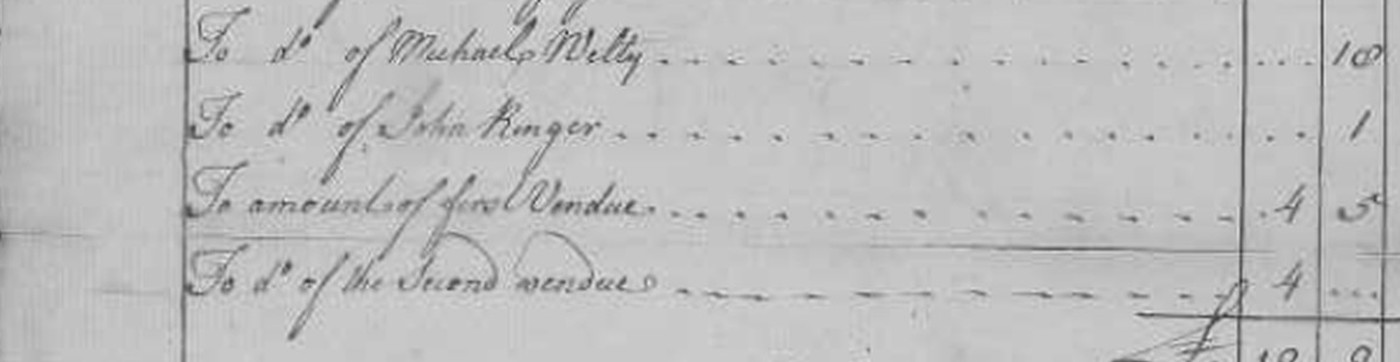
The Richard and Mary docked at Philadelphia on 30 September 1754. Within two years a Michael Welty is present, transacting, and known to a household of his own name in the German settlement the shipload’s own dispersal points at. Yesterday’s Dover leaf had already dented the old claim that the shipmate leaves no trail in Pennsylvania; this removes it, much closer to the landing. It was missed for exactly the reason the morning’s audit identified: the spelling “Welty” was never once searched on its own.
What does not follow is that this is the shipmate, or the Michael this project follows to Dover and then to Ohio. A debt line carries no age, origin, wife, trade or signature, and this log already keeps several Michaels firewalled from one another. Nothing has been merged. An absence that made the immigrant reading look unsupported has been removed; the positive case has not been made.
The same leaf settles a smaller question. In the heading and the Michael Welty line the clerk writes Welty — a looped l, then a t with a crossbar running out to the right. Four lines down the other column, paying for the burial, the same hand writes “the funeralls of John Welly” — two ascenders of equal height, no crossbar, identical to the double l he has just written in Campbell. One clerk, one page, one man, two spellings. This project has never had that attestation inside a single document before; the “Welly” rung had rested on machine misreadings and one printed entry that turned out at the image to say Kelly. The consequence is practical: a search for Welty finds the heading and misses the funeral line, and a search for Welly finds the reverse.
George Welty of Douglass Township, Philadelphia County, dead by 21 October 1767, when two neighbours appraised his goods. The inventory is the man: apparel at nine shillings and ninepence, a hammer and anvil, an axe and drawknife, scythes, two casks, a pail, a tub, a reel, a spinning wheel, old books, a bed at fifteen shillings. No land, no stock. A cooper’s and jobbing tradesman’s kit — and the Oley man in the Berks list of the following year is entered as “Welte, Geo., cooper.” One year and one county apart, and therefore two different men, since the Oley one is alive and assessed in 1768.
George Weldy of Berks County, dead intestate by 30 June 1794, administration granted at Reading to his son John, the widow Dorothy having renounced her right, the decedent described as “late a Soldier in the Service of the United States of America.” The first ladder man ever placed in Berks with a family attached — and the widow’s name is a genuine discriminator: a Georg Welde and his wife Maria Dorothea baptize children at Reading in 1771 and Philadelphia in 1772, a couple this project has held for weeks with nothing to test them against. Still not merged, but the question has moved from is there any link to is this the same Dorothy.
Then the arithmetic, which cuts against the tidy version. The Johann Georg this project reads as the third man on the 1754 list was baptized in 1710. A soldier of the United States dying in 1794 was not born in 1710. The 1710 baptism and this administration cannot both describe one person — so either the Berks soldier is not the Oley cooper, or the Oley cooper is not the man off the ship. Saying which is not possible today, and saying that plainly is worth more than an identification would have been.
Set the day’s finds on a map and they stop being a scatter. Inside about ten miles and twelve years, on the Philadelphia–Berks line, this log now holds: John Welty, tenant, of Hannover Township, dead in 1755 or 1756; Michael Welty, his named debtor, in 1756; Johann Jacob Welte and his wife Maria Margareth, baptizing children in the New Hanover congregation to 1763; Johannes Welty and his wife Christina in that same congregation; George Welty of Douglass Township, landless, dead in October 1767; and George Welde, later Welte the cooper, in Oley across the county line in 1767 and 1768.
Six exposures, one settlement, one generation — in the corridor a calibration off the ship’s own passenger list had already pointed at. Not one is attached to a person on this tree, and several are firewalled from each other on purpose. What the pattern changes is the method: this is now one problem, not six, and chasing each George and each Michael separately is the wrong shape of work. It also makes the next step obvious and free — two of these estates were administered through the same Philadelphia office, and an administration bond names its sureties, who in a German settlement are overwhelmingly kin. (Both bonds were read that evening. He is not on either.)
One more pass at the Gültstein baptism register, testing the question the evening left open: could the Michael Welthe who married there in 1732 have fathered a son Michael early enough to be the man who later appears in Dover Township? The book was read line by line, 1739 to the middle of 1745, every father’s name down the parentage column of every page — and in those years there is no son Michael to any Welthe couple. Three baptisms this project did not have turned up instead.
Anna Maria, baptized 8 October 1741, daughter of Michel Welthe — citizen, day‑labourer — and his wife Catharina: the first child recorded to that couple since a son Jacob in 1736, so that five‑year gap is now known to be a real silence rather than an unread stretch of pages. The other two belong to Hans Jerg Welthe and Maria Agnes — a son Johann Georg in August 1741, a daughter Anna Maria in February 1744 — with one godparent couple at both fonts, the sort of cross‑lock that keeps two entries from drifting into two different families.
Two things follow, neither a conclusion. The window this test still has to cover has narrowed to mid‑1745 to November 1747, and those pages are not read. And both 1741 infants carry the register’s mark for a child who died, which promotes a nicety into a real next step: the village’s funeral book for the 1730s and 1740s has never been opened, and a series of infant burials would account for this family’s spacing better than any amount of inference. The parish’s family‑register volume was searched the same session and the household’s page was not found. It remains the single most valuable unread thing in that village.
A week ago the German origin of this line was a family legend with a wrong year stapled to it. Tonight there is a house at Gültstein holding three brothers of exactly the three remembered names, whose record in that village ends the way an emigrating family’s does — graves for everyone who stayed, and none for the three whose names turn up on a 1754 passenger list. That is a hypothesis with its remaining tests written down. On the American side the Dover Michael went from a man known by a marriage and an estate to a man standing on the record year over year, with a column of five Weltes, one under another, on a single 1781 Dover leaf that nobody had read.
And here is the part worth being honest about. The line’s one unproven rung is more open tonight than it was on Monday, not less. Reading the 1800 census at the manuscript removed the birth year that had been quietly doing the work of ruling out the 1754 crossing — it came from a compiled pedigree, not a record. So three readings sit live at once: that this Michael was born in Pennsylvania to the Dover Philip Jacob, which is where the tree still draws him; that he was himself aboard the ship in 1754; or that he was the son of a man who was. Each has a test attached in the log, none is settled, and the tree will keep drawing that link dashed until a record settles it. A genealogy that only ever narrows is a genealogy that has stopped checking itself.
This has been an unusually heavy stretch — long daily runs, whole films read end to end, registers worked line by line — and that pace has a bill attached. The German church‑register subscription has lapsed; the American ones have roughly a month left. So the heavy research pauses for a while. Not stopping — pausing, with the log, the leads and the unread page numbers written down precisely so the next run starts where this one stopped. Everything already found stays where it is: free, unwalled, public domain.
Several of the most promising things left are free, online and open to anyone. If you have an evening and a tolerance for eighteenth‑century handwriting: the York County township assessment film (FamilySearch 008350826, 793 images, home‑viewable), the film that produced the 1781 Dover leaf, with many Welte‑bearing leaves located but not read closely and the Manchester ones barely touched. The ship‑list facsimiles — Strassburger’s Pennsylvania German Pioneers volume II, holding the actual signatures, including two same‑day exemplars of the 1754 trio; and volume III, which prints the 1785–1808 arrival lists, the only Philadelphia arrival class that names women, and which this project has still never opened. The Gültstein registers — the baptisms from mid‑1745 to November 1747, the funeral book for roughly 1736 to 1748, and the parish family‑register volume. The Pennsylvania Donation Land patents (state archives, free, no login). The printed Pennsylvania Archives depreciation lists on archive.org, where mapping the block headings would turn every bare name into a name with a county attached.
And newspapers, Bibles and drawers. The York papers of 1789–1798 have never been browsed for the estate notice that would be the first direct record of Philip Jacob’s death. And the thing no archive holds: a family Bible, a German Familienregister, a fraktur baptismal certificate, a hand‑copied sheet of names in somebody’s attic. Those have decided more questions on this site than any subscription has.
This is the ask, and it is meant plainly: this project could use other people’s eyes on the actual pages. Much of what is written up here was read fast, and some of it was read by a machine that is very good at not getting tired and entirely capable of being confidently wrong about a letter. A second reader who slows down over one leaf catches what a fast reader does not.
No sweep here is finished, no register is exhausted, and no “not there” means more than not found yet, by these eyes, under these spellings. Add a rung to the spelling ladder and you have quietly reopened every search run before you added it — not hypothetical: a negative on this very page, published in good faith on four spellings, broke on re‑running, and what fell out of it was the 1781 Dover leaf. If you read one of these films and find something that was walked past, that correction is worth more than another week of new searching. The address is at the foot of the page.
With the township question settled, the film that raised it was worked to its end — every Welte‑candidate leaf on all 793 exposures opened at the image. The Dover Michael now stands on the record year over year: the 1781 class list places Michel Welte in the township’s third class, inside the five‑man Welte block; the same year’s property valuation lists him again among the single men, a Jacob of the name beside him; in 1782 he occupies a forty‑four‑acre farm; in 1784 he is on the township assessment once more — and on 18 May 1784 he marries at York. One township, one name, four documents, straight into the marriage record.
The same read‑out killed two lookalikes at full resolution — a promising 1785 “Welty” trio that resolved into the Holly family, and a “Willy Michael” that resolved into a Worley — and opened a thread deliberately not attached to anyone: a Jacob in Manchester Township, present every year from 1781 to 1785 among Manchester’s own community of names. A Jacob also recurs beside the Dover Michael. Whether either is the same man, a brother, or another family is a question for records, not name‑matching. One limit holds through the whole run: not one of these documents states an age.
A living cousin, reading along, wrote to say he had found the 1754 trio himself — and to propose that the third signature reads not “Hans Jerg Welte” but a different name altogether. Run down at the facsimile, it paid twice. The check surfaced something never catalogued here: the volume holds a second, same‑day exemplar of all three signatures, so every reading of these hands can now be tested against two independent specimens. And the proposed reading does not survive: at both exemplars the letterforms rule it out, and the ship list’s clerk — a fourth, independent hand — wrote the man down as “Hans Jurg.” Hans Jerg Welte stands. But one instinct in that letter was exactly right in a way its writer could not have known: reading “Hans Jurg” as a Johann Georg is precisely what a German marriage register proved the same afternoon, an ocean away.
The morning left the Gültstein family as a hypothesis with three named tests. By evening the decisive one had run. The parish’s death register was read line by line, 1749 to 1790 — and everyone in that family who stayed has a grave. The mother, “Michel Welthin’s wedded wife,” buried February 1752 at seventy‑five. The old father, buried April 1756 at seventy — at home, two years after the crossing. An unmarried daughter, buried 1767 at sixty, the last of the name in the book. And the three men whose names sailed have no graves — not in Gültstein, not in the neighbouring parishes, not anywhere in the fifty‑million‑row index. Absence, with coverage verified, is what emigration looks like.
The same pass repaired the cast. The man first cast as the trio’s “Hans Jerg” — seated a village over, at Mötzingen — was buried in January 1746: he boarded no ship. The marriage‑book index supplies his replacement and more. It records the 1749 remarriage of the Gültstein brother Johann Georg, a fresh widower, under the name “Hans Jerg” — the parish’s own hand equating the two names exactly as the ship list does — and discloses a brother the hypothesis did not have: Jacob, the eldest, married 1726. The reading tightens from a family circle to three full brothers of one Gültstein house — Jacob, Michael, Hans Jerg: the very names the family’s hand‑copied papers have always given the trio. And the register’s years 1749 to 1756 read like a departure: Johann Georg buries a wife, an infant son, then a second small boy; the mother dies; the three names sail; the old father dies with no man of his name left in the book.
The German end now stands on register‑level evidence. That the trio are these three brothers is still a hypothesis, strengthened, with its remaining tests named. And whether the Michel Welte who signed that list is the Michael this project follows through Dover to Ohio is untouched by anything a Württemberg funeral book can say: no record on either side of the ocean yet states that man’s age.
Yesterday’s signature — the 1786 assignment a living second cousin’s tip brought to light — demanded a second one to stand next to, and the search for one corrected a long‑standing mistake. The page this project has carried for months as Philip Jacob’s immigration oath is not a signature at all: it is the typeset transcription from volume I of Strassburger’s Pennsylvania German Pioneers. The signatures live in volume II, a facsimile photographed from the original lists. On the leaf reproducing printed p.499, List 149 C of the ship Royal Union, 15 August 1750, second line from the top, is Philip Jacob’s own signature — a small, cramped, confident German school hand, exactly where the printed list places “Phipps Welde.”
And he signed. Strassburger prints a cross or an initial for every man who could only make his mark — five on these same two pages. There is no mark by this name. Writing‑literacy is now documented in this family a generation before the 1786 autograph, which removes the most obvious objection to that find before anyone raises it.
The same volume holds List 218 B: the ship Richard and Mary, 30 September 1754. In the left column, one directly above the other, stand Michael Weldta and Jacob Weld[t], each in his own hand, neither a mark. The men behind the legend now have faces. What those faces cannot do is prove kinship — and that was tested rather than assumed. Nine unrelated German immigrants sampled off the same page share the same loops, the same rounded W, the same slant: the letterforms are the curriculum, not the person. Sharper still: the 1754 Michael’s hand resembles the 1750 Philip Jacob’s at least as closely as the 1786 signature does, and nobody claims those two were kin. The ruling is now in the log: letterform resemblance is not evidence of identity or kinship in this corpus, in either direction.
Michael’s birth year of “about 1757” — the date on every online tree, and until this morning on this page — comes from a compiled pedigree, not a record. There is no baptism for him anywhere. The one primary age statement that exists is the 1800 census, read this morning at the manuscript at high zoom: the head of the household stands in the 45‑and‑over column, and the 26–44 column holds no adult man at all. The only record that states his age says he was born on or before about 1755.
That single tick of an enumerator’s pen — and one tick can err — opens a question this project had treated as closed: the man who signed the 1754 list was assumed ruled out because “Michael was born in 1757.” Dating a man from a pedigree and then using that date to exclude a record candidate is circular, and the log now carries the rule permanently: never use a pedigree‑derived date to exclude a record candidate. The census bracket cannot by itself split an older Pennsylvania‑born Michael from an immigrant one — his single‑freeman years and an evident first marriage in 1784 still lean toward the younger reading — but the question is open, on the record, where it belongs.
The family papers hand the 1754 trio a tidy dispersal: Jacob to York, Hans Jerg to Hagerstown, Maryland. Maryland had never been swept. It has now been — the 1776 state census and 1778 oath rolls read eyes‑on at their index leaves, the 1783 Washington County tax, the 1790 federal census, the county histories, and the full‑text corpus for the whole eighteenth century, across every spelling on the ladder. There is no Michael of any spelling anywhere in Maryland in the window, and — the sharper result — no Hans Jerg at Hagerstown either: not one George of the name in Washington County until an 1808 bond surety, half a century after the crossing. The trio’s “known” dispersal was never known. Maryland’s real eighteenth‑century Weltys are there — Johns, Jacobs, a Christian, a Frederick, in traceable and separate streams — and none of them is any of these men.
Then the trail crossed the ocean. The indexed Württemberg church registers — fifty million rows — turn out to be searchable under the project’s current subscriptions, and the first calibration shot used the rarest surname on the 1754 passenger list to find the shipload’s recruiting ground: the middle Neckar, around Stuttgart and Böblingen. Inside that pocket, at Gültstein near Herrenberg, sits a family: Michael Welthe Sr., citizen and farmer, with sons Hans Jerg (married 1719), Michael Jr. (married 29 July 1732, the register page read at the image) and Johann Georg (married 1739) — and eight kilometres north at Magstadt, a Jacob Welthe, baptized 10 April 1721, who was thirty‑three the September the ship landed. The hand‑copied family papers have always named the trio “Jacob, Michael, Hans Jury.” Here are those three names in one extended family, in one ten‑kilometre circle of parishes.
Two quieter observations lean the same way. The only Welthe burial the index holds in that orbit belongs to a kinsman who demonstrably stayed; the three men whose names sailed have no burials there at all. And the parish’s family‑register index, compiled around 1808, has no Welthe page. Absence of burials is what emigration looks like in an index — and also what incomplete coverage looks like, and the register’s death sections have not yet been read. So this stands as a hypothesis, the best‑shaped one this question has had, with three named tests in the log.
One more correction, freely admitted: yesterday this project recorded that the 1754 shipmate “leaves no post‑arrival trail under his own spelling in Pennsylvania.” That negative rested on four keyword forms. Re‑run today across the full eighteen‑rung ladder, it broke — and what broke it is the day’s last find. On a militia‑class assessment film this project had never worked stands a 1781 York County leaf carrying, in one column: Philip Welte Jun · Michel Welte · Jacob Welte · George Welte, read at the image at high zoom. Which township it belongs to is now the live question, and it cuts both ways cleanly: the warrant sheets ahead of it name Heidelberg Township, a different Welty family’s country — but the neighbours on the leaf, the Quickels, Ramseys, Reisingers and a Wilt, are the documented Dover and Manchester community. Until the township is established, nothing on that leaf attaches to anyone.
By the end of the day that question had an answer, established four separate ways, none of them the warrant that made it ambiguous. The packet’s own docketed cover sheet reads “1781 Township Assessments — Dover, Manchester.” A few leaves on, a recruiting‑class notice names Dover Township outright and numbers its first class down the page. A return further still is headed “Dover … First Class Duplicate.” And the neighbours standing around the Weltes — Quickels, Ramseys, Grosses, a Reisinger, a Rothrauff, a Wilt — are the documented Dover and Manchester households, name for name. The Heidelberg warrant that sheeted ahead of the list is a stray: a summons against a delinquent collector from another township’s paperwork, interfiled in the same run of film.
Read at the image, the Welte column holds five men, one under another: Philip Welte, Philip Welte Jun, Michel Welte, Jacob Welte and George Welte. (The two heavy marks crossing the lower names are not cancellations but ink bleeding through from the back of the sheet — read as strikes on first pass and corrected on the second.) The largest assessment on the block is the first Philip’s; and a second Dover leaf, a property valuation, carries two Philip Weltys holding land, at a hundred and ten acres and a hundred. It is the fullest single‑document view of the Dover Welty group this project has found.
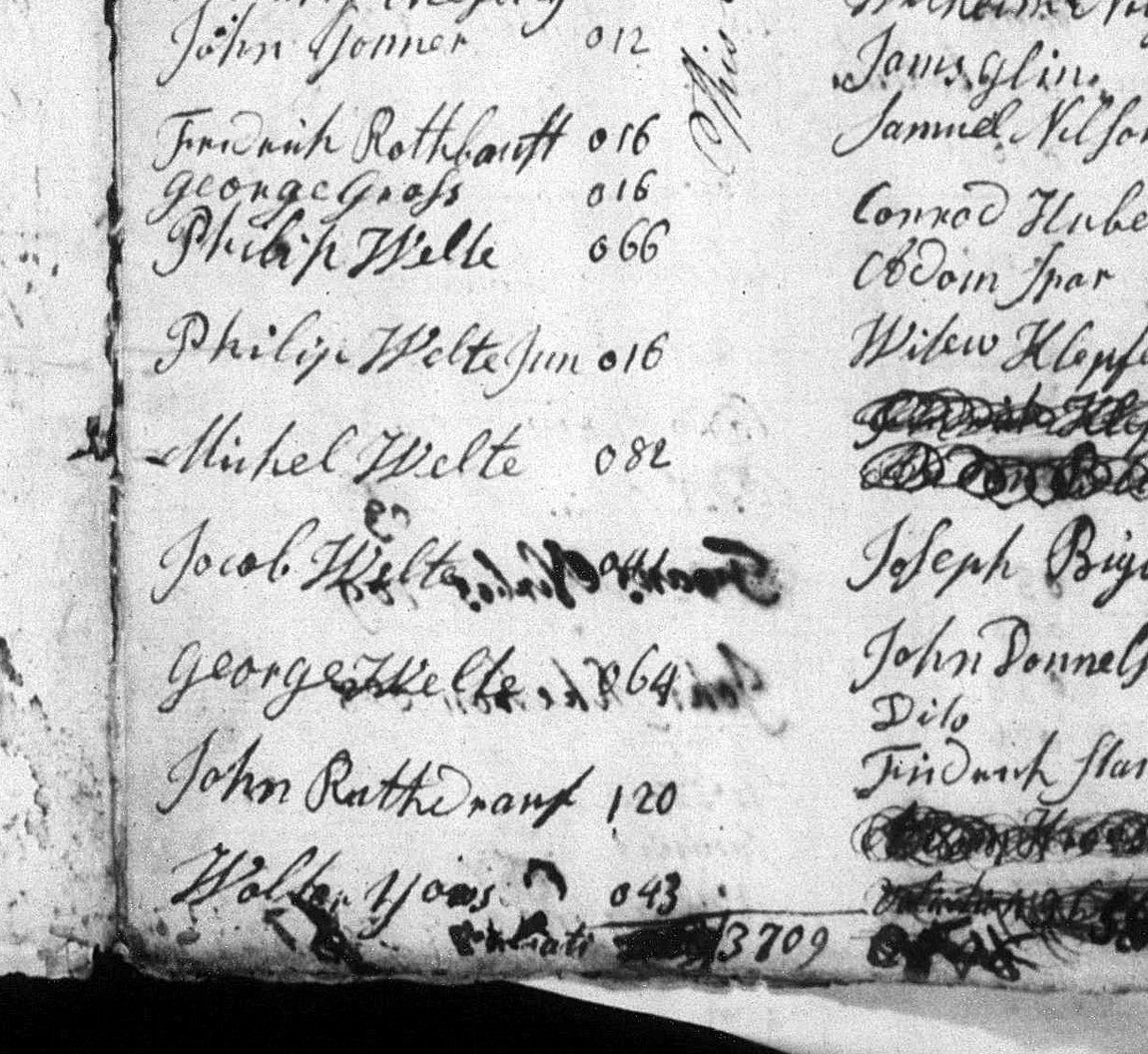
What this is not, yet, is an identification. The one documented Dover Michael of these years was a single freeman in that township in exactly this window — so a Michel Welte standing among a Philip, a Philip Jun, a Jacob and a George in one 1781 Dover column is the first document that so much as shows a Michael inside a Welte family group there. It is not proof that he is the Michael this project follows west to Ohio, and it names no father. What it does close is the older worry, admitted only that morning, that the man had left no trail in Pennsylvania at all. He was in Dover, on a tax roll, spelled plainly, the whole time.
A living second cousin, working the same ground from a different direction, sent word of something this project had no reason to expect: the Camp Security Virtual Museum has photographed the original manuscripts behind the Camp Security paperwork — the actual strips of paper, filmed from the Comptroller General’s records at the Pennsylvania State Archives — and put them online. Among them is the discharge of Michael Weltty, dated at the stockade 20 September 1781, the original of a certificate the state printed in 1906. And on the back of that same strip, four and a half years later, something the 1906 editors never printed at all.
It is an assignment: “For a valuable Consideration to me in hand paid by Jacob Sittler I do hereby Assign, transfer and make over unto the said Jacob Sittler … all my Right and Title of in & to the within Discharge and all Monies due & to become due thereon. Witness my Hand & Seal this 22d day of April 1786.” Two men witnessed it — Conrad Laub and a Forsyth — and the archivists’ docket reads No 39. A soldier had turned an unpaid claim on the state into cash, and signed away the paper that proved it.
What it says about the archive matters beyond its contents. The printed Pennsylvania Archives have been the spine of this whole militia investigation, and the volume in question was swept end to end only yesterday. That sweep is not wrong — it is simply not the whole record: the originals in Harrisburg hold documents the editors left out. Every negative this project has drawn from the printed volumes is now a negative about the print.
The body of the assignment is a clerk’s English round hand — even, thin‑nibbed, practised. The signature at the right is not. It is heavier, differently slanted, built out of the letterforms of a German school hand, and followed by a drawn seal. Crucially there is no “his mark” formula and no cross, which is what a clerk writes when the man in front of him cannot sign. So this is almost certainly the assignor’s own hand: the earliest handwriting this project holds for anyone in the investigation.
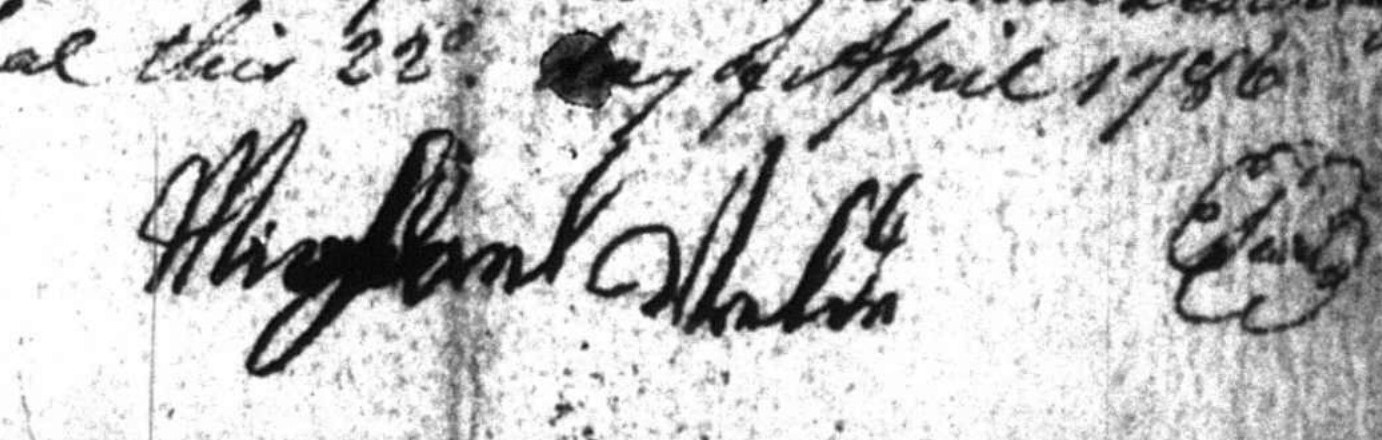
What it is not, yet, is a way of telling men apart. This is the hand of the Michael of Camp Security. Whether that man is the Michael of Dover Township who later farmed at Crooked Run is an identification this project supports but has never proved: the strongest thing behind it is that the class‑levy he served in is the same one the only documented Dover men served in, which is an alignment and not an identity. A signature can settle that, but only against another signature, and the Dover‑to‑Ohio man died intestate in 1815 without leaving one on any document yet found. It is filed on the tree exactly that way.
The 1906 print gives the discharge under “Michael Willty.” The manuscript does not. Read at full resolution the clerk’s surname carries a plain double t — Weltty — and the vowel is the ordinary ambiguity of the hand, not an i. So one rung of this project’s spelling ladder was never a rung at all: it is a nineteenth‑century editor tidying a soldier’s name. The ladder has found real men, but it is worth knowing which of its rungs were cut by clerks and which by typesetters.
The state settled this man’s militia service with certificate 12,706, issued 26 October 1786 for £10.10.0. The assignment is dated 22 April 1786 — six months earlier. Whoever collected that certificate, it was very probably not the soldier: he had already sold the claim. The interest register in Harrisburg records who was paid on each certificate, and the leaf is known — volume B, folio 95. Whether Jacob Sittler’s name stands there is a specific question with a specific page number attached, which is the most useful shape a research question can take.
On the other side of the project, a subscription ran out and two loose ends were pulled in before it did. The Edenkoben Reformed baptism register has been searched for the baptism of the Croissant daughter who married into this family in 1738; the last unswept leaves were read this morning, and she is not in that book between 1713 and 1723. Nothing after that can be her either — a baptism in 1724 or later would make her a bride under fifteen. If she was baptized at Edenkoben at all, it happened before 1713. Separately, the Lutheran marriage register at Gommersheim gave up its remaining years — 1736 to 1743, read entry by entry — and returned nothing under any spelling. With that, the ring of parishes around Edenkoben is finished. Two candidate books remain, both long shots.
The week’s two halves pull in opposite directions and both are gains. In Germany a search closed, and closing it means the next person who opens those registers will not spend a month learning what is already known. In Pennsylvania a search opened, on the discovery that the printed archive is an abridgement of a fuller one still sitting on microfilm in Harrisburg. And in between sits a signature — the first handwriting of a man this project has been reading about for months, now finally read from.
Camp Security was the prisoner‑of‑war stockade outside York, holding men taken at Saratoga and Yorktown, and the York County militia guarded it in shifts from July 1781 to April 1782. The printed archives carry the paperwork in two bodies: the captains’ pay rolls, and then eighty‑eight pages of discharge certificates, powers of attorney and pay assignments filed alphabetically by claimant — no index, no headings, no unit structure, nothing findable by searching for a regiment. Read whole and sorted by the one thing nearly every certificate states — the soldier’s class — the section gives up the rotation itself. The 4th class served under Capt. Peter Ford, with John Mappin as the lieutenant signing releases, 8 July to 8 September 1781. Then the 5th under Capt. Samuel Fullton and Maj. John Edie; the 6th under Maj. William Ashton, with Capts. Edgar, Dodds and Forman; the 7th under Capt. Ephraim Pennington, styled in one document “Capt. Comdt. 7th Class,” through the winter; the 8th under Lieut. Charles Barnitz into April 1782. A class was never a squad. It was the county’s draft cohort, and whose turn it was. Which means any York County man whose Camp Security paper names a class can now be placed to a two‑month window and a named set of officers — and two men in different classes were never there at the same time.
Two certificates, both read as page images. On the first, Capt. Peter Ford certifies over his own signature that a soldier “as Sarved is two month in Camp Securtey in my Companey in the Forth class of York County Militia” — and that soldier is himself a private on Ford’s July–September 1781 pay roll, so the class statement and the roll describe one body of men. On the second, a man declares: “I Joseph Bigler of Dover Township York County have in the 4th class Sarved a touer in the Militia in Camp Security … for Casper Spahr of the Same place” — with the clerk’s own footnote underneath putting Spahr in the 4th as well. The class that guarded the stockade that summer is the class in which the only documented Dover Township men appear. That is an alignment and not a proof, and it rests on a single document naming two men — but the objection it answers was the last structural one standing, and what replaced the objection leans the other way.
A Michael Wellty appears on Ford’s pay roll. A Michael Willty has his own discharge certificate, dated at Camp Security on 20 September 1781 and signed by Lieut. John Mappin. These have been carried as two records in two spellings. Mappin signs twelve discharges in the alphabetical section and every one falls between the 11th and the 29th of that September — and four of the men he releases (Bowman, Philip Henry, Ramsey, and McWhirter, discharged “as Orderly Serj.”) are privates on Ford’s roll. Mappin was letting Ford’s company go as its two months ran out. So it is one service by one man, enrolled and paid at one end and discharged on his own certificate twelve days after the roll closed. The weight of the evidence does not double. The record beneath it gets a good deal harder.
A state index card described a John Welty in the 4th class of Capt. Michael Hahn’s company, 1st Battalion, on a “True List” of 12 October 1780 — and cited the printed page where that list appears. The machine‑readable text of that page puts him in the first class. One of them was wrong, and it was not the card. The page is set in two columns with the class headings centred between them, and reading it column‑by‑column — which is how the scanned text is assembled, and how every sweep of this volume has read it — throws names into the wrong class. On the image he stands plainly under 4th Class. The volume was then rebuilt from scratch out of its own word coordinates, 155,820 words across 896 leaves, reassembled row by row into true reading order, and swept again. A second, independent return of the same company confirms him in the 4th class — and spells him “John Wealty.” That spelling is on no list this project has used. It would have defeated every search ever run here, and it is now on the ladder.
What the correction buys is a whole militia identity for one man: enrolled in the 4th class of a named company under a named captain in October 1780; called up when the 4th class took its turn at the stockade the following July; a private on Ford’s roll; and paid, at the end, on a numbered certificate. Four records, no gaps. The rebuilt volume also settles a smaller thing by the same means. On Ford’s roll read properly by rows, the two Weltys are not side by side at all — one sits in the left column about ten rows above the other in the right. A shared surname and a shared roll were never evidence of kinship; now they are not even evidence of proximity.
Pennsylvania settled its militia debts through a loan raised in 1784 and 1785, and the Comptroller General issued each veteran a numbered certificate. Three York County Weltys hold one. John, certificate 12,665, issued 26 October 1786. Michael, certificate 12,706, the same day, for £10.10.0. Philip, certificate 13,453, issued 30 December 1787, for the same sum. That figure is not arbitrary: a receipt in the same archive itemises it as “Five Pounds for Two Months Melitia Duty and Five Pounds Ten Shillings state Bounty” — the settlement for exactly one two‑month tour. Each card names the leaf of the interest register the entry was copied from: folios 94, 95 and 117 of volume B. That ledger is still in Harrisburg. This trail had been written off a week ago as unrunnable, on the correct finding that a particular printed volume could not carry it — which was true, and beside the point. It runs through the comptroller’s own records, and it now has three numbers and three folios attached to it.
Two cards away in the same drawer, under an identical name, sits a Philip Welty of Northampton County — John Ritter’s company, under Lieut. Col. Christian Shouse, 1st class, entered 16 September, duty recorded as “actual service on the frontiers.” Wrong county, wrong war — frontier defence, not the prisoner guard — wrong officers, wrong class. He is filed with the decoys, where he will be waiting for the next researcher who searches Philip Welty, Pennsylvania militia, 1781 and takes the first hit.
A lead had been open for weeks on a reasonable premise: York County had no newspaper of its own until 1789, so the county Lieutenant would have published his militia delinquents — the men who failed to turn out for their class — in the Philadelphia press, where a name might sit that no muster roll preserved. The Philadelphia papers of those years are digitised and searchable, and the phrase to look for is a fixed one. Across every location, 1779 to 1788, “list of delinquents” returns nothing at all. “Delinquents in the militia” returns two, and both are the same thing: the text of the 1787 militia act, which directs that delinquent returns go from the commanding officer to the county Lieutenant. It was a filing, not a notice. Nobody printed it because printing it was never what the law asked for. The premise was wrong, and the search that proved it wrong is worth more than a hundred empty queries against a surname — a negative that rests on what a document type was survives bad transcription, and a negative that rests on not finding a name does not. Three archive volumes long carried as “missing” closed out the same afternoon: two of them turn out to be forfeited‑estate books that never held a muster roll, and the third covers 1783 to 1790, which is after the war it was wanted for.
Back in the Palatinate, in the Edenkoben Reformed baptism register, folio 346: “d. 26 [Sept] nat. / 29 bapt. Hanss Jacob Waeldy, & ux. Anna Cath. filius. Testes: H. Georg Wolfg[ang] Georg Schaefer, Kirchenschuldiener, & ux. Anna Elis. m. inf. Georg Wolfgang.” Born 26 September, baptized 29 September 1716. The surname carries both its marks plainly — the umlaut over the a, the diaeresis over the y — so there is no reading to argue about. The man standing as godfather is the village Kirchenschuldiener, the church schoolmaster, and the child is given his name. This family named its children after their sponsors and not after their fathers, which is now documented at every baptism in the sibship, and it is the reason a namesake hunt in these registers has to chase godparents. The entry had been inferred before, from a bracketed note in a sibling list. It is now an entry: a date of birth, a date of baptism, a leaf, and two witnesses.
Three weeks ago a reading of this register reported a faded August 1714 baptism for a daughter, Anna Barbara, with a godmother from Neustadt. A later sweep went back through 1714 entry by entry, found nothing, and concluded that no such baptism existed and that the girl’s year had only ever been back‑calculated from her age at confirmation. Both accounts could not stand. The page was opened again and read at full magnification, and the entry is there: “Aug. d. 4 nat. / d. 6 bapt. Hanss Jacob Waeldj, & ux. Anna Cath. filia” — born 4 August, baptized 6 August 1714, the godmother an Anna Barbara of Neustadt, the child named for her. It is the final line of the leaf, squeezed in under the last full entry in a smaller and lighter hand, on a lower edge that has browned with age. At the magnification a page‑by‑page sweep normally runs at, it reads as staining rather than as writing. The first reading was right and the second was wrong, and the correction has been written into the record beside it rather than quietly replacing it. The rule it leaves behind is a cheap one and will be followed from here: read the last line of every page deliberately and separately — a scribe filling the foot of a leaf writes small, and that is exactly where an eye running down a column has already stopped paying attention. With the entry recovered, the Edenkoben children of this household are complete and every one of them is dated: 1710, 1713, 1714, 1716, 1719. The intervals are ordinary and there is no gap left for a sixth to be hiding in.
The pension file predicted a week ago turned out to exist, and it was read: thirty‑one pages for Jacob Welday Jr of Cross Creek Township, Jefferson County, Ohio. His own 1850 bounty‑land declaration gives the man in the first person — “Jacob Wilday aged Sixty two years”, sworn November 1850, which puts his birth at about November 1787–88, a year or two earlier than every estimate the tree was carrying. He was a private in the company commanded first by Capt. John Alexander and lastly by Capt. Thomas Latta, Col. John Andrews’ First Regiment Ohio Militia; he went in as a substitute for one John Long at the end of September 1812, served five and a half months, and was discharged at Fort Stephenson in mid‑March 1813, his discharge papers long since lost. He signed his own name. He died 9 December 1866.
And then the file settles a question two records had been quietly disagreeing about. The widow who drew the pension is Mary Price, married 20 December 1842 under a certified public record — which means the Mary “Polly” Lockart of the 1816 marriage is a different woman, dead before that second wedding. Two wives, both named Mary, one of them married twenty‑six years before the other: exactly the shape that collapses into a single person in an online tree and stays wrong for a generation. They are now firewalled apart. One further page‑jacket detail is worth its own note: the 1930s correspondence bound into this file traces to the same researcher whose 1938 letter is the only source anywhere for the competing claim that Jacob’s father was a “John Jacob” — a claim that now has a name, a decade, and no evidence behind it.
Last week a Pennsylvania newspaper trail argued that the Stark County Philip Welty (b. 1789) served in Col. Rees Hill’s regiment — the thousand‑man Erie detachment raised in April 1813. This week the federal index answered: a card exists, and it reads “Welty, Philip / Hill’s Regiment Pennsylvania Militia / Private.” A Philip Welty demonstrably served in that regiment. What the card does not carry is an age or a residence, so the identity is not closed — the muster rolls behind it, held at the National Archives and orderable for a fee, would give an enrollment date and place, and that is the test. Two New York decoys were disarmed in the same sweep: a Philip Welty of Hopkins’ New York militia appears in both the service and the pension indexes as one man, and he drew a survivor’s pension — something a man buried in Stark County in 1848 could not have done.
The state grave‑registration card for the same Philip, paywalled and unread for weeks, opened: died 11 September 1848, born 1789, Welty Cemetery, Sugar Creek Township, Stark County — Lot 21, Grave 3, upright marker. It carries the War of 1812 service as a bare claim, Private, and then the line that says as much as any of it: “Regt. unknown.” The 1930s compiler who filled the card in could not name the unit either.
The last leg was a clean sweep of both federal 1812 indexes — service and pension applications, every spelling on the ladder. The result is a negative worth as much as a find: apart from Philip and the Welday cousins, no federal service or pension record exists for any of Michael’s other sons — not Jacob, George, Michael Jr, Samuel, Daniel, nor Henry — under Welty, Weldy or Welday. One card stays open on the table: a John Welty of Bay’s 3rd Ohio Militia, no rank, no residence, unidentified.
That empties the War of 1812 of everything the subscriptions can reach. What is left of it is offline and costs money: two bounty‑land files in Washington, and the muster rolls that would put a first name to Hill’s private. Next, and quickly — the German pass lapses on the 31st.
Eight lines of Kurrent on a page of the Edenkoben baptismal book, and a name on the tree that had carried only a year now carries a date: “Hanss Jacob Wäldj … et ux. Ann Cath. filius. Testes: Johannes Neu et ux. Maria Cath. — inf. Johannes.” Three things come out of one entry. The child is named for his godfather, not his father — the third documented instance of the naming custom in this family, and the reason namesake hunts here chase sponsors rather than fathers. The godfather is a Neu, which puts the two families in god‑kinship as early as 1713 and bears directly on a Doll × Neu wedding at Edenkoben in 1754 that has been the soft origin of an unsourced “married 1754” floating around the trees. And the register gives the first occupation ever recorded for the man at the trunk of this line: the word reads Küfer — cooper — and not Müller, miller, which is what the family’s mill‑byname tradition would have preferred. That one is flagged for a second pair of eyes before it hardens.
Her sister’s turn went the other way. Every baptism from 1713 to August 1716 was read, entry by entry, and there is no Wäldi child but Johannes in any of them — so Anna Barbara’s “b. 1714” is derivative, back‑calculated from her confirmation age rather than read off a page, and her real baptism sits later in the book than anyone had looked. Two decoys were guarded on the way past (a Hans Jacob Helm in 1714, a Hans Jacob Noll in 1716 — neither a Wäldi), and two Croissant daughters were dated as bycatch, which matters because the same stretch of images is where a Croissant baptism has been wanted for months. One pass now serves both hunts.
Weidenthal — a Reformed parish twenty kilometres over the mountains into the Pfälzerwald, serving a dozen forest hamlets, and the remotest place a couple from the Edenkoben plain would plausibly have married — was swept end to end: the single October 1724 entry and then every marriage from 1737 to January 1759. Groom, bride, and both named fathers on each. Zero. With that, every accessible Reformed marriage register in the ring around Edenkoben is negative for the years either side of the 1750 crossing. The same day, the earliest Edenkoben baptism book was opened at its 1691 war‑year pages — sparse, half‑blank openings from the Nine Years’ War — looking for the baptism of the man at the trunk. Not there, and most likely destroyed with the years around it, so his birth stays an inference drawn from his own children’s dates.
A Tuscarawas County partition suit had been read once through a machine transcription and a faint copy‑book hand, and its central name confirmed only by convergence. Re‑read at high zoom, it gives itself up. The decedent is Jacob Welty, died intestate “on or about the 3rd day of June” 1861; a clerk’s slip calls him “Joseph” once, in the very sentence that places his widow Christina in Holmes County. Then the heirs, with fractions: sons John, William and Finley a sixth each; Wesley, gone to New York, having deeded his share to his sister, so that Lucinda holds a third; and Charles C. of Tuscarawas and Edwin of Holt County, Missouri, a twelfth apiece as “the only children and co‑heirs of Elijah Welty dec’d” — who is named, in the same breath, “a son of the said Jacob Welty.”
And the word that had refused to make sense makes sense. Finley, whom the tree had born about 1831 and who should therefore have been a man of thirty, is “a resident infant” with a guardian appointed by the Probate Court — a legal minor in January 1862. The transcription had not garbled it; the tree had. Finley was born nearer 1844–46, and the entry that has him a decade earlier comes down. Two smaller corrections ride along: Lucinda’s husband is H. S. Stockwell, not A. P., and only Edwin is the Missouri man — Charles stayed in the county. Six stems of a family move from a compiled chart onto a court record, and a birth year that had been quietly wrong for years is gone.
A roster row had been fusing two men: a real son of the Dover household, born about 1823, and a Jacob Welty born 16 January 1817 whose death, burial and marriage had drifted onto him from a lookalike. The marriage register image settles it. The man who married Barbara Miller in September 1839 is the 1817 Jacob — son of the Tuscarawas Mennonite bishop Abraham Welty, of the Manheim‑and‑Ohio line, living in Dover Township, which is the whole trap: a man of one Welty family keeping house in another family’s township. The arithmetic agrees — he was twenty‑two at the wedding, while the other Jacob was sixteen and had been a ward of the court a decade earlier. The borrowed dates come off the row.
The Canton newspaper was swept systematically for the first time, every spelling, 1815 through the 1830s, and a business cluster came out of it that no one had been looking for. A distiller advertising in September 1816 gives his address as “in Pike… two miles south of Welty’s” — a Welty place‑name already functioning as a landmark. In April 1817 a storekeeper’s last notice calls in debts owed to “my stores, either in Canton or the one lately at Welty’s Mill”: a mill named for a Welty, prominent enough to host a store, and shut by that spring. In 1819 a Jacob Welty leaves his vendue notes and accounts with a collector and disappears from the paper — the paper trail of a man leaving the county. And in the county’s own expense list for January 1819, printed three weeks running, a Philip Weldy draws a chain‑carrier’s fee for survey work: the earliest civic record of a Philip anywhere in the Canton orbit. Which Welty family ran that mill is unassigned, deliberately — it is not being hung on a line until a deed or a tax duplicate says so.
The immigrant of 1750 married somewhere, and not at Edenkoben — that register has been negative for years. The working logic says a Reformed groom marries in his bride’s church, so the target became every Reformed marriage register within reach of the Edenkoben plain, read for the years either side of his August 1750 crossing. Two days took four of them. Hassloch, the largest Reformed parish left in the ring, 1739–1750: zero. Gommersheim, 1744–1752: zero — and the entry standing three days after his Philadelphia qualification, the one that would have been perfect, is a Sieber. Böbingen with its Duttweiler filial, two ring parishes in a single book, 1736–1750: fifteen marriages in fifteen years and not a Welty among them — though two grooms named Philipp Jacob turned up in 1736 alone, a Fuchs and a Frey, both read at full zoom and both firewalled before they could become somebody’s ancestor. Meckenheim, 1739–1748: zero, in a register the pastor himself had to reconstruct after the old one was lost.
Two of those books are physically misbound — leaves out of folio order, marriages spliced among burials — so the sweeps had to be navigated by the year headers written on the pages rather than by image number, and that trap is now written down where the next person to open them will find it. A fifth parish, Altdorf, closed itself: nothing survives there before 1759, and its Protestants of the 1740s appear in the Böbingen book anyway, which the same pass had just read.
An old typescript names an Ensign Frederick Spaar in the same York County company as the Michael of this line — a claim that has never been tested against a record. Spaar left a federal pension file after all: rejected, twenty‑one pages, read cover to cover. Bound into it is his own militia officers’ return, certified at Harrisburg in 1834 as a true extract from the state files, and it names the unit outright: Ensign, 4th Company, 1st Battalion, York County Militia, under Capt. Christian Lowman, commissioned September 1777 and still serving at the April 1778 return. A neighbour’s deposition then walks him out of York County to western Virginia about 1809, which is why he vanishes from Pennsylvania records. The other four men named beside him left no federal file at all.
The same session put the question to the federal catalogue directly: is there any Revolutionary War record for Michael Welty — a compiled service record, a militia return, anything — that the subscription sites have not been showing? Every spelling, forward and reversed. The hits are a general store on the historic register, a land‑patent index, two censuses and a stack of twentieth‑century files; the variants return nothing. And the negative holds up, because the catalogue demonstrably does index these records by name — a Welty of a New York regiment surfaces from the same search, filed at exactly the level a Michael would be. So the absence is real and not a gap in coverage. Michael’s entire Revolutionary footprint remains two Pennsylvania state pay records — a militia pay certificate and a depreciation‑pay roll. One untried test is left, and it is a paid one: a typescript roster in Washington that reportedly names Michael and a Jacob in one company, which can now be checked against Capt. Lowman’s 4th Company by name.
For weeks the Place‑by‑Place timeline did something the rest of the site had quietly outgrown: it marched a single household — the Edenkoben line — from the Palatinate to Michigan, while every other family sat in a static drawer at the foot of the page, outside of time altogether. That split undercut the page’s own argument, which is that these unrelated families kept piling up in the same few square miles. So it was rebuilt into one braided narrative: every family now enters at the moment it actually appears in the record, and the eras where several arrive at once — colonial York, frontier Ohio — read as the pile‑ups they were, not as a footnote. The page now opens where the paper trail does, on Anthoni Wälti, christened at Lenk in 1568 — the oldest dated person anywhere on the site. Two new chapters gather the southern and valley lines and close the page on the DNA, tying each family to its own kit and haplogroup.
The all‑families tree used to load with its top two generations already unfolded across every branch — a wall of names before you had chosen anything to look at. It now opens fully collapsed: just each family’s name and a line of description, quiet until you pick one. Click a family to meet its founders; click a founder to walk down the generations. The “Key” legend and the “how to read the sources” panel came off the top of the page in the same pass — the proof and DNA badges still sit on every individual name, where they earn their keep, but now the reading starts with the families themselves instead of the instructions.
The timeline and people‑map pages had accumulated a layer of scaffolding around their two interactive maps — an intro paragraph, a row of stat chips, an eleven‑colour legend, a proof key, a quotation banner at the foot of the page. On inspection the maps explain themselves the moment you touch them, so all of it came off across a few careful passes, leaving one clean line: a hint, the German map, a hint, the American map. Every dot still scrolls you to that family’s fullest paragraph in the timeline. 380 people placed, none dropped.
One group on the tree had been carrying its deep origin as its name — “Swiss” — which hung a sixteenth‑century Emmental valley over a family whose real American story runs through Manheim Township in York County and out to Fairfield and Putnam Counties in Ohio (the branch that eventually gave the world the writer Eudora Welty). The public label now names those American places — where the records are, and where a descendant would recognise their own people — while the Swiss I2b ancestry stays on the page as ancestry, not as the family’s name. Manheim with one n, the York County township — not Mannheim in Baden, the different place the sources love to confuse it with.
The front page used to open on a number — “Eight Welty families” — and the number would not hold still: as lines were added, split, and relabelled, eight and nine were already contradicting each other across the site. The count was never the point, so it is gone. The hero, the tree’s introduction, and the page metadata now say “a cluster of” and let the family headers and filter chips do the actual enumerating. The tallies that are true — the count of documented people, the running lead and backup figures — stay, because those are honesty rather than branding. A family tree should not have to amend a headline number every time the evidence moves an inch.
None of this added a name to the tree — that was not the week’s work. It was two days spent making the families already on the record easier to find, fairer to one another, and honest about which labels are still only labels. Then back to the records.
For a week the single best shot at a stated Pennsylvania birthplace for the Cross Creek Welday brothers has been Henry Welday’s own 1871 pension declaration — found last session, unread. Today the file was read cover to cover, all twenty‑seven pages eyes‑on. The answer is a clean miss: the 1871 form has no birthplace field, and nothing else in the file states one. What the file gives instead is the man himself. His own narrative of the war: drafted at Smithfield, Jefferson County, into a rifle company; marched Cleveland to Fort Meigs to Detroit to Mackinac Island, where they “engaged with the enemy and were defeated” — the failed assault of August 1814 — and discharged at Chagrin Harbor. His age, seventy‑nine in March 1871, squares with the grave card’s 4 August 1791. And bound into the file sits a prize the county books had only whispered: a certified copy of his marriage record — Nancy Smith, 12 December 1816, Jefferson County, Ohio — image‑verified, upgrading a date that had stood at index grade. Nancy’s widowhood dates her end too: dropped from the rolls, 4 February 1883. The birthplace question survives Henry with exactly one documentary shot left — his two bounty‑land application files at the National Archives, unread, offline, orderable.
The other leg of the day went at the York Pennsylvania Herald, 1789–1798 — the paper that should hold Philip Jacob’s death or estate notice, if one was ever printed. The machine search says zero, so the approach went sideways: targeted probes, every hit read eyes‑on. “Late of Dover” returned fourteen hits and all fourteen are now identified — a 1792 estate (George March’s, with its executors) and the Orphans‑Court dockets of 1798 — which proves the point that matters: the paper demonstrably carried exactly this class of notice. A Welty estate would have had a channel. One trap was disarmed on the way: an April 1792 vendue advertisement under the will of “Philip Jacob, dec., of Paradise Township” — a man whose surname was Jacob. Any index hit for a “Philip Jacob will, York, 1792” is this man, and he is now firewalled on the log. And the bycatch was worth the trip: the Carlisle Gazette of September 1793 shows a “Welty” sitting as a member of the Pennsylvania House that session — an unsorted man, awaiting a name from the member rolls. What remains is the honest slog: an eyes‑on browse of the 1789–91 legal columns, some four hundred pages — until then the Herald negative stands at OCR grade only.
A six‑page handwritten family manuscript from about 1897, kept on the Hicksville doctor’s own letterhead and long buried in a library scan, surfaced on archive.org and was read in full. It is the earliest family‑kept statement of where his father was born: William (b. 1816), born at Connellsville, Fayette County — the family’s own ink agreeing with the county the records had already argued for. It hands the doctor an unknown first wife — Hellen A. Stanley, married 1880, dead within the year, before the Clara the tree knew (her maiden name, West, is the manuscript’s bonus). And one line moved a birth on the tree: the manuscript’s “a boy of two years” puts Scudder Garfield Welty’s birth at about 1895, not the compiled 1905. The manuscript opens, inevitably, with the three‑brothers‑from‑Switzerland legend and names nobody above Henry — a third independent witness to the telescoping that erased Philip Jacob from every branch’s memory. The myth ledger has its entry.
The 1875 Everts atlas of Tuscarawas County, in its biography of Dr. John D. Otis, prints the filiation outright: he “married Miss Eliza Welty, daughter of Philip Welty” — a nineteenth‑century printed statement of a parent link the tree had carried from compiled sources, with the marriage dated 16 March 1843. The same paragraph surrenders two grandchildren the tree had never held: Miriam (1844–1847) and Malcom (1851–1856), Otis children dead young, now seated under Eliza. An atlas biography is testimony from the family’s own generation — secondary, but close to the source, and logged at its grade.
The declaration was opened for one fact, and the fact was not in it. But the file certified a marriage that had stood at index grade, dated a widow’s death, preserved a soldier’s war in his own telling — and collapsed the question “where was Henry Welday born?” from a hope smeared across an archive down to two unread files in Washington. That is what a properly read miss does: it doesn’t just fail to answer — it tells you, exactly, where the answer still could be.
Next: the Herald’s legal columns, eyes‑on — and the ring of parishes around Edenkoben, before the German pass lapses at month’s end.
A record class the project had barely touched gave up its first Ohio harvest: the Ohio Repository of Canton, swept for the first time, 1815 onward — thirty‑six hits, the key ones read eyes‑on. The oldest is the best. An estray notice of 19 September 1816: a black horse, spavined, appraised at $35, “taken up by Jacob Welty, of Dover township, Tuscarawas county.” That is Jacob (b. 1788), resident on the home farm one year after his father Michael’s death — the first primary anchor placing him there, and quiet context for the guardianships that follow in 1819. The same columns kept naming a place: “Welty’s Mill,” a landmark in southern Stark County by September 1816, with a store attached in 1816–17 and corn still taken there in 1823. Whose mill it was is a genuinely new question — deliberately left open on the log rather than assumed into any family.
The same newspaper settled two generations of Henry’s branch in two notices. First, 8 December 1842: “in virtue of the last Will and Testament of Henry Welty, late of Sugar‑creek township, Stark county, deceased… MARY WELTY, Executrix.” Henry (b. 1790) died testate — a will book page now waits at Stark, and it may name every child at once. Then, 18 September 1850, a partition notice lays the family out: William against George and the rest — George, Henry Jr. and David “residents of the state of Iowa”; Nancy, married to John Stansbury of Ashland County; Susan, married to Walter Carr of Stark. Two sons‑in‑law new to the log, three sons placed in Iowa at mid‑century, all in one column of agate type.
The first systematic War of 1812 sweep — service indexes, pension indexes, the files themselves — put paper under old assumptions and pulled some away. Philip (b. 1789) has his Ohio grave card saying it plainly: “War Served In: War of 1812” — his first official soldier’s standing, unit still to name. On the Cross Creek side, Jacob Welday Jr.’s pension file was read — Steubenville to Canton to Lower Sandusky in the panic winter of 1813, then fifty years of documented Jefferson County residence — and a third serving brother, Abram, surfaced in the cards. The negatives hold their own weight: no service card for any Welty Jacob, George or Michael; Sarah never applied for her bounty land; and the “John M. Welty” whose signature haunts dozens of files is a Pension Office clerk, not kin.
A long‑standing hypothesis for Elizabeth’s missing marriage — New York — was closed with an index built for exactly this: the colonial province’s complete marriage‑license index, 1664–1783, which double‑lists both parties. The search tool was validated first (703 Smiths), then the Wel‑ pages were read eyes‑on: Welch, an unrelated Weldrige, Welles, Wells, Welsh — no Welty‑plausible bride or groom in a hundred and nineteen years. Elizabeth was not married under a New York license. One route in one colony — but a whole shelf of “maybe New York” is now off the table.
At the German end, a door everyone had walked past was opened at last. The Edenkoben Lutheran marriage register, 1735–1756, had been dismissed years‑deep on a confessional assumption — a Reformed family wouldn’t be in it — without anyone reading it. Read now, entry by entry in the old Kurrent hand: zero Wäldi. And the zero means something, because the same pastor demonstrably recorded cross‑confessional weddings — one couple married “in der reformirten Kirch” lands in his book anyway. The mixed‑confession escape hatch is closed. Then the first parish of the surrounding ring: Neustadt an der Weinstraße, Reformed, 1738–1751 — chosen first because the family’s own baptisms twice name Neustadt godparents — also zero. Two more “Philipp Jacob” decoys were firewalled on the way, and a misbound 1761 folio was caught sitting inside the 1746 run. The point of the ring: under the old custom the wedding happens in the bride’s parish — so an Edenkoben zero is exactly what a real marriage elsewhere would look like. The front is officially re‑opened, parish by parish, against a clock: the archive pass lapses at the end of July.
The Tuscarawas County marriage book, 1808–1844, has been searched before — as “Welty,” and thinly. It turns out the clerk’s index carries the family as Weldy (and one bride as Witty), so a plain‑spelling search misses the early entries entirely. Searched right, the book gave up eight Gen‑5 marriages in one sitting, every one read on the register page. The heirloom chart’s unnamed “daughter who married a Wallick” became fact and date: Susanna × John Wallick, 27 May 1828 — the last lore‑only card in that generation, retired. Jacob × Elizabeth Butt now rests on the primary record — 7 November 1810, the index’s “9th” being wrong. Philip × Sarah Overholt, 1816, explains at a stroke why an Overholt stood guardian to Philip’s minor siblings in 1819. David’s wife is found — Ann Bollman, 1826. Elizabeth’s husband, the chart’s “Plough,” signs the register Blauch. Sally × Jacob Fisher, 1826; John × Hannah Allman, 1812, both to the page. And one correction that changes the tree: George married Sarah Altman, 24 December 1816 — the old family chart had handed George his brother John’s wife’s name, Hannah. Brothers marrying into the same Altman family explains how the chart’s compiler slipped.
The same register tried to hand over more, and some of it was refused. Where the book says Samuel married a Sophia Lower in 1832 and the censuses say his wife was Susannah, the conflict is logged as a conflict — not overwritten in either direction. And the book’s twenty‑five unassigned Welty‑variant marriages, 1821–1856 — prime candidates for the daughters of the next generation — go on the log as a lead with a standing rule attached: they get assigned by census and probate, never by name‑match. One flat negative earns its row too: Barbara — no marriage, any spelling, county or statewide.
An early family email listed four “Welty landmarks” that have floated through every conversation since; all four are now formally sorted. The Hicksville doctor: real kin, long since proven — grandson of Henry (b. 1790). The Wheeling distillery (“C. Welty & Bro.”): a Baden‑born Roman Catholic family arrived about the 1850s — it cannot descend from any colonial Welty line, and is firewalled. Welty’s Mill at Waynesboro: still not an Edenkoben line, and the founder’s given name is a genuine open‑web negative — every published sentence echoes one source; the 1798 federal tax, which enumerates mills by owner, is the lookup if it’s ever needed. And Welty’s General Store of Dubois, Wyoming: honestly unsorted — founded 1889 by a Texas‑born son of a frontier doctor who drowned in the Horse Creek flood of 1919, and whose parentage rests on one orderable document: his Wyoming death certificate. Three closed, one parked with its next step named — and none of them left to soak up another session’s attention.
The Welday question — whether the Cross Creek settler was Michael’s brother — has always rested on a twelve‑marker whisper. The FTDNA Welty project’s public results table allows something better: reading genetic distance as topology. Against the Edenkoben‑anchored kit, the Welday‑line kit #346970 sits at a genetic distance of 1 in 25 markers — measurably tighter than the documented uncle‑line kits, which sit at 3 to 5. On paper pedigrees of similar depth, that ordering is what brotherhood would look like — corroboration, not proof, and the log grades it exactly so. The same table surrendered a mystery: an unlabeled kit at genetic distance zero, pedigree unknown — now its own unsorted lead. The Big‑Y was, at this date, the awaited arbiter. [Corrected 22 August 2026: it has since landed — and it cannot settle brother against cousin by itself, being one coordinate with nothing inside the family to compare it against. A second kit in the cluster is now the deciding test. See the entry of 20–22 August; the genetic‑distance reading above is unaffected.]
A survey of every surviving Welty family tradition — the 1897 letter, the compiled heirloom chart, a 1902 physician’s autobiography, the old typed genealogy — found they all agree on one thing, and it is wrong: each names a mythical immigrant “Michael Welty Sr.,” and not one of them names Philip Jacob. Grandfather Michael swallowed his own father in every retelling — the same telescoping, three independent witnesses. The consequence is a program: if no memory preserves Philip Jacob, only a contemporaneous register — a family Bible — still could. The hunt opened with its biggest index: the DAR’s Bible‑record files, eighty‑four thousand records, swept under every spelling to a graded negative. The negative is the map’s first edge; the county Bible files and manuscript collections are next.
The open web keeps offering two ready‑made “matches” for Michael’s sons, and both are now formally firewalled. The Jacob Welty of Sandyville who married an Elizabeth Holm belongs to the Manchester I1 family — not the Edenkoben Jacob (b. 1788), whose Elizabeth was a Butt. The John Welty of Pickaway County who married Barbara Wissler is not the Edenkoben John (b. 1786), whose wife was Hannah Allman. Same names, same state, same decade — different families. The tree stays clean because the log now says so in writing.
The John Welty born 21 April 1760 — the Revolutionary militiaman of Cumberland Township whose grafted‑on parents were debunked earlier this week — now stands on the all‑families tree as his own small group: the Cumberland (Adams) line, four people strong. Beside him are the three sons the records will presently support: Henry (b. 1805), husband of Eva Wert, on documented ground; Jacob, husband of Sophia Walter, from the lineage applications; and Solomon (b. 1815), of Gettysburg, at index grade. His parentage stays an honest brick wall, and the group is deliberately firewalled from the colonial Dover cluster until a record connects them. The next record that could: his January 1838 estate file at Gettysburg, which should name every child at once. With the new group seated, the site’s timeline and people map were rewritten to carry every family’s story — the Edenkoben line now reads as one thread among many, which is what the evidence always said it was.
The morning’s pass through the compiled birth records produced a genuine start: Humphrey’s Chester County volume carries a “Weldy, Maria Elisabetha, circa 1752, father Georg” credited to a Brownback’s Reformed register beginning in 1753 — a book the log had concluded, two weeks ago, does not exist before 1832. If real, it was a live venue for Michael’s missing ~1757 baptism. The source was run to ground the same day: Humphrey’s register is Hinke’s eleven‑page typescript at Franklin & Marshall College — and its baptisms cover only 1753–54 and 1765–67. Michael, born about 1757, falls squarely in the gap. The venue reopened and re‑closed inside a single session — but the Georg entry itself stands, and its likeliest identity is George Wolfgang in the window between his October 1752 landing and his first York record: which would place both Edenkoben brothers’ households in Chester County in the early 1750s.
That first York record is itself new this noon. In the personal register of Jacob Lischy, the circuit‑riding Reformed pastor — a book begun in 1744, twenty years before the Strayer’s register opens — stands Johan Görg Weldy, baptized 14 December 1755, parents Görg & Anna Maria: the earliest church record of George Wolfgang’s household in York County, eighteen months before his 1757 covenant signature, and a son named for his father in the family’s own godfather‑naming custom. The same compilation block repaired three corrupt readings from an older extract — two Anna Maria baptisms restored to their true dates, a phantom “Margaret” retired, and a swapped column in a 1789 entry set right.
The other half of the itinerant‑pastors program came back all zeros — and usefully so. Schlatter kept no private baptismal register: his own journal shows him entering acts into each congregation’s book, and the one private record‑book he did keep — marriages, from his later years — was last seen in an aged schoolmaster’s hands before 1857 and is presumed lost. The Muhlenberg journals, the Hallesche Nachrichten, Daniel Schumacher’s register of 1754–74, the Tulpehocken corpus, and the Moravian registers were swept whole against the full spelling ladder: zero Welty variants, 1750 to 1771. And the Germantown Reformed baptisms, 1753–1780 — the one venue whose pastor bracketed the family’s ~1754 marriage window — came back zero as well. The gap in the family’s church paper remains — but the map of where it cannot be filled is now nearly complete, and every zero is on the log so no one sweeps these books twice.
The Pennsylvania Land Office’s warrant register for York County — all nine manuscript index pages of W surnames, 1733 to 1957 — was read at full resolution: not one Welty warrant, under any spelling, in Dover Township, ever. So Philip’s 110 acres, Michael’s 44, the dead John’s 50 — the whole 1781–86 tax ladder read yesterday — were improved farms held under other men’s earlier warrants, and their boundaries live in the York County deed books, not at the Land Office. The negative redirects the entire Dover‑farm hunt down the deeds route. The county’s only variant‑ladder warrantees, all four of them, are now logged — and one correction made eyes‑on: the Abraham Welty warrant of 1761, long carried as Manchester, sits on the old Adam Simon tract in Shrewsbury Township, down in the Barrens — a southern‑York man, not Manchester stock.
The register’s bycatch paid twice. A Jacob Welty of the Manchester line had the old Ludwig Fritlein tract — 166 acres — resurveyed in his own name on 30 October 1815, “at the request of the owner”: a fixed, mappable anchor for the branch, complete with a chain of named neighbors — Wogan, Day, Lichtenberger, Huber, Keller. Then, hunting Dover deeds, the full‑text index surfaced a will of George Welty of Manchester Township naming sons “Jacob Wilty, Philip Welty, Henry Welty and George Welty” — three spellings of one surname in a single clause — and an estate distribution that pays money to George Wogan and Frederick Day’s estate: the very neighbors on Jacob’s 1815 survey. Will, farm, and account interlock on the same block of ground. Whose estate it is exactly — the old George, or Jacob himself — waits on an eyes‑on read of the pages.
All thirty‑three Welty patents in Ohio were pulled from the federal General Land Office database in one exhaustive pass. John’s 1816 patent on Section 10 — the “John Welty from the President of the United States” line in the old abstract ledger — is confirmed from the federal side; a Michael Welty patent of 1825 sits in the same section as John’s 1824 entry, and can only be Michael Jr., ten years after his father’s death. Michael Sr. himself has no patent at all — consistent with an estate farm that was bought, not granted. And one long‑standing assumption failed its check: Abraham Forney, the man on the other side of the 1818 heirs’ deeds, holds exactly one Ohio patent — in Wayne County, nowhere near the estate. Who patented Michael’s home tracts is now an open question, and Deed Book 3, page 51 — the offline errand — remains the page that decides it.
Across the ocean, the deep‑origin question got its first systematic Swiss survey. In sixteenth‑century Zürich, Welti was still a living given name — a diminutive of Walter — so the surname sprang up independently in many places: there is no single “Zürich Welti clan” to descend from. Some 256 Welti and Wälti grooms in the canton’s early marriage books cluster hardest at Adliswil and the Sihl‑valley villages, with the city of Zürich itself a documented blank — no old burgher family of the name at all. The spelling itself splits by region: Welti in the Aargau and Zürich homes, Wälti in the Bern‑Emmental villages that cradle the Swiss I2b line. And one fix landed on the DNA map: the FTDNA project kit anchored to a Hans Heinrich Welti, b. 1586 “Zurzach” belongs to the old county of Baden — not canton Zürich at all. For the Edenkoben apex, the survey’s verdict is measured: Zürich was the single largest Swiss source of the great resettlement into the Palatinate — some ten thousand Swiss by 1720 — so a Zürich origin is geographically plausible, and so far entirely unevidenced. The checks that could evidence it are offline, and they are on the list.
The morning’s best find was a book. Sitting uncatalogued‑online at the York County History Center was Frederick Welty’s own family Bible — a Mannheim devotional printed in 1764 — and its register pages were photographed end to end. It is the primary record for the Maryland Welty line (the Roman‑Catholic family out of Eppingen in Baden — a genuinely separate clan from the Edenkoben Weltys, and the best real‑world seed of the family lore’s “Gettysburg brother”). In the family’s own hand it gives the immigrant John Welty Sr. his obituary — died 16 January 1817 “aged 94 years, 4 months, 2 days,” which sets his birth to about 14 September 1722 — his wife Barbara’s death in 1816, and Frederick’s self‑entry: born 12 March 1779, married Sarah Elizabeth Eichelberger, six children set down with dates. Two died in infancy; the others — Levi, Kizia, Elizabeth Caroline, Lydia — now rest on register dates instead of guesses, and the book still holds the original 1857 marriage certificate of Kizia to James Blair, tucked between its leaves. A pencil pedigree at the back runs the line down through Lydia to Ella M. Coover, born at Grantham in 1854 — a descendant now added to the tree. And German memoranda inside name Rohrbach‑by‑Eppingen, corroborating the family’s Baden origin from the far side of the ocean. Sixty‑one Maryland people stand on documented register dates this morning that yesterday stood on compiled guesswork.
Yesterday’s “Witty” thread paid off again. Michael’s 1800 census household finally surfaced — “Micheal Witty,” Donegal Township, Westmoreland County — a man over 45, a wife of 26–44, and nine children under sixteen: exactly the family a 1784 marriage would have grown by 1800. It closes a gap that had stood open since 1797, and it overturns the old picture of Michael as an absentee owner holding Somerset land from a distance. The 1798 tax cabin, this 1800 census, and the adjoining‑proprietor rows read last week all agree: he was living in Donegal, not holding it from afar. The statewide blank the log had carried for his 1800 whereabouts is now retired.
Michael’s Dover years were read straight off the manuscript tax lists, 1781 through 1786, one page at a time. In 1781 a Philip Welty holds 110 acres while two young men — Michael and a brother Jacob — appear as landless single freemen on the very same list (the Jacob the modern index had missed entirely). By about 1782 Michael holds 44 acres; by 1783, that same 44, plus an entry for “John Wilty, deceased — 50 acres,” the farm appearing only in death. By 1786 Michael is landless again — most likely a farm sold in preparation for the move west that lands him in Donegal by 1798. And the surname bends down the years in the clerks’ own hands — Wilty, Welty, Watty, Witty, four spellings of one family across five lists, with “Watty” and “Wilty” now added to the permanent sweep.
A second pass through the lineage‑society files put more flesh on the John Welty b. 1760 of Cumberland Township — the Dover‑farm patriot untangled two days ago. A DAR application fixes his death to 30 December 1837, names his wife plainly as Catherine Weaver (independent of the Weaver land corroboration found last week), and — new to the log — gives him a second documented son beside Henry: a Jacob, who married Sophia Walter. His estate papers wait at Gettysburg, on the Adams County side of the 1800 line; that is the next leg.
The trail of the Donegal tax list’s mysterious “Welty John Junr” (found two days ago, hiding index‑blind at entry #205) ran straight into a primary record: a deed of 30 December 1796, in which John Harbaugh of Bullskin Township, Fayette County, conveys a tract bounded “by lands of John Welty.” So a John Welty held Bullskin land a full two years before the 1798 Donegal entry, one township over — and his 1800 census household (a couple in their prime, four children all under ten) reads like a family begun about 1790. By 1810, no Welty of any spelling remains in Fayette County; where he went next is an open door.
Then a typescript in the Ohio Genealogical Society’s First Families application files laid the whole puzzle out in one sweep. It walks through the family of John Welty Sr. of Manheim Township, York County — the Mennonite elder of Bair’s Meeting House near Hanover, whose 1793 will the log already holds at image grade — and disperses his children westward: son Peter buys the Hunsaker homestead in Springhill Township, Fayette County, in September 1796; the youngest, Joseph, is beside him there by 1800; and John — the eleventh child — “and family lived in Bullskin Township in Fayette County in 1800.” The father’s estate had just distributed a £1,532 balance in June 1796 — the exact funding window for those land entries. And the old will styles the father “John Welty Senr” — which would make his son, wherever he sat, a John Junr. The three “Welly” households of Fayette County, a riddle on the log since the first census sweeps, now have candidate names, parents, and a reason to be there. A typescript is a lead, not a proof — but its child list matches the will’s heir clause one for one, in order.
That one‑for‑one match untangled the will itself. A knotted clause had been read as giving daughter Eve a husband named Peter Weldy — an oddity flagged on the log as a decoy risk. The typescript’s numbering shows the simpler truth: Peter is the second child — the same Peter who turns up in Springhill Township — and Eve’s husband was a Golding. Above the whole generation, the typescript adds a name the log has never held: the father of the two Manheim patriarchs was a Peter Welty, whose sons Abraham and John married two Cocghnower sisters. Every claim of it is derivative until a register or deed says otherwise — but the elder generation of this family now has a shape, and legs to verify.
The same typescript carries a challenge. It makes Jacob Welday of Cross Creek — the Jefferson County settler whose line the log has long weighed as a possible brother of Michael — the tenth child of the Manheim John Sr., born about 1770, “Welday” being a spelling he adopted in Ohio. Its list of his ten children meshes, name for name and date for date, with the Welday family the log has already documented from deeds and estates — so the typescript is unquestionably talking about the right Jacob. Which leaves exactly one question: whose son was he? A 1938 pension‑inquiry letter already whispered “father = John.” The DNA hint that started the brotherhood theory rests on twelve markers. One proper Y‑test on a Welday‑line male now decides it cleanly: one haplogroup makes him Michael’s brother, the other makes him Mennonite Manheim stock — and either answer settles a corner of the tree.
The Jacob Welty who let his mail pile up at the Canton post office in 1834 now has a shape: his 1830 census page, read eyes‑on, shows a man and wife both born in the 1780s with five children born 1810–1825 — and a sweep of the 1820 census finds no Welty of any spelling in Stark County at all. He arrived in the 1820s, and by 1840 he was gone: a decade’s residence, bracketed by absences. He is provably not Michael’s son Jacob, who kept his own household in Tuscarawas the same census night. Who he was stays honestly open on the log — as does the John Welty of the 1835 letter list, who matches no Stark County household in either census.
And the John Welty b. 1760 of the old SAR application — the Dover‑farm patriot whose parentage graft the log untangled two days ago — turns out to have the quietest biography of all: the same Cumberland Township farm in the 1798 tax, and the censuses of 1800, 1810, 1820, and 1830, until his death in 1837. What moved was the county line: Cumberland Township left York for the new Adams County in 1800. The practical yield: his 1837 estate papers — the next leg — will be filed at Gettysburg, where a York‑only search would have come back a false negative. His 1789 marriage, though, is not where it should be: the Trinity York register’s Welty weddings stop in 1785, so the hunt moves to the Lutheran and Adams‑side registers.
Almost everything found today came from a document a careful genealogist is trained to distrust: a twentieth‑century application typescript, compiled long after the fact, unproven line by line. The reason it earned a place on the log anyway is that it kept agreeing with the primary record in ways it couldn’t have faked — its child list matches a 1793 will clause for clause, its Fayette land claims sit beside a 1796 deed that names John Welty’s ground, its Welday children match deeds and estates logged weeks ago from the county books. Trust isn’t granted to a source; it’s accumulated against the record — and spent carefully, one graded claim at a time.
Next: the deeds that can turn candidates into kin — Peter’s Springhill purchase, John’s Bullskin chain, and an estate file waiting at Gettysburg.
The morning left a question hanging: which of the names on the old heirloom chart belong under John (b. 1786), and which under his brother Jacob? The answer came from John himself. His estate package was sitting in the same administration films — “Whereas John Welty deceased lately died intestate” — letters granted to John Altman and the widow, Hannah; an inventory of his goods at Sugar Creek Township taken 25 August 1827; the sale bill of his plantation. That places his death about the winter of 1826–27 — and the family’s heirloom chart had always said “1786–1827.” The record now agrees with the ink the family kept. Better still, the guardianship of his four minors names his children directly: Isaac, ten; John; Jacob, four; and Rachel, aged two. So the old chart straddled two brothers: Rachel is genuinely John’s, while the Wesley–Lucinda–Elijah stems belong under Jacob. Both estates have now spoken, one brother from each side of the page; the re‑hang of that branch is paperwork now, not conjecture.
The September 1815 inventory of Michael’s own goods — long held only at transcription grade — was read eyes‑on in the administration volume, appraiser Conrad Roth’s name plain on the page. Beside it, a negative worth nearly as much: the county’s typed index to probate files, read entry by entry through the W’s, shows no Michael Welty under any spelling. His 1815 administration never entered the numbered‑file series at all, so there is no loose estate file left to order. What survives of his probate is what the log already holds — plus one last untried vein, the pre‑1817 Common Pleas journals, readable only on film at a FamilySearch center.
The 1798 U.S. Direct Tax had always come back empty for Michael — statewide, every spelling. The reason turned out to be the index itself. Reading the entire Donegal Township (Westmoreland County) land list eyes‑on, entry by entry, found him twice as an adjoining proprietor — spelled Welty, plainly — in a column the index never keys; and then his own rows surfaced after all: “WETTY Michael,” owner‑occupant of a cabin twelve feet by fifteen, and “WITTY Michael,” a dwelling on four acres, valued at $164. He was in the roll all along — the modern index just spells him Witty. Two more spellings join the permanent sweep list. The same session image‑verified the Cumberland Township John’s 198‑acre farm, with Henry Weaver adjacent on all three lists — quiet corroboration for that John’s 1789 marriage to Catherine Weaver.
A record class the project had never once touched: newspapers. The first sweep of the Library of Congress’s digitized pages found the German‑language Vaterlandsfreund of Canton, Ohio — printed in Fraktur type that defeats OCR, so the pages were read eyes‑on. In the Canton post office’s unclaimed‑letters lists of 1834–35 stand a Jacob Welty and a John Welty — and, nearby, a Jacob Routhrauff, the in‑law surname. Which Jacob and which John is deliberately left open on the log while the candidates are sorted against the census. The same day closed one hope for good: the Tuscarawas Chronicle, the local paper that should have printed the 1828 partition notice enumerating Michael’s heirs, was never digitized — and no 1828–29 issue survives in any catalogued collection. That notice is not late; it is gone. The court record stays primary.
The Sons of the American Revolution membership files carry exactly twelve applications with a Welty or Weldy rung, and all twelve are now triaged. Two findings stand out. The parentage that many online trees hand the patriot John Welty (b. 1760) — son of a John Jacob and a wife “Braiff” — traces to a single 1908 application and no further back; the 1921 application through the same patriot names no parents at all, but carries a state‑library certification of his actual militia units — a unit‑level firewall against ever confusing his service with Michael’s. And Michael himself is a clean negative in both DAR and SAR: in over a century of lineage filings, no descendant has ever filed on him. One more paper in the margin: an Ohio grave‑registration card gives Philip (b. 1789) his first official standing as a soldier — Private, buried at the Welty Cemetery.
The Manchester branch — the I1 fatherline, a separate people from the Edenkoben line — got a full day of its own. In the morning, the nine children of Philip (b. 1780) and Elizabeth Knaub were worked through one by one; in the evening, an old knot untied. George (d. 1819) left four sons by two wives, and which boy belonged to which mother had long resisted sorting. Now it is sorted: Jacob (1803) and Philip (1805) by Magdalena Rupert; Henry (1809) and George (1810) by Susanna Bethman, married November 1807. The youngest, George b. 1810, was then walked end to end — his 1850 Manchester household, his 1860 move north to Fairview, his death in January 1864, and an estate administered by John Lichtenberger, the man who in 1850 had been his next‑door neighbor. And a widow’s petition of 1837 put a number on Philip’s family: nine children at his death, two of them under seven — a figure that quietly implies at least one child the record hasn’t yet named.
Deepest of all, and from the least likely instrument: a quit‑claim deed of 25 May 1790, in which nine heirs of George Shram of Manchester Township release the home tract — “Long Ridge,” 257 acres across Manchester and Dover Townships — to the eldest son. Among the signers: “Jacob Welty and Anna Maria his Wife.” Anna Maria (Schramm) Welty, a second‑generation wife of the Manchester line whose parentage had never been proven, is a daughter of George Shram — by a primary deed, image in hand. One more gift in the margin: Jacob signs the deed “Jacob Walde” — a live 1790 spelling of the surname, now added to the sweep list.
Nearly everything above lives in the gap between an index and a page. Michael sat in the 1798 tax roll as “Witty”; his Donegal land hid in an adjoining‑proprietors column no indexer ever keyed; the Fraktur newspaper defeats OCR entirely; the probate‑file index proved its worth by showing a file was never made; and the one index that could not help at all belongs to a newspaper of which no relevant page survives anywhere. The project’s standing rule — read the page, not the pointer — earned its keep today, morning to night.
Day one of the big run is on the log. The run continues in the morning.
The quiet days ended where Michael Welty’s story ends — with the land he left behind on Crooked Run. An 1837–38 Abstract of Titles ledger for Tuscarawas County, read at full zoom, lays out the recorded title chain of his estate farm instrument by instrument, each with its deed book volume and page: the 1818 conveyances between the Welty heirs and Abraham Forney for the two home tracts, and the chain’s later links into the 1830s. The ledger is an index, not the deeds themselves — the pre-1830 deed books aren’t yet readable online — but for the first time we know exactly which pages to pull, and the first of them (Deed Book 3, page 51) may name the heirs one by one.
The final decree that closed Michael’s estate had been known only as a bare line — “decree, 1829.” Today the recorded case itself was read at zoom: the commissioners report that the farm “cannot be divided without prejudice to or spoiling the whole” and appraise it — subject to the widow’s dower — at $465 for the two parcels. Then a human detail the summary never carried: six heirs were paid their shares directly, but Henry (b. 1790, by then away in Fayette County, Pennsylvania) and David never appeared — their money was left waiting with the clerk of court.
Independent corroboration, from print: the 1884 History of Tuscarawas County records that Abraham Forney “entered a farm on Crooked Run, which he sold to Michael Welty, and in 1814 came to Franklin” — putting Michael’s purchase of the estate farm at 1814 or earlier, from a named seller, in a book written while memories were still alive. The same page adds a surprise: a second Michael Welty tract, the northwest quarter of Section 13, co-owned with Peter Walter — land that never appeared in the estate partition and now needs an explanation of its own.
A recorded 1862 partition case — John Welty v. Christena Welty et al. — turns out to be the probate of Michael’s son Jacob (b. 1788), who died about 1861 still holding his “Horsefield tract” in Dover Township. The petition enumerates his family stem by stem: widow Christena with her dower, and the children and grandchildren named heir by heir. That list matters beyond Jacob himself, because several of these names — Elijah, Wesley, Lucinda among them — have long hung on the tree under his brother John (b. 1786), on the strength of an old family chart. This record says they belong under Jacob instead. The tree has not been moved yet — a faint line or two in the record still wants a higher-zoom re-read first — but the evidence is now on the log, waiting.
No new ancestor today — instead, the kind of day genealogy is mostly made of: the paper under the people. A title ledger that turns “somewhere in the deed books” into three exact pages; a decree that turns a date into a scene, with two absent sons’ shares sitting uncollected at the clerk’s desk; a county history that quietly dates a farm purchase; and a partition case that may re-hang a dozen names on the right branch. (One negative went on the log too — a corpus-wide sweep for a will naming Philip Jacob’s wife Elizabeth as a daughter came back empty, closing that route and pointing the search elsewhere.)
Next from here is mechanical and satisfying: pull the three deed pages the ledger names, re-read the faint lines in the 1862 case, and then let the tree catch up to the paper.
Page 4 of the “Welty Black Book” — the hand-copied family register whose page 3 the project already holds — was found attached to a FamilySearch profile, after being believed unavailable. In the register’s own voice it completes John Jacob’s child list with his wife Christina Broff: “my Son John Henry” born 4 November 1764 — the future founder of Weltytown — Frederick in 1767, Margaret in 1770; and then, plainly, Christina’s own birth year, 1730. That date is family-sourced now, independent of a debunked index match this project discarded weeks ago, and it supports the reading that Christina was a younger second wife whose children arrived long after the first set. One caution stays firmly in place: whether this John Jacob is the same man as the Edenkoben-born John Jacob of 1710 remains an open question, and the register alone doesn’t settle it.
Since a week of quiet accumulation is hard to picture, here is the shape of it. The family tree now carries 444 people across many distinct lines, and every one of them wears a grade rather than a bare claim: 38 proven outright, 314 documented, 32 resting only on an index awaiting an image, 24 still openly marked as family lore, and 13 flagged as working hypotheses the record hasn’t yet settled. The direct spine runs seven generations deep — from the Edenkoben roots down to the edge of the living — and the deepest root on the whole chart, on the separate Swiss line, reaches a 1568 ancestor in the Simmental.
Behind that tree sits the master research log it’s all generated from: 21 tabs and roughly 1,480 rows, every find a typed, numbered entry. Two ancestors have soaked up the most ink — the Michael Welty workup at 171 rows and Philip Jacob at 167. The log now holds 32 settled conclusions, 27 leads still open, and 166 leads closed and archived — because a dead end written down is worth as much here as a discovery, and keeps the next session from re-walking it. The whole thing has been copied to a dated safety backup 27 times, and the surname has been swept, every search, across eight spellings — Welty, Weldy, Welti, Welte, Welde, Wildy, Wäldi, Wäldy.
The public side you’re reading has its own tally: 81 record scans pulled down at full resolution, 41 people with a record card of their own, 35 pieces of evidence linked to the pages beneath them, and about 90 family photographs catalogued.
None of these numbers is the point — the point is the eighteenth-century miller and the soldiers and the widow the record had lost. But the count is how you keep an honest project honest. A tree of 444 where every name carries a grade can’t quietly launder lore into fact; a log where 166 leads are closed can’t keep chasing its own tail; 27 backups mean a week’s reading can’t vanish in one bad save.
And the compute budget is part of that same honesty. This work is cheap enough, right now, that one person and a tireless reading machine can do in a week what once took a lifetime of letters and courthouse visits — but it isn’t free, and pretending otherwise would be its own small dishonesty. So we spend it deliberately, save the big sweeps for the big runs, and tell you plainly when we’re pacing ourselves.
If the day’s earlier work walked the Edenkoben line up to its German roots and down to the living, the evening turned outward to everyone else who carries the name. The family has never been one family — the Y‑DNA has shown at least four unrelated fatherlines wearing the same surname in the same few square miles of colonial York County, plus whole clans elsewhere who only look like kin. Tonight each of them got a place of its own on the tree, honestly labelled and honestly graded. The chart now stands at 444 people across many distinct lines — and, just as importantly, it now says out loud which branches share blood and which merely share the ink of the name.
With the German logins in hand, the evening did something prior sessions had always deferred to a human: it read the Edenkoben registers directly, entry by entry in the old Kurrent hand, rather than waiting on a machine transcription. Calibrating first on Philip Jacob’s own 1719 baptism — “Jacob Wälti & his wife Anna Catharina” — to prove the hand could be read reliably, the search then swept the whole 1739–1771 baptism book and found not a single Wäldi standing as a parent. No stay-behind household was baptising children in Edenkoben; the Edenkoben family had emptied out entirely into Pennsylvania. Along the way it caught a genuine trap at the source — a contemporaneous “Hans Jacob Wild, saddler” with a wife also named Anna Catharina, a near-twin of the miller “Hans Jacob Wäldi” — confirming that Wild and Wäldi were two different couples at the German origin, not one. A comprehensive negative is still a finding, and this one closes a lead that had been open for months.
One of the Y‑DNA‑tested branches had been quietly bothering us: five generations of it rested entirely on a compiled pedigree, with no independent record behind any rung. The evening changed that. An 1850 census page from Manchester Township now serves as the keystone — Henry, Mary, and their children, including the Daniel born 1836 who carries the tested line — and above it hang three obituaries a generation apart (1918, 1931, 1978) that walk the branch down, name by name, to its modern endpoint. The rung that had long been a question mark resolved cleanly to Bessie Welty Ochs (1896–1942). And the chart’s eerie phantom — a nameless “Living Welty” node the code had been hiding — turned out to be Merle William Welty (1925–2012), who has been gone for years; he is de‑redacted and named at last. The branch is now paper‑proven end to end.
The family’s oldest legend — a brother who settled near Gettysburg — has a real family behind it, and the evening gave that family its own group and then filled it in. This is the Roman‑Catholic Welty clan of Eppingen in Baden, whose immigrant John Welty (b. 1722) crossed in 1751, lived in York County, then settled the Taneytown–Emmitsburg district of Maryland, ten miles south of Gettysburg, and died there at 94 — a documented Revolutionary patriot, and a wholly separate line from the Edenkoben one. Starting from the immigrant and his eight children, the branch was built out generation by generation — grandchildren from an 1834 deed and an 1836 will, a census slice, then the nine children of James M. Welty and Ellen Hobbs, and finally twenty‑five great‑grandchildren harvested from the published record. Sixty people, six generations, including the DNA‑confirmed rung that ties this branch to the author Rita Welty Bourke’s family. The seventh generation, being likely still living, was deliberately left off.
One node on the tree had been carrying a marriage it didn’t deserve. A 1783 York wedding — John Welty and Margaret Ilgenfritz — had been pinned under the Edenkoben Philip Jacob on nothing more than proximity: a John, in Dover, in the same church and decade. But this John’s line tests R1a, which cannot share a father with the Edenkoben R1b line, so the two can’t both be true. Doing the work rather than leaning on assumption, the evening established him for what he actually was: John (Nicolaus) Welty Sr., a German‑born Continental Army soldier of the German Regiment, a documented Revolutionary patriot (DAR A203144, pension S39882) who married Margaret, followed the Great Wagon Road down into Virginia and Tennessee, and founded a line of his own. It even corrected the log’s own error — the “George” and “Peter” once read as his forebears are in fact his son and grandson. He is now his own group, and the Edenkoben Philip Jacob is freed of a marriage that was never his.
The evening closed by seating two further families, each honestly qualified. The Goochland County, Virginia Weldys trace on paper to a Revolutionary soldier, George Weldy — but the two DNA kits that should agree don’t quite, a discrepancy that hints at a break somewhere in one branch. Rather than smooth it over, the tree seats the family with the discrepancy flagged, not silently merged. And the Saanen Wälti — a Swiss clan of haplogroup G, a genuinely separate people unrelated to any other Welty line on the chart — got its spine from a 1568 ancestor in the Simmental down to the immigrant who settled at Upper Sandusky, Ohio, with the deep Swiss rungs marked plainly as parish lore. Eleven people each, both clearly labelled as their own thing.
The trunk was made sound earlier in the day; the evening’s work was about honesty around it. It grew by addition — four families that share the name now stand on the chart as their own lines rather than drifting toward the Edenkoben trunk. It grew by proof — a branch that had rested on a bare compiled pedigree now rests on census pages and obituaries. And it grew by reading the record itself — the German registers, seen firsthand, confirming that the home household left nothing behind.
What ties the evening together is the refusal to let a shared surname pass for shared blood. The R1a soldier, the Baden Catholics, the Virginia puzzle, the Swiss G clan — each is real, documented, and worth a place; none of them is us. A genealogy earns trust not only by the kin it claims but by the near‑kin it declines — and tonight the tree did a great deal of careful declining.
The morning pinned the paper beneath the family’s deepest roots; the afternoon turned around and walked the other way — down the direct line, generation by generation, until the record ran up against people still alive. It now does so unbroken. From Michael the immigrant, through his son Henry (b. 1790), Henry’s son George W. Welty (b. 1823), then Austin, Robert Warren, and Dr. Alan Sprow Welty — every rung from the eighteenth century to the threshold of the present generation now opens to a record of its own. The next two rungs are living, and the tree keeps their pages closed on purpose. Set beside the morning’s work on Philip Jacob and the grandfathers above him, the whole direct spine — seven generations from the deep Edenkoben roots down to Dr. Alan — now stands documented end to end, each rung handing you the ink that it rests on, stopping exactly where the living begin.
The son who carried the line into Ohio began the day with no page of his own and ended it with five. His baptism at Center Lutheran Church, Somerset County, on 2 January 1791 — which newly fixes Michael’s household in Somerset in 1790–91, between York and the move to Ohio — names Michael and Christina as his parents, the plain proof of the father-to-son join. Beside it now hang the family’s own Bible-style register, one page that records his 1812 marriage to Mary Byerly and the births of all nine of their children; his place on the Connellsville town council across the 1810s and 1820s; the appraisement of his estate at his death in 1842, with his widow sworn as executrix; and the partition suit that, eight years on, names his heirs one by one. A whole life, from the font to the division of the estate, in a single afternoon’s gathering.
With the spine imaged, the afternoon turned to breadth — the generation of Michael’s grandchildren who went west to Indiana, until now documented but deliberately left off the tree pending proof. That proof having landed, the households opened all at once: Samuel’s twelve children and Daniel’s ten, read straight off their 1850 and 1860 Owen County census pages, and then Michael Jr.’s eight in Adams County. Thirty new people in one afternoon; the tree grew from 314 names to 344. Where an age disagreed between one census and the next, or a name sat only on an index and not yet on a manuscript, the row says so plainly rather than smoothing it over.
One of the day’s quieter satisfactions was raising a man the books had written off. David Welty, born 1802, had long stood on the tree as dying unmarried in 1835 — a terminal twig, a line that stopped. He did not stop. A Greensburg death notice, a cemetery transcription, and then two census pages a generation apart — 1850 and 1870 — tie the knot shut: David left a widow, Anna Maria, and a daughter, Elizabeth, who married Jacob Newmyer and raised five children of her own near what became Swissvale. A branch that the record had called dead turns out to carry issue for at least two more generations. The lead that asked the question (TL‑90) is now closed, and proven.
Not every family that spells the name this way belongs on the tree, and part of the afternoon was spent proving one of them off it. Three “Weldy” men in an 1887 Adams County biographical volume had looked, from a distance, like Michael Jr.’s people. Read closely, they are the Fairfield County, Ohio Weldy family — a separate, Swiss-derived line the log had already flagged as a trap, sharing the spelling and nothing else. There is no Michael Welty among them at all. Recording the mismatch is what keeps the near-namesakes from drifting quietly into the family and blurring it.
A long-standing puzzle on a collateral line — why Jacob Welday, Sr. left no probate estate to trace — resolved itself in a single 1824 deed. He had not died intestate and unrecorded; he had, while living, deeded himself into his son Isaac’s care in exchange for maintenance, with his wife Mary named first, another son a witness, and his daughters accounted for. The absence of an estate was never a gap in the record — it was the record, doing exactly what it should. The keystone that explains the silence, and redirects the search from probate to the deed books.
If the morning was about depth — standing the founding line on its own documents — the afternoon was about the two directions a tree grows once its trunk is sound. It grew downward and outward, carrying the direct line all the way to the edge of the living and filling in thirty grandchildren who had waited, proven but unplaced, for the evidence to catch up. And it grew by subtraction and repair: a family of near-namesakes proven not to belong, and a man long recorded as childless restored to his wife and daughter and their descendants.
Yesterday’s note began this thread — the documents behind the earliest names, pinned to the tree so that a person opens to the very page they rest on. This morning that work reached its natural end for the founding line. From Michael, the immigrant who carried the family to Pennsylvania, up the Edenkoben line the tree gives him — his father Philip Jacob, Philip’s brother Georg Wolfgang, their father Hans Jacob Wäldi the miller, and his father Johann Georg Wäldi of Bischheim, the deepest man the record reaches — every generation now hands you its own paper. Around thirty-three images across twenty people in all. The most satisfying gain sits at the very bottom: Johann Georg, who left almost no footprint at all, now stands on two independent records — his son’s confirmation at Easter 1707 and a 1709 marriage entry that names him, already “the late,” as the groom’s father. A progenitor who was until this week only a name is, this morning, a name with documents beneath it. One rung of that climb, it should be said plainly, still rests on inference rather than ink — the join from Michael up to Philip Jacob, the single link the whole tree hangs on, which last night’s note set down as the real frontier. The pass gathers the paper on either side of that step; the step itself is still the next thing to prove.
One page in this pass had to be taken down and re-hung. A September-1709 Edenkoben marriage had been pinned to John Jacob (born 1710) as though it recorded his bride’s father — but read slowly at the page, it is nothing of the sort. The entry is Hans Jacob Wäldi’s own marriage, the miller of Durchsteinbach, “surviving son of the late Johann Georg Wäldi, citizen of Bischheim.” So a single record does double duty: it is the father’s marriage and the only life-mention the grandfather ever earned — and it plainly cannot belong to a man not yet born. It now hangs where it belongs. The quiet kind of fix that a hurried pass would have carried forward as fact.
The immigrant’s own life is now imaged from one end to the other. To his 1784 marriage and his Revolutionary depreciation pay, this pass added the inventory of his estate, taken at his death in September 1815 in Tuscarawas County, Ohio — a public probate page, read and set on the tree. Around it came the marriages of three of his daughters: Elizabeth to George Gauf, Christina to Peter Messerle, and Catharine to Jacob Boehm — the last of these the real double Welty wedding of 10 May 1785, which is very likely where that stray “10 May” once wandered onto Michael’s own 1784 marriage date and had to be chased back off.
A different kind of morning’s work ran alongside, and it ended in an honest nothing. When Bedford County was divided in 1787, its northern half became Huntingdon — and a worry had sat on the file ever since: that some Michael-era record might have fallen on the Huntingdon side of the new line and been quietly lost there. So both authoritative counts for the young county were read at the page — the 1788 taxables and the 1790 census of heads of families — every Welty spelling swept: Welty, Weldy, Welde, Wildy, Welday and the rest. Not one. The nearest names the pages offer are a Welch and a Wiland. The negative earns its keep precisely because it shuts a door: Michael’s Bedford footprint is genuinely Bedford’s, not a misfiling into the county next door. The single leg no screen can reach — Huntingdon’s Orphans’ Court and deed books, held at the courthouse — is written down and set aside for a visit in person.
It is worth pausing on the shape of a morning like this, because it grew in two opposite directions at once. On one side, the founding line of the family is now not merely asserted but shown — you can open the immigrant’s grandfather, a man who was a bare name a week ago, and see the ink that proves he lived. On the other, a whole county was read edge to edge and found empty of us — which reads like a wasted morning and is in truth a fence, telling the next searcher exactly where not to look again.
The first kind of result is the one anyone would celebrate; the second is the one that keeps the first honest. A tree that only ever added, and never ruled anything out, would drift; a tree that hands you the page beneath each name, and marks the empty ground as empty, holds its shape. This morning did both.
A quieter kind of progress, and a visible one. For the first four generations of the family, the actual documents behind the names have been gathered and pinned to the tree itself: open a person and, where one survives, the original page now appears beside them — Philip Jacob’s 1719 baptism in the Edenkoben register, his brothers John Jacob’s and Georg Wolfgang’s, and a growing set besides. Around twenty images across fourteen people so far. The aim is simple: the tree should not merely assert a fact but hand you the paper it rests on.
Reading Daniel Welty’s 1850 household in Owen County, Indiana at first hand turned up more than expected. Daniel — a proven son of Michael — is there with his wife Louisa and their children, and a small correction rides along: the census calls him a house carpenter, not the farmer an earlier compilation had made him. But the striking thing sits in the very next dwelling. A Samuel Welty, about thirty-nine, born in Pennsylvania, keeps house there with his wife Susannah and eight Ohio-born children. A Samuel is exactly the son the family’s memory attaches to Michael yet never documents as a grown man — and here one stands, Pennsylvania-born, the right age, settled next door to a proven brother along the same Ohio-to-Indiana road. It is a strong case, and it is written down as exactly that: strong, but not yet proof. No record welds this Samuel to Michael, and a Samuel-and-Sophia marriage in the right Ohio township carries the wrong wife’s name. So he is logged as a promising candidate, his eight children with him, and the record that would settle it — an Ohio probate, an 1840 census, a second marriage — named as the next thing to find.
Two brothers of the Westmoreland County branch — David and Samuel Welty, sons of John Henry — had their record set straight tonight, and the tree changed with it. A wife named Mary Lobengier has drifted between them in various online trees; a printed county genealogy settles her firmly on Samuel, whose birth is corrected in the same stroke from 1800 to 1802. That leaves David, long carried here as a bachelor who died young and childless in 1835. But a Greensburg death notice for an Anna Maria — “widow of the late David Welty,” with a married daughter — argues the opposite: David very probably married and left issue after all. It is graded as probable rather than proven — a baptism register would seal it — but the tree no longer calls a married man single. (An earlier note this week had the two brothers reversed; this is the corrected reading.)
A loose thread worth pulling, and worth cutting. A twenty-six-page Revolutionary War pension file for a “John Welty” kept surfacing in searches for this family — but read through, it belongs to a John Welty of Maryland (survivor pension S.39882), whose file names a comrade from a German regiment raised in Maryland and Pennsylvania. He is not the York County John, not the Dover John, not the Swiss John. The reason it kept turning up at all is a small modern artifact: a later page carries reader-added notes — “Jacob Weldy,” “George Weldy” — tags someone attached online, not anything the record itself says. Filed as a decoy, so the next searcher need not chase it twice.
A step back tonight, to ask what questions about the earliest generations have simply never been put — and the answer is revealing. For all its length, this investigation has run on two rails: Y-DNA, and paper records read upward. Almost every unasked question falls off the side of those two. Autosomal DNA — the ordinary kind that cousins share — has never once been used, though it is the obvious tool to test the single unproven link the whole tree hangs on. And the deep origin of the Edenkoben line has never really been questioned: “Swiss” was tested and set aside for the other Welty families, but never examined for the Edenkoben line. Both are now written down as the real frontier.
One small finding tonight points the same way. Had the immigrant brothers’ siblings crossed to Pennsylvania as well, they would likely appear as godparents at the family’s baptisms — and a complete reading of the York church register finds not one of them in that role. A quiet, negative sort of clue, but it leans a particular way: the brothers who stayed behind, stayed in Edenkoben. The next real answers may lie less in another county courthouse than in a saliva tube and a Rhineland mill town.
Last night’s note ended on a promise: that the easy, open web was nearly worked out, and the next real gains sat behind logins and in courthouse films — the Ohio wills and marriage books, a Civil War service card, the headstone pages that kept refusing to open. This afternoon, roughly four o’clock, that was exactly the ground worked — one signed-in session, one record pulled at a time — and nearly every door that had been shut the night before swung open.
Only last night this was a clean, empty search: the seven children of Catherine (Welty) Forney — Michael’s daughter, married into the Forney family and gone west to Tuscarawas County, Ohio — could not be tied to their mother anywhere on the free web. Today the county’s own probate and court books settled it in a single stroke. The estate of Abraham Forney, who died about 1827–28, names his widow Catherine and his minor heirs at law: Susanna, Catherine, Fanny, Abraham Jr., Christiana, Mary and John Forney — all seven, read from the manuscript. And the men the court appointed to stand as their guardians were Philip Welty and George Welty — in all likelihood Catherine’s own brothers, Michael’s sons, farming in the same townships. So the record does two things at once: it proves the seven grandchildren, and it shows the family closing ranks around a widowed sister’s children. The negative of last night is superseded by a record.
The same volume held a second guardianship, and this one added a name to the tree that was on no chart the family kept. At the term of 15 November 1827, the court appointed Frederick Swinehart and George Welty guardians of the “children and heirs at law of John Welty, deceased” — Michael’s son John, who had died young in Tuscarawas County. The children are named with their ages: Isaac, aged 10 (so born about 1817), John (old enough at fourteen to choose his own guardian), Jacob, aged 4, and Rachel, aged 2. Rachel and John were already known from the family’s heirloom chart, and this record lifts them from tradition to proof; but Isaac appears nowhere in the family’s own memory — a first-born son, recovered from a court page two centuries on. One honest wrinkle is logged and not smoothed over: the record’s Jacob, aged four in 1827, would be born about 1823, while a Jacob already on the tree is dated 1817 — so either a clerk’s age is off or there were two Jacobs, and the question is flagged rather than papered over.
The Weltytown grandson lost in the war — William Bierer Welty — had been carried on the strength of a county history; today his own service record was read. The Pennsylvania Civil War card file, reached through his memorial, gives the plain facts: a resident of Latrobe, he enlisted there on 21 August 1861, mustered in as a private in Company D of the 11th Pennsylvania Infantry, and was killed at Antietam on 17 September 1862. With the signed-in grave pages open, the household around him fell into place as well: his father Daniel Welty (b. 1806) and Barbara Bierer with all ten of their children, each with dates and married names; and a neighboring branch — John Welty (b. 1793) and his wife Rebecca Lose, her name recovered at last — whose daughter Elizabeth, only guessed at last night, is now confirmed. One further thread runs bright through this line: a grandson, Welty McCullogh, who went to Washington as a United States Congressman from Pennsylvania in 1887.
The open question about the Welday branch — where exactly it joins the immigrant family, and which Jacob is its father — sent the search into the Ohio marriage books, and two records did come up: Jacob Welday’s marriage to Polly (Mary) Lockart in 1816 and Elizabeth Welday’s to George Thomas in 1807, both in Jefferson County. They confirm the family was settled there early, which is worth having. But they cannot answer the parentage question, and for a structural reason worth writing down: Ohio married couples by license and return, not by bond, so these registers name only the groom, the bride and the date — there are no bondsmen or witnesses to trace back to a father. The Ohio marriage books, in other words, simply cannot settle which Jacob this branch descends from; that answer will have to come from Pennsylvania records or from the Welday estates. A door opened, and honestly showed there was nothing behind it.
The grave pages that sat behind a security wall all last evening opened on the first try once signed in. In the Welty Cemetery at Brewster, Sugar Creek Township, the memorials for Philip Welty (d. 1848) and his wife Sarah were read, along with their son Isaac’s, which lists both as his parents. They add no new fact to what the cemetery transcription already gave — but they do something quietly satisfying: Philip’s stone records his age at death as 59 years, 4 months, 9 days, which counts back to exactly 2 May 1789 — the very birthdate the old family pedigree carried, now independently confirmed by the stone.
An afternoon like this one produces two kinds of result, and both are kept. There are the finds — a recovered son, seven proven grandchildren, a soldier’s enlistment, a birthdate confirmed on stone — and there are the honest walls: the Ohio marriage books that, it turns out, can never answer the Welday question no matter how many are read.
A bit of upkeep, not a discovery: the site moved to free, static hosting served straight from its open-source repository, so it can’t be paused or walled off and every version is preserved in public. The research doesn’t change — this just makes sure the record stays reachable, for good.
The depreciation-pay roll named a few nights ago has now been read at the page itself, at full zoom. Under the heading “Depreciation Pay,” page 481, three names stand in a row — John, Michael and Philip Welty — each a private drawing back-pay for Revolutionary service. That much is now confirmed beyond the index. What the page does not do is name a county: the printed genealogy that filed these men under the “York County militia” put a label on them the manuscript never carries. So the service stands as first-hand fact, the county tag is set back down as unproven, and the three names sitting together are not assumed to be one household. A clean line between what the record says and what a later book added.
The 1850 and 1860 censuses of Tuscarawas County, Ohio were pulled and read image by image, and they put two families in order. In Dover Township, Jacob Welty (born about 1788) and his wife Christina kept house with a son, Finley — and the same couple, the same Finley, appear together again ten years on. That settles a point the notes had gotten wrong: Finley had been filed under the wrong man; the two censuses running back to back show him plainly as Jacob’s son, and the earlier reading is corrected. A short way off, George Welty (born about 1793) and his wife Susanna sat with their children Sarah, George and John — two of whom the family had carried only as names in old family lore, now found living in their father’s household in the federal count.
Among the many children of Henry Welty and Mary Byerly, two daughters gained proper marriage records this pass. Susan Welty married Walter Carr in Stark County, Ohio, in March 1843 — a courthouse register line that anchors her to Stark County and quietly confirms that the Welty sisters set out from the same corner of Ohio before turning up, married, in neighboring Indiana towns a migration later. Lucinda Welty’s marriage to Hosea Stockwell in 1846, until now known only from a memorial, was found in the marriage book itself and upgraded to a record. And one hoped-for match — a Welty–Hoopingarner marriage — was searched both directions across the likely years and simply is not there: a clean, useful nothing.
Two printed county histories of eastern Ohio filled in a corner of the Welday branch that had stood empty. Abraham Welday, a twin born about 1794 whose brother was already on the tree but who had himself been left off, is restored; and two of the next generation — Abraham Jr. (born 1831, married Mary Foster) and Jacob (born 1822, married Eliza Jane Parr) — are added on the strength of those books. Three new names on the tree. Held deliberately off it, though, is the tempting link that would carry this whole branch upward to the immigrant family: that join rests today only on other people’s online trees, and a night’s reading found those same trees may in fact root the Welday line to a different Jacob Welty altogether — a Manheim, York County man who married a Hoover. Until a record settles which Jacob is the father, the branch grows sideways but not upward.
A smaller correction was begun in this spirit and finished by nightfall. A wife recorded in the tree as Mary Lobengier had been attached to one of two same-era brothers, David and Samuel, and a first pass this morning was not yet sure which. The fuller evidence that evening settled it — a printed county genealogy places her with Samuel — and the corrected reading, together with what it means for his brother David, is written up in the night’s entry above. The quiet kind of fix that keeps a growing tree honest.
A note on method and direction, for anyone following the shape of the work. For a solid week the richest ground was the free, open web — registers, indexes and old county books anyone can read — and that ground is now nearly worked out: several passes this week rediscovered questions already answered, which is its own kind of signal. The next real gains sit behind logins and in courthouse films: the wills and marriage books of Wayne and Tuscarawas Counties, Ohio, which could crack the parentage of a set of orphaned children in a single stroke; the Ohio marriage records that would finally prove — or disprove — where the Welday branch joins the family; a Civil War service card for the Weltytown grandson lost at Antietam; and headstone photographs, once past the walls that keep blocking them.
The way the work is run has settled, too: many readers searching in parallel, but a single hand writing to the master log at a time, and every promising lead checked against what’s already known before it is chased. It keeps the record from tripping over itself — and it keeps the tree matched, entry for entry, to the evidence beneath it.
The morning’s open question — whether the Ruthrauff bride was Michael Welty’s first wife or his second — now has an answer, and it came from four tax returns read one after another at full zoom. Dover Township assessed Michael as a single man in 1779, again in 1780, and again in 1781, each time on the single-men’s list with no land of his own; by 1782 he holds 44 acres on the main roll, and the 1783 septennial count carries him at the same 44. He married Christina Ruthrauff in May 1784. A man taxed as a single freeman into 1781 cannot have married anyone in 1754 — so the old pedigree’s “married Elizabeth, 1754” belongs to a different Michael entirely, and Christina stands as the first wife, not the second. The reversal that yesterday was logged only as a hypothesis is now the plain reading of the record. The same volume gave up one more page: the Pennsylvania Archives’ Revolutionary depreciation-pay roll, where three Welty men — John, Michael and Philip — stand on the one page, each marked “private.” The family’s “Lieutenant” tradition finds no support, but three Weltys drawing a soldier’s back-pay for the Revolution do.
Michael’s son Philip (born 1789) carried the line into Stark County, Ohio, and this pass found where he rests. The usual grave pages would not open all evening — they sat behind a security wall — so the answer came instead from a published book of cemetery inscriptions for Stark County, read through its full text. In the Welty Cemetery in Sugar Creek Township — a small ground on Welty Street, a little over a mile west of the highway — stand the stones of Philip and his wife Sarah, worn past legible dates but named plainly, beside their son Isaac. And a 1916 county history supplied an origin the family had never had in writing: Philip, it says, “fought in the War of 1812, received a grant of land for his services, and located it in Sugar Creek” — very likely the very ground the cemetery still occupies. That account is a century-old secondhand sketch rather than a federal record, so the 1812 service is carried as reported, not proven; but it points a clear way toward the land warrant that would settle it. One more name surfaced on the same page — a Susan Welty, born 1823 — noted and set aside until an original stone or register can say whose daughter she was.
A step sideways from the direct line sits the Gauf family — George Gauf married Philip Jacob’s daughter Elizabeth — and its records had gone stubbornly quiet: search after search for the elder Philip Gauf’s 1777 will returned nothing. This pass found why. In three York County deeds the family is written “Philip Gauff, by the name of Philip Kauff” — an alias no index search under “Gauf” would ever surface. With the right spelling the deeds opened: one recites a son’s will — “Philip the younger,” holder of the 213-acre home plantation — leaving a yearly annuity “unto my mother Christina, as my father’s will says,” which fixes him firmly as the elder man’s son. The elder’s own will is still not among the digitized books, so the question that began the hunt — does it name a son George? — waits on the will book itself; but a family that kept slipping out of the record now has a second name to be searched under.
Christina Welty’s mother was Barbara Ruthrauff of Newberry Township, and her estate came up for settlement in 1802. The hope going in was that Michael Welty might appear on it — as administrator or bondsman — which would have been the first legal document to tie him directly to his wife’s family. The record was pulled and read: administration went to a Jacob Miller, and no Welty appears anywhere on the account. It is a negative, but a clean and useful one — it corroborates the Ruthrauff parentage the church register already gave, and it closes a door so no one need open it again. Who Jacob Miller was to the Ruthrauffs is a new small question, set down for later.
Further back, at the immigrant generation, John Jacob Welty’s wife is given across the internet three different maiden names — Broff, Braff, and “Bruss of Solingen,” the last stated with confident detail: a christening at Wald, near Solingen, in 1730. Run to ground, the whole structure rests on a single index card attached to a family tree in 2014 — a bare first-name-and-date match to an unrelated German infant, with no record of any kind connecting her to Pennsylvania. A sweep of the ship lists and the local church books turned up no Broff, Braff or Bruss family at all. The name the family has carried, in other words, is unproven, and the tidy “Solingen” origin is a modern invention rather than a record. What her name truly was remains open — the likeliest real candidate is an anglicized misreading of a common Lancaster surname — and it is filed just so, precisely so no one builds further on sand.
A small confirmation to close the night’s records. The date of Michael Welty’s death — narrowed a few days ago to “on or before 7 September 1815,” against the pedigree’s unsupported “9 September” — was this time checked against the manuscript itself: the Ohio appraisers’ book, in the original hand, opening “the goods and property of Michael Weldy, dec’d, Sept 1815.” A court cannot appraise a living man’s estate; the date now rests on the page, not on an index.
And a closing word, since the night’s work is done. Thank you — to the family who have been reading these entries as they appear, following the hunt night after night, and caring about people four and five generations back. Writing the search down in the open only means something because there are people on the other end of it who want to know. Your interest is the reason it is worth doing carefully. More soon.
A Ruthrauff household turned up at the family’s own Dover church: Johannes Rohtrauf and his wife An Maria baptized a daughter at Strayer’s in June 1785, one year after Michael Welty married Christina Ruthrauff — and on the same day as baptisms in the Messerle and Lauer families, three households of the kin web at the font together. Following that thread into the 1925 Ruthrauff family genealogy produced its chapter on the marriage: the Ruthrauff who married Michael Welty of New Philadelphia was, by that book’s account, the only daughter of Johannes Ruthrauff and Anna Barbara (Hoffman) — “wedded without consent.” The book guesses her name as Barbara, but the guess traces to an 1834 deed belonging to a later Michael and his wife Barbara; the 1784 church register supplies the name, Christina. The chapter’s own citation then led to a page image: the 1779 Dover Township tax return, and on its single-men list “Michael Welty” — his earliest known record anywhere — sharing the township with Welty Philip at 100 acres, Welty George at 120 (the acreage family tradition always gave him and no deed ever showed; here he is assessed on exactly it), John Rudrauff at 195, George Gauff at 150, and Daniel Messerly. The whole kin web, one list, five years before the wedding. And a quiet consequence: single in 1779, reportedly still single in 1781, married in 1784 — the old family letters’ claim that the Ruthrauff wife was Michael’s second is likely reversed. If Christina was the first wife, the line of descent this project follows runs through her — and through Johannes Ruthrauff and Anna Barbara Hoffman behind her. That reading is logged as a hypothesis; the 1780–83 returns are queued to test it.
The tax film that yielded the 1771 Manchester list has now given up the next chapter. The Dover provincial tax list warranted 8 December 1774, read at full zoom, contains the entire December-1771 Manchester community — the same Quickels, Rudys, Walks and Wolfs — running in one continuous list under Dover: between 1771 and 1774 the family and its neighbors stayed put, and the township label around them changed. In the W-block: Welty Philip, Welty George — and “Walty Widow.” The John who was assessed beside them in 1771 is gone; John died between 11 December 1771 and 8 December 1774, and a widow now heads the household. She persists: the printed 1780 return carries “Welty, Widow,” with 80 acres, landed on a par with George beside her — a six-year widow household the record had never registered. That she is John’s widow is the natural reading, and it is logged as a hypothesis; who John himself was remains open. The same sweep hardened the edges of the 1771 picture: Dover’s own 1771 list survives only A through O — there is no W-section to hold anyone — and a county-wide read of all seven surviving 1771 township lists found Weld-form taxpayers in Manchester and nowhere else. The 1771 “Welty Paul” was re-read at zoom and stands exactly as written, but the 1774–1780 runs show a Wilt/Wild Paul in his place and no Welty Paul anywhere — the entry is now judged a probable clerk’s slip rather than a fourth Welty household.
The Dover home-church register has now been eye-read across its whole early run, 1745–1786, with surname-blind sweeps over all 174 images. The published extracts the project once leaned on did not survive the comparison: of the twelve Welty entries audited against the typescript, only one stands unchanged — the rest carried swapped columns, grafted dates, a child recorded as a wife, sponsors promoted to parents — each now corrected against the page. The page that refused to render two nights ago finally rendered, and its “Georg Gauf & Elisabet” proved to be the known 1782 baptism itself — the daughter whose sponsor was Christina Welty — not an earlier child. With that page read and every candidate venue now searched, the working hypothesis is that the 1782 child was the couple’s firstborn. The elder Gauf household also gave up its children — seven baptisms, 1750–1764, among them Magdalena (1753), the future wife of the orphans’ guardian Jacob Lauer — and no Georg among them, which keeps George’s parentage a hypothesis for the queued will-pull to decide. Oldest of all: the union-church covenant of 30 May 1757, by which the Reformed and Lutheran members agreed to share the land and churchyard — and the first signature on it is Görg Weldy, with Philliph Gauff and Daniel Messerly signing the same page: the earliest church act by anyone of the name in Dover, years before the families intermarried.
A negative worth keeping. The hope that Philip Jacob’s blank years (1754–1771) might surface in French & Indian War supply paper — the army contracted York County wagons in 1758 — has been run to the end of print: all nineteen transcript volumes of the Bouquet papers plus the letterpress edition, swept surname-blind, hold no Welty under any spelling, and the contracting letters name the contractors, never the wagoners — the wagoner name-rolls were simply never printed. The one record series that could still cover those years, the provincial rent rolls (three York County volumes, roughly 1749–1776), exists only on paper in Harrisburg — queued for a reading room, not a browser.
A side session that ran without access to the research log came back with three “new” leads. Checked against the log, two were old acquaintances — one a question answered in full last week, the other a bounty-land warrant already pulled and shown to belong to another man entirely. The method note is filed: memory lives in the log, and leads get checked before they get chased. The third lead survives review, and it is a good one: an Ohio county history reports a “Welty Church” (United Brethren) with its own burying ground in Sugar Creek Township, Stark County — squarely in the orbit of Michael’s son Philip (b. 1789), whose son Isaac lies in the Welty Cemetery at Brewster. Whether Philip himself is buried on that ground is now on the hunt list.
Last night’s suspect for the origin of “married Elizabeth, 1754” has been checked against the manuscript. The marriage is real, and it sits in the same Edenkoben Reformed register series that holds the family’s own baptisms: on 9 January 1754 the pastor married Philipp Jacob Doll to Maria Elisabetha, daughter of Lorentz Neu. The entry was read at full zoom, and the groom’s surname is unambiguous. Just as telling is where the 1754 date doesn’t appear: a sweep of the public trees and databases found it nowhere — the one public tree that names the wife offers a different, equally uncited guess (“about 1751”). The date survives in exactly one private pedigree, and the question for its keeper is now sharp: does a record stand behind it, or an Edenkoben index hit that belongs to another man?
A children-pass on the five little-worked sons and daughters of Henry Welty (b. 1790) and Mary Byerly re-read the primary 1902 sketch and corrected the map: John settled at Crawfordsville, Indiana, while Susan (m. Carr) and Nancy (m. Stansbury) both settled at Ligonier, Indiana — the same small town. Catherine (m. Dowell) died in Ohio in 1840, and the youngest, Mary, died at age three, closing her line. The census then produced John’s household outright — wife Frances and children Henry, George and Mary E. — and Nancy’s daughter Mary E. Stansbury appeared in her widowed mother’s 1880 household: four new names in the seventh generation. The remaining households are queued for the same treatment.
Philip Jacob’s wife has been asserted everywhere as “Elizabeth, married 1754” but cited nowhere. A primary record now names her. The full Strayer’s (Salem) register of Dover Township, 1745–1921, proved to be online and searchable end to end — not just the published extracts the project had used — and the extracts held an error: a 1786 baptism long filed as a Welty child belongs to another family; the columns had been swapped. In the corrected line, “Philip Welty & Elisabet” stand as the sponsors at a neighbor’s baptism on 9 November 1786 — the first primary record to name Philip Jacob’s wife, and evidence the couple were alive together in Dover in late 1786. The line was re-read at full zoom and stands verbatim in the typescript; it remains a translation of the register, with the original manuscript page still to be captured. A full sweep of the register is underway.
An undated record that had sat unidentified in the log since the project’s early days is now placed: the Manchester Township tax assessment of 11 December 1771, part of the earliest surviving tax bundle for Manchester and Dover. Its W-column, read at full zoom, lists three adjacent heads of household — Weld John, Weld Philip, Weld George — with a fourth, Paul, whose surname reading still needs verifying. The only known adult Philip in York County in 1771 is Philip Jacob of the Edenkoben line (the Manchester family’s own Philip Jacob, born 1759, was twelve), and the George beside him is very likely the Manchester patriarch Georg Wolfgang. If so, this is the family’s earliest tax sighting in America, three years earlier than anything previously known, with the two households side by side. The identifications are logged as hypotheses, and the John is a new question. Dover’s own 1771 list holds no Welty under any spelling, bracketing the move to Dover to 1772–1774, where a 1774 land-warrant application “adjoining Philip Welty” picks up the trail. The thread came from a family hunch that the name hides under odd spellings — bare “Weld,” “Wilty,” even “Wöldy” — which also surfaced a “Wilty, Jacob” on the 1780 Dover rolls, filling a one-year gap in the brother-candidate’s tax run.
The 1754 marriage got a brute-force search: every published or indexed Pennsylvania register that could cover August 1750 through 1757 was swept surname-blind — every Philip married to every Elisabeth, some 330 index rows, plus full-text reads of the major printed sets and a line-by-line read of the First Reformed Lancaster register. Fourteen candidate couples emerged; none is the right one. The surviving registers have holes right at the window — First Reformed Lancaster’s marriage book starts only in 1752, Chester’s early records are lost, Philadelphia has a gap — so the marriage was likely never recorded, or sits in a book that no longer exists. The sweep did surface one suspect for the tradition itself: an Edenkoben marriage of 9 January 1754 — Philipp Jacob Doll to Maria Elisabetha Neu — just the hit a pedigree-builder searching Edenkoben indexes for “Philip Jacob” would find. The Edenkoben Philip Jacob had been in Pennsylvania since 1750, so it cannot be his, but it is the likely source of the uncited “married Elizabeth, 1754.” One lead survives the negative: a “Jacob Weld” naturalized in Lancaster County in 1761, which under the law of the day required seven years’ residence and a church’s sacramental certificate.
The Elizabeth (Welty) Gauf story gained its last chapter. The Quarter Sessions docket shows that in the same March 1792 court cycle as the guardianship petition, the widow Catharine Gauff was indicted for assault and bound to good behavior toward Elizabeth Gauff, the nine-year-old orphan; witnesses included the court-appointed guardian and Peter Messerle, the child’s uncle by a Welty marriage. Catharine pleaded guilty and was fined five shillings — and her treatment of the child is the likely reason the family went to court. The guardian, Jacob Lauer, had married a Gauff daughter in 1779, making him the orphans’ uncle by marriage. A generation up, Philip Gauf of Dover died testate in 1776/77, his estate handled by Daniel Messerle (Peter’s father), so the Gauf–Messerle bond predates every Welty marriage in the cluster; George fits as his of-age elder son, though that will-pull is queued and the reading stays a hypothesis. The hunt for Elizabeth’s burial closed without a stone: no York-town church kept burial registers across 1783–1790 — Trinity’s book has an eighty-one-year gap in that record class, Christ Lutheran’s earliest burials are three entries from 1801, and county cemetery indexes hold no early Gauf stones. Her burial is unrecoverable; her death window — after November 1782, before about 1790 — rests on the court reconstruction alone. The same night opened two doors: the Strayer’s register shows Jacob Lauer and his Gauff wife baptizing at that Dover church in 1786, and its 1777–1786 pages carry “Georg Gauf & Elisabet” as a couple — parents or sponsors, the page images wouldn’t render to say.
Last week’s two baptisms at Quickel’s church in Michael and Christina’s “silent years” — Catharina (March 1785) and Johannes (March 1786) — had been logged as children who died young, since neither appears in the estate papers. A re-analysis makes a tidier claim: they are likely the first two children on the family’s heirloom chart — Catherine (1785–1863), who married a Forney, and John (1786–1827), who married Hannah Aultman. The birth years match exactly; the chronology leaves no room for same-name doubles (Michael and Christina married in May 1784); and the pair’s absence from the estate records was already explained — John died the year before the land was partitioned, and Catherine appears to have been bought out rather than deeded land. It is logged as a hypothesis, and the tree stays unchanged until the merge is decided. (A bonus from the same pass: the chart’s daughter who “married a Harney” may be the same hard-to-read surname as Barney/Forney — possibly the same Catherine, written twice.)
The oldest of the three hypothesized Dover daughters — Elizabeth Welty, who married George Gauf at Trinity York in 1775 — got a full day of Orphans’ Court work. The register hunt for her children came up empty: every Trinity York baptism from 1775 to mid-1790 was read, and the Gaufs never baptized there. The York County dockets told the rest. George Gauf of Dover Township died in 1791 or early 1792, leaving two small daughters — Elizabeth, about nine (the child whose 1782 Dover baptism, sponsored by a Welty aunt, first tied this family together), and an infant, Margaret. But administration of the estate went to a Catharine Gauff, not to a widow named Elizabeth — and the law hands those letters to the widow. George had remarried, which means Elizabeth (Welty) Gauf died young, between her daughter’s baptism in November 1782 and about 1790 — and baby Margaret, added to the tree that morning as a Welty granddaughter, was removed by evening as the second wife’s child. What remains: a nine-year-old orphan of the Welty line, raised under a court-appointed guardian with her aunt Christine (Welty) Messerle nearby, almost certainly the “Elizabeth Gauff” who married Peter Schmidt at York in 1803.
The one untried record series flagged last week — the York County Orphans’ Court dockets — has now been read. The W-sections of the docket index from 1777 through 1813 contain no Welty in the books bracketing Philip Jacob’s death around 1788–90. His passing produced no court action — no sale, partition, or guardianship. With the earlier blanks in the will index, administration bonds and estate files, every York County record class that could have named his children in one document has now been searched and come up empty. The Michael–to–Philip-Jacob link now rests where it was heading: on the land-partition fingerprint and Y-DNA. The one 1790s Welty who did appear in those dockets belongs to the unrelated Swiss family of Manheim Township.
That Manheim Township man supplied the day’s caution. His estate account — a substantial £1,532 — was settled by an executor “according to the said deceased’s Will,” contradicting an earlier finding that no John Welty will existed in the York index. A full-text search turned up the will in minutes: John Welty Sr. of Manheim, written 21 September 1793, naming his wife Eve and a dozen children — the entire elder generation of the Swiss-line family, in one document. None connect to the Edenkoben line, but the lesson holds: an index sweep can miss what the record plainly contains, and every “no such record” in the log now carries that caveat.
From the Trinity York register browse: baptisms to a “Jacob Welty & Anna Maria” — Johannes (1784), Johann Peter (1786), Henrich (1787), and, from an earlier read, Abraham (1791). Cross-checked against the 1826 estate petition listing the Manchester patriarch’s surviving heirs, the fit is clean: John and Henry appear as heirs with matching birth years, while Peter and Abraham are absent — both died young. One flag: a second Jacob-and-Anna-Maria couple married in the same church in 1785, so the identification is corroborated rather than closed.
The date every tree carries for Michael Welty’s death — 9 September 1815 — traces to one source: the same pedigree line whose marriage date the church register already disproved. Against it, the court recorded that administration of his estate opened 7 September 1815, and an estate cannot open before its owner dies. The family record now reads: Michael died on or before 7 September 1815. A small correction, made before the wrong date could fossilize further.
Three Greensburg-area sons of the Weltytown founder had sat with no recorded children. The county histories gave them up — not under “Welty” but in a chapter on the Brady family: sisters Jane and Hannah Brady married the brothers Jacob (b. 1791) and Henry (b. 1794) Welty, and the Brady pages name five of Jacob’s seven children and both of Henry’s. Henry was the Greensburg Main Street merchant who died at ninety-one; his daughter Emma married a Civil War general. Susanna (b. 1798) added her eight Kuhns children, and three more households filled in with seven, seven and eight children apiece. Only John (b. 1793) stayed silent — a clean, six-volume negative, logged so no one reads those books for him again. A line in the general’s biography — a Welty father “come from Switzerland” — is standard county-history legend, rejected on the documents.
The same regimental pages held a hard story. At Antietam, on 17 September 1862, the colors of the 11th Pennsylvania were handed to William Welty of Company C, a Weltytown grandson, “who was killed a few minutes after it was put into his hands.” The flag passed to Frederick Welty of the same company, who was wounded and left it on the field. The roster confirms it: W. B. Welty, killed at Antietam Sept. 17, 1862 — dating a death the family record had left open.
Michael’s son John Welty (b. 1786) left nine children known only from a great-grandmother’s hand-drawn chart. A sweep of three Tuscarawas County cemeteries — Fourth Street in Dover, Bunker Hill, Brandywine — found five of them on stones: Rachel (m. Hoopingarner), Jacob (m. Barbara Miller), Elijah, Wesley and Lucinda (m. Stockwell). A tenth child the chart never listed — Elizabeth, 1815–1845 — appeared beside them. The stones also identified John’s widow as Hannah Allmon (the “Aultman” of the estate papers), who outlived him by decades and remarried. Nearby, brother George’s wife got her own stone — Sarah Aultman, 1800–1841 — correcting a duplication in the chart, and a Susan Welty Wallick (1801–1860) gave the rumored “daughter who married a Wallick” her first record. Seven great-grandchildren of Michael entered the tree.
With the first six generations standing on records, the project’s new goal is set: carry every line of the Edenkoben family — daughters’ lines included — complete through the seventh generation, each person resting on at least one independent record and every legend either upgraded or fenced. A scoreboard now tracks a children-search for every person in the first six generations. The tree crossed 298 people today.
The brother-candidate line got its paperwork upgraded at the source. The federal land office’s database confirms Jacob Welday Sr.’s Ohio patent — issued 10 August 1813 for the quarter-section at Cross Creek his family had entered under the old credit act — with son John patenting the adjacent quarter of the same section eight years later. A spelling-variant sweep found three of his sons as Ohio patentees. The Welday memorials confirm that Jacob Sr.’s own grave was lost to strip-mining; the oldest Welday stone belongs to his son. One memorial adds an independent source for his wife’s name (Mary Rubel), and another gives son Abraham a birthplace — Milford Township, Somerset County — exactly where Jacob Sr. and Michael sat side by side on the 1796 tax roll. A widely-copied online tree that grafts this branch onto the Manchester family is contradicted by the DNA and logged as a decoy. What would settle brother-or-cousin to Michael is a deeper Y-DNA test on a Welday-line volunteer.
The middle Dover daughter’s family firmed up. Peter Messerle, who married Christina Welty at Trinity York in 1784, has his own Dover baptism — 1760, son of Daniel Messerle — making the couple a local match, and two of their children (Magdalene, 1785, and John, 1793) joined the tree from the Strayer’s register. The same sessions opened the record hunt on her sister’s Gauf household and surfaced the 1803 “Elizabeth Gauff” marriage whose meaning — daughter, not widow — the Orphans’ Court work would settle two days later. All of it still rides, clearly flagged, on whether these Trinity brides were Philip Jacob’s daughters.
An audit compared every parent in the tree against the children named for them in the family’s heirloom papers — and found twenty-three people the tree was silently missing. Eighteen of them are the sons and daughters recorded for Michael’s sons John (b. 1786) and George (b. 1792) on a great-grandmother’s chart: all added, every one graded honestly as family testimony rather than proven fact, awaiting records. (Within four days, the cemetery sweep above would document five of John’s and correct one of George’s.) Five more came already documented from a published Westmoreland history. The tree grew from 227 to 250 in a single sitting — the audit’s real product is the discipline: nothing in the family’s papers stays untested, and nothing enters the tree with more certainty than it has earned.
A long pass through the public family trees sorted every rival spelling of the name once and for all, and none of them is the Edenkoben line. Welti is Swiss; Welte is a separate German family; Wälti / Walti is entirely Canton Bern — the Emmental cradle of the unrelated Swiss branch; Welde is mostly sixteenth-century Norwich in England, with a distinct Baden family behind the rest; and Weldy is itself three unrelated families, one of them carrying a grafted “born 1614 in Switzerland” ancestor. The result is reassuring: the surname noise that has bred look-alike ancestors for years is now charted, so a stray “Welti” or “Weldy” in a record no longer has to be argued from scratch. One more origin tale — a “Peter Welty, Mennonite settler of 1727” — went into the myth ledger as belonging to none of these lines.
Some widely-shared online trees (on Geni and WikiTree) list a different father for the Edenkoben Michael Welty — John Jacob Welty, of the immigrant uncle’s line, rather than Philip Jacob. That rung is an easy place for trees to differ, so it’s worth setting gently alongside the family’s own papers. Those trees pair John Jacob with a wife, Christina Braff, married in 1757 — and a hand-copied Welty family register, kept in the first person, records that same couple: John Jacob Welty and Christina Broff, married 28 March 1757, followed by their children as they arrived — Ann Elizabeth (January 1758), John (April 1760), Christina (May 1762), and on. Michael isn’t among them, and the dates make it hard to fit him in: a couple who married in the spring of 1757, with their first child in January 1758, are unlikely to be the parents of a Michael already born around 1757. So the record leans back toward the Philip Jacob reading, and a Y-DNA test on the direct male line would settle the question for good.
The parentage at Michael’s generation still rests on DNA, and no record naming Philip Jacob’s children turned up this session — but the afternoon found the one documentary path never actually tried. An earlier York County search had come back empty, yet it had only covered administration bonds and partitions; the county’s Orphans’ Court dockets — a separate, image-only series — have never been read for a Welty. That matters because a person’s land could be sold by order of the court, with no will and no administration bond — which is exactly the shape of things here: Philip’s Dover house and two town lots left the family around 1788–1790 with no deed to explain it. If that sale went through the Orphans’ Court, the docket would name Philip Jacob and his heirs outright. A separate check of the published Adams County wills (1745–1800) came back cleanly empty — an honest negative pointing to a family already scattered west — so the docket browse is now the next real step.
A push through the early family closed the last soft spots in the first six generations of the Edenkoben line. Where the morning began with four children known only from family tradition and one name held up by DNA alone, by midday every one of them stands on a record — a document, a gravestone, or a probate file with a Welty’s own hand in it. The apex, the immigrant crossing and the trunk still have their open questions (below), but the descent from the immigrant generation down through Michael’s grandchildren no longer carries a single unsourced name.
Four of Michael Welty’s children had only ever been names in a family list. All four are now documented, by one repeatable move: searching an in-law’s surname alongside “Welty” in the full-text records, then reading the Tuscarawas County estates where Michael’s sons served as administrators, guardians and sureties for one another. Catherine (Welty) Forney — Abraham Forney’s estate names his widow Catherine, with her Welty brothers George settling it and Philip made guardian of the orphans. George Welty — documented as Michael’s son by administering his sister’s estate beside proven-son Philip; since George is the father of Levi of Cripple Creek, that entire Colorado branch is now documented descent. John Welty — his own estate, administered by widow Hannah and a John Aultman, shows he married Hannah Aultman, whose sister Sarah married George: two Welty brothers wed two Aultman sisters. Jacob Welty — named in William Butt’s will as husband of daughter Elizabeth, living in Michael’s own Dover Township and standing surety on Philip’s 1828 guardianship bond; carried honestly as the most circumstantial of the four.
One person on the six-generation chart had rested only on the Y-DNA pedigree: Isaac Welty, born 1820. His gravestone at Welty Cemetery in Stark County, Ohio — reading 22 June 1820 – 26 February 1894 — independently names his parents (Philip b. 1789 × Sarah Overholt), his spouse, siblings and children, matching the DNA line exactly and confirming the published 1903 family account. It also settles an old January-versus-June birthdate dispute in favor of June.
On the separate John Jacob Welde (b. 1710) line — the immigrant uncle’s family — the Weltytown / Greensburg thread firmed up. Lewis Welty (b. 1796) gained his wife, Susan Stanabaugh Wannamaker, and a death year of 1871; Daniel Welty (b. 1820) earned an independent gravestone at St. Clair Cemetery, Greensburg, that matches the Y-DNA pedigree exactly and adds a first wife, Mary Ann Drum, the pedigree had never recorded; and a new great-grandchild, Susanna b. 1820, surfaced in a church baptism. The remaining siblings of that generation have no free-record descendants yet — a later census project.
The 1902 obituary of Levi Welty — grandson of Michael, and the man credited with naming Cripple Creek, Colorado — was run down at last: the Rocky Mountain News carried it on 27 December 1902, confirming his age of 77, his survivors, and the Denver-1861 → Monument-ranch → Cripple Creek arc of his life. A cluster of 1868–1877 notices turned up alongside it, showing Levi as a well-known figure around Monument and Divide years before Cripple Creek made his name.
The same full-text move that recovered Michael’s children was pointed at the hypothesized daughters of his father, Philip Jacob of Dover — and it does not transfer, for a reason worth recording. Philip Jacob left no will, and his family had already scattered west before those daughters’ in-law estates arose, so no Welty was ever on hand to appear in the York County records the way Michael’s sons were in Ohio. The only eighteenth-century York-PA Welty records in the full-text corpus are the Dover baptisms already logged. No claim was upgraded here. The honest paths forward are an on-site York County orphans’-court docket search, or DNA from a daughter’s descendant — and the failed shortcut is logged so it isn’t re-run.
A tradition held that one Edenkoben son — Johannes Wäldi, baptized 1713 — remained in Germany while his brothers crossed, leaving a European branch of the family. Tested and set aside: every Edenkoben Reformed marriage from 1709 to 1757 was read entry-by-entry with no Wäldi groom, and the confirmation lists are too broken in his years to place him. There is no stay-behind line to chase — the whole family went to Pennsylvania. One genuine gain fell out of the same sweep: a 1726 confirmation entry spelled “Wüldy” adds another cousin to the German generation.
Grandmother’s own hand-written note names the crossing: the Richard and Mary, out of Cowes, carrying “Jacob, Michael & Hans Jury Welty” in 1740. Two things now settle it. There was no Richard and Mary voyage in 1740 — the ship, the port and the “30 September” all match the real crossing of 30 September 1754, the year simply mis-copied down the generations. And a full sweep of Strassburger’s published Pennsylvania passenger lists turns up zero Welty, Welti or Weldy in the entire volume — no three-surname trio on any 1754 list. The conclusion is clean: the three brothers’ names were grafted onto a real ship by a later hand. The note is a treasure; its date and its passengers are legend. [Corrected 1 August 2026: half of this held, and half did not. There was indeed no 1740 voyage. But the “zero” was an artifact of spelling — swept under the family’s later spellings, Welty, Welti and Weldy, the volume is silent; read at the facsimile, the 30 September 1754 list itself carries three men of the name in its German spellings: Michel, Jacob and Hans Jerg Welte. The trio is real, and only the year was mis‑copied. Whether any of the three is an ancestor of the line this project follows remains an open question — see the entries for 1 August 2026.]
Five snapshots from the family’s own papers each carry a thread. Together they give a name for Michael’s burial place — “Crooked Run / Welty’s Graveyard,” matching the 1897 letter’s “Uncle Jake’s farm” — a location for Henry’s grave about ten miles north of Massillon, and a correction that sends Michael Jr. not to Ohio but to Owen / Clay Co., Indiana. Each is now its own line of inquiry.
The internet’s Welty lore was swept into one running ledger, each story paired with the fact that answers it: a Gettysburg “Swedish Welde,” a pair of eighteenth-century immigrant claims that belong to other families, a “Welty’s Mill” whiskey tale, the commercial coat-of-arms sellers, and an Ellis Island story that is really an 1851 arrival. Ten decoys logged with their counter-facts — and, notably, no “three brothers” or stowaway tale exists in any of it; that one appears to be the family’s own.
The Marian Welty Family Archive is now up as its own page — the hand-drawn lineage charts, the 1897 letter, the family registers and record copies, shown as-is with corrections noted beneath each. More of Marian’s collection will be added as it is re-photographed.
Henry’s son David Welty (1831–1924) followed the country west all the way to Escondido, California, where he lies in Oak Hill cemetery. His son Owen L. (“O.L.”) Welty turns out to be the recipient of the treasured 1897 family letter that carries so much of this family’s oral tradition — so we now know exactly who was being written to, and why a copy survived on the California side. Along the way, a widely-copied online memorial that had given David an impossible set of parents was corrected against the record. The Ohio-to-California branch is now traced end to end.
Michael’s family had a five-year blank between his 1784 marriage and his next recorded child. Two baptisms at Quickel’s (Conewago) church — his wife Christina’s home congregation — close part of it: a daughter Catharina, born March 1785, and a son Johannes, born March 1786, both naming Michael and Christina as parents. Neither appears in the family’s 1815 and later estate papers, so both almost certainly died young — the documented shape of the old family tradition that several of Michael’s children were lost in infancy. Two names return to the record.
A published Ohio genealogy lays out the full household of Jacob Welday Sr. — the candidate immigrant-brother whose descendant’s DNA (a 12-for-12 Y-match) ties this family to the Edenkoben line — naming ten children, all born in Pennsylvania before the family crossed the Ohio River at Mingo Junction and split into the “Welday” and “Welty” spellings. One caution is logged in plain sight: the book gives him a wife, “Anna Maria Wild,” that looks lifted from a different, unrelated Welty who married a woman of that exact name in the same year — a classic shared-name graft. So the marriage is held at arm’s length while the child-list, anchored by a well-documented son, is carried as evidence with the flag attached. The book’s “Swiss from Lancaster” origin tale is set aside; the DNA is what does the real work.
The Conewago (Quickel’s) baptismal register had been the wall behind several questions, its microfilm locked behind a library-only tier. The same register turns out to sit on a second archive, home-viewable — the way around the lock. Beyond Michael’s two children above, it confirmed two sons of the Manchester Philip (Johan Paul, 1794, and Johan Georg, 1797) exactly where an older list had placed them, while three other entries on that list proved absent here and must have been baptized elsewhere. A lead that had sat blocked for weeks is retired.
The Edenkoben register, read directly, dates Georg Wolfgang’s baptism to 29 September 1716 — the entry just below his fixes the month beyond doubt. The “26 August 1716” birth date copied across online trees has no support in the register and is set aside as index-lore. His death year remains the open question.
The sister-pair found earlier at Dover firmed up. Naming custom now points to Philip Jacob as their father: his wife was an Elizabeth and his mother an Anna Catharina, matching daughters Elizabeth and Catharina, whereas George Wolfgang’s known daughters carry an entirely different set of names. It stays a hypothesis — no record yet states the parentage outright — but the three candidate sisters are upgraded from a bare guess to a naming-corroborated set that leans one way.
A full-text sweep of York County records, 1783–1815, turns up John of Dover only as a taxpayer — no will, no estate administration, no orphans’-court file naming a wife or children. The free-record avenue for his family is therefore a closable negative: he is documented as a Dover taxable and by his 1783 marriage, and nothing more is coming from that quarter. What remains are image-only and on-site records.
All four southwestern-Pennsylvania county census schedules for 1800 — Westmoreland, Somerset, Fayette and Bedford — were read image by image (no name index exists for them), and Michael appears in none. That blank had long been read as proof he had already left for Ohio. A 1797 deed overturns it: it records “Michael Weldy, of Somerset Township, Somerset County, Yeoman” buying a Donegal Township (Westmoreland) tract from Daniel Prosser — so in 1797 he was a settled Pennsylvania farmer, holding land beside the Weltytown kin while living one county east. The 1800 gap is an enumeration miss in Somerset Township, not a departure; his move west now dates to about 1807.
Henry Welty (b. 1790, m. Mary Byerly 1812) had a two-decade blank on the Pennsylvania side before the family reached Ohio. Ellis’s 1882 History of Fayette County fills it: Henry sat on the Connellsville borough council in 1818, 1819, 1824 and 1827, and appears on the 1823 township tax list — a settled tradesman-townsman, and the only Henry Welty in the entire county history. The competing “Ligonier” reading turns out to be a later Indiana namesake and is set aside; the family’s Fayette chapter is anchored for the first time.
Until now the Welty daughters were only names in a marriage cluster. A transcription of the Strayer’s / Salem Reformed baptisms at Dover puts two of them in the same records: Christine Welty stands as sponsor at her sister Elizabeth (Welty) Gauf’s child’s baptism in 1782, then marries Peter Messerle in 1784 — an internally consistent sister-pair at the family’s home church, the strongest daughter evidence yet. Which father they belong to — the Edenkoben line’s Philip Jacob, or the Manchester founder, whose household shared the same church — is left deliberately open, and the pair is logged as a hypothesis.
Philip Jacob’s house and two town lots at Dover were traced forward from his last tax returns of 1787–88. By 1789–94 no Welty appears on the Dover rolls, the 1790 census and 1793 county lists show no Welty household or widow there, and the property passed to a non-Welty buyer around 1788–90. The hoped-for first trace of his wife Elizabeth — as a widow holding the lot — does not materialize; that leg is closed negative. His death still brackets to about 1788–90.
The Edenkoben Reformed baptism book (1739–1771) is now swept image-by-image. It yields the four children of John Jacob Welde × Anna Catharina Croissant — Anna Elisabetha (1740), Maria Margaretha (1744), Johann Nicolaus (1746) and Anna Barbara (1748), all of an age to have crossed on the Snow Ketty in 1752. And on the 14 June 1750 leaf sits Johann Jacob, son of Georg Wolfgang Welde — the Manchester branch’s founding son — with Jacob Welde & Anna Catharina standing as his godparents. The two Welde households sponsor each other: the kinship between the uncle’s line and the Manchester line is now welded on primary paper.
John Jacob’s son Philip Jacob Welty (b. 1780) × Catharina Knaub is filled out to nine children — seven new great-grandchildren added to the Manchester (I1) branch of the tree — and John Jacob’s own five proven children get firmed birth years. Three further sons floated by descendant trees are flagged unconfirmed, and the unreliable WikiTree conflation (Welty-342) is marked so it can’t contaminate the line.
Every remaining venue is now exhausted. Brownback’s has no pre-1832 register (its early records are East Vincent’s, already negative); Fluck’s 1891 church history confirms East Vincent is the only northern-Chester German Reformed register surviving into 1754–60; the “New Hanover” cluster’s book is identified as New Hanover Lutheran and its 1756–59 baptisms were paged one by one — no Welde. And the 29-year blank finally closed: the complete Chester County proprietary tax lists 1765–1785 were swept at full OCR coverage — not one Welty, no Philip. Michael’s ~1757 baptism remains unlocated; the search now widens beyond Chester.
Every Edenkoben Reformed marriage from 1739 to Philip’s August 1750 crossing was read entry-by-entry: no Philip Jacob Welde wedding. He married Elizabeth on the Pennsylvania side, ~1751–56 — redirecting the hunt to the German Reformed churches that served fresh Philadelphia arrivals (First Reformed Lancaster, the Goshenhoppen circuit).
The baptism book was read to its last leaf (“FINIS,” 1771): zero further Wäldi or Welde after 1752. That closes the hunt for late-born children of the vanished uncle Hans Philipp Wäldi — he leaves no trace in the register — and means the Edenkoben Reformed baptisms are now 100% swept.
Image-verified in the Edenkoben Reformed register (Bild 79): John Jacob Welde × Anna Catharina Croissant, 5 February 1738. That marriage welds the Snow Ketty’s self-signed “Jacob Welde” (Philadelphia, 16 Oct 1752) to the Edenkoben household — the uncle’s crossing is solved.
The Palatine emigrant card-file (IPGV Migrationskartei) carries a card for Jakob Welde of Edenkoben: wife Anna Catharina Croissant, and a child recorded at Nantmeal, Chester County, 1773 — the uncle documented in Michael’s own birth county. The Croissant in-law chain (1741/1749/1752 crossings, Pennsylvania alias “Crassan”) came with it, image-checked; and a Peter Wälti, Switzerland → Bolanderhof, surfaces as a candidate bridge between the Swiss cradle and the Palatinate. A Krebs abstract separately documents Anna Catharina’s own emigration (~1756).
The novelist’s line is solved: Eudora Welty (b. 1909, Jackson MS) descends from the separate Swiss (I2b) family via a newly-traced John Welty b. 1765 branch through Fairfield and Hocking Cos., Ohio. Five generations added to the roster and the tree.
The census schedule reads “Welty, Micael: 1 male 16+, 2 boys, 1 female.” Philip (b. May 1789) is one boy and Henry wasn’t born yet — so the second boy is the first record-grade support for one of the tradition-only elder sons (John b. 1786 or Jacob b. 1788). And with only one woman in the house — and no female-headed Welty household anywhere in Pennsylvania in 1790 — grandmother Elizabeth was most likely dead by census day, within a year or two of Philip Jacob.
Philip Jacob’s wife — “Elizabeth, m. 1754,” known only from a cousin’s pedigree — got her own research front (six new leads). First sweeps: every published Philadelphia marriage corpus (licenses, Gloria Dei, 1st Reformed) is negative, pointing the wedding to Chester Co.; a Chester in-law sweep found no father’s will but flushed out two flags — a “Weldy” taxpayer who proved to be Welsh (Obedia Wieldy of Haverford, decoy, killed same day) and a keeper: a 1804 Hagerstown MD will naming son-in-law Jacob Weldy — a documented Weldy family at Hagerstown, right where the 1897 letter’s legend put a “brother.”
The flagged “Philip Welty” entries at Bethlehem (1772) and Moore Twp (1781) — the one man who could have rewritten Philip Jacob’s blank years — are a persistent Moore Township farmer (40 ac in 1785, 60 ac in 1786, same neighbors both years, image-read) living there through the exact years Philip Jacob heads the Dover tax rolls. Two simultaneous households, two men: decoy, fenced.
How the Crooked Run farm was really acquired: Abraham Forney entered the two estate quarters in 1817–18 (patents image-verified — the clerk genuinely wrote “Fawney”) and sold his interest to Michael, exactly as the 1884 county history says. The 1825 “Michael Welty” patent long pinned to Michael Sr is structurally excluded (its cash act postdates his death) and re-reads as Michael Jr.’s own quarter.
Michael’s baptism hunt narrowed hard: the East Vincent IGI batches cover the register’s entire 1733–1880 run with zero Welty variants, and Falckner Swamp (New Hanover) Reformed — Leydich’s own book — is negative too. The “New Hanover Welte cluster” appears in neither New Hanover book; its source is unidentified.
A full re-read of the 1709 marriage entry shows Anna Catharina’s late father was a farmer zu Neckargemünd (near Heidelberg) — the “von Steinbach” misparse theory is dead. The Kraichgau rival reading for the apex’s hometown was then tested and killed: zero Wäldi in Neckarbischofsheim’s burials 1684–1712, zero Durchsteinbach in Neckargemünd’s. The apex tilts back to Donnersberg-Bischheim. Kirchheimbolanden’s book is also now 100% swept: no Wäldi family.
GLO bycatch: a female “Catharine Walta” patented 80 acres in the estate farm’s own section in 1833 (“to HER heirs,” image-verified), with no 1830 household of her own — a fit for Michael’s widow Catharine living in a child’s household and buying land beside her dower third.
Jacob Welday’s 1800 Somerset household holds an unexplained second man 45+ — the first record-grade datum compatible with an aged Philip Jacob having gone west with his sons instead of dying ~1789 in Dover. Killer test: the 1810 follow-through. The same read pushes Jacob’s own birth to before 1755 (the old “b.1759” came from a 1946 query).
A sweep of every federal Rev-War collection finds no Michael and no Jacob Welty among the 13 exact-surname hits — consistent with York Co militia service living outside the federal rolls. The unpublished DAR GRC company roster remains the only known service paper for the pair.
A new cluster: John Welly of Bullskin Twp — adjacent to Donegal, ~10 mi from Michael’s 1797–1807 residence — is a live candidate for brother John of Dover tracking west; Joseph + Peter Welly of Springhill Twp are unsorted.
The Trinity York sibling-set — Elizabeth (×Gauf 1775), Christina (×Messerle 1784), Catharina (×Boehm 1785), plus John’s 1783 Ilgenfritz marriage — is now on the family tree as clearly-flagged hypotheses under Philip Jacob. Two date audits opened alongside: Michael’s “9 Sep 1815” death vs. an administration docket opened 7 Sep, and Philip Jacob’s death bracket now carries the 1800 fork above.
The 1790 Newberry Twp census entry that threatened Philip Jacob’s d. ~1789 death bracket is Philip Jacob Welty, born 1759 — a Welty who married a Wild, Anna Maria Wild, at Trinity in 1780, and who died at Conewago in 1813. The 1779 Newberry tax list has zero Weltys. The Edenkoben Philip Jacob’s death bracket stands.
(Corrected 22 August 2026: this entry originally gave his surname as Wild and called him the “third Philip Jacob.” He is a Welty who married a Wild — she is a Wild by birth and an in‑law of a different Welty family — and four men of this county carried the name Philip Jacob, not three. The identification of the 1790 Newberry householder is unchanged)
A full-text sweep of PA Archives vol. 21 surfaced a 1783 Dover tax pairing — “Weldy Phillip 100” and “Weldy Jacob 100”, two ladder‑spelled householders assessed at a hundred acres apiece on the same township roll.
(Corrected 22 August 2026: this entry read the two names as adjacent and took the proximity as fresh support for the farm‑partition and brother readings. Both were later withdrawn. The Dover returns were read whole at the image, in print and in the assessor’s own manuscript, and every one of them is grouped by initial letter: standing together in the W‑run means two surnames begin with W and nothing else, so no Dover tax list of any year can carry a neighbour signature. The two hundred‑acre assessments are as read and stand. The entry’s aside that “1781 prints two Philip entries” does not survive either — the 1781 Dover run, read whole at the page, carries a single Philip, at 110 acres)
The 1925 Ruthrauff book’s claim fails: the complete 1779 Dover tax list has no John Welty — the book misread the adjacent line “Wilte, John.” The real John of Dover (1786–88) is untouched, but 1790 shows two Johns in the future-Adams-Co grouping, and the Adams Weltys trace to Washington Co MD — so the Straban leg is now in doubt.
20 May 1753 turns out to be a Lutheran confirmation day — the Ancestry entries carrying that date as a “baptism” are confirmations of older children, and are now treated as suspect.
The vol. 21 hit-map cleanly separates the lines: a continuous “Welty, Jacob 100” in Manchester Twp 1779–82 (the Manchester I1 branch — George Wolfgang’s Edenkoben descendants), the Manheim Twp cluster of John + Peter verified (the separate Swiss family), and the Dover Weldys (the Edenkoben main line — the same family). The Taneytown/Emmitsburg MD Weltys — Catholic, from Eppingen not Edenkoben — are confirmed a separate family entirely.
All 20 sheets audited: numbering collisions fixed, the ghost 10-May wedding date purged everywhere, four new leads opened (highest-payoff: the New Hanover register test), and the trees regenerated.
The Hinke typescript of the Trinity Reformed (York) register gives Michael Welty × Christina Ruthrauff verbatim as 18 May 1784. The long-circulated “10 May 1785 double wedding” date is a ghost — killed.
A 1943 genealogical query and its answer name her parents: Johannes & Anna Barbara (Hoffman) Ruthrauff of Newberry Twp, and show Christina died before 1814 — which means Michael’s two marriages split earlier than assumed.
Hoover’s 1925 county history (ch. XIX) preserves an 1897 family letter in full: grave slab at the Pleasant Hill Schoolhouse, Blicktown (Tuscarawas Co.) — now geolocated. Same letter carries “wedded without consent,” the 10 + 7 = 17 children count, and a claim that Michael’s father settled at Gettysburg — legend, rejected: his father is Philip Jacob of Dover (Edenkoben line); the Gettysburg lore likely borrowed from the separate Taneytown/Emmitsburg MD Welty family (D12).
Full sweep of the Edenkoben Reformed baptismal register (all 133 images): no Michael Wälti. Michael’s namesake must come from the Pennsylvania side — a Chester Co. godfather or his mother Elizabeth’s kin. Bycatch: two new siblings in the Edenkoben generation (Johannes bp. 1713, Anna Barbara bp. 1714) and a new uncle, Hans Philipp Wäldi (b. ~1693).
“Jacob Welde” and “Geörg Welde,” both self-signed (facsimile-checked), arrived Philadelphia 16 Oct 1752 — now positively identified as the brothers George Wolfgang and John Jacob, who followed Philip across. Philip himself had crossed alone on the Royal Union in 1750 (“Phipps Welde”).
The register holds a tight cluster — likely a sibling set. New sisters surfaced: Christina × Messerle (1784), Catharina × Boehm (1785), plus Johannes × Ilgenfritz (1783).
An unpublished DAR GRC typescript roster (2nd Battalion, York Co., ~1780s) lists both Michael and Jacob Welty in one company — strong brother evidence. Photocopy ordered.
Dover Twp tax lists, 1782: Philip’s 100 acres shrinks to 80, a “Jacob 80” appears on the same roll, and Michael is assessed on 44.
(Corrected 22 August 2026: the word adjacent is withdrawn, and with it the reading of this as the classic signature of a father dividing land among sons. The Dover rolls are grouped by initial letter in print and in manuscript alike, so nothing can be read from where two W‑names stand; and a full sweep of the York warrant register found no Welty warrant for any Dover farm, so how these tracts were acquired is not established. The acreages are as read)
Levi (1825–1902), a probable grandson of Michael, is credited with naming Cripple Creek. His son Alonzo ran a $100k livery business there.
The founder of Weltytown was John Henry Welty b. 1764 (wife Eva Catherine Stoner) — not the Edenkoben Michael, who is clean-negative in all three Ruff volumes 1782–1820.
The village pastor from 1681 was Johann Jacob Walth — the apex surname is also the pastor’s family. A kinship hypothesis is open.
The separate Swiss (I2b) family’s spine now runs York → Frederick MD (1766) → Rowan NC (1773) → KY → Missouri. All “Swiss origin” grafts onto the German line trace to Bishop Abraham of Dover Twp, Tuscarawas — Michael’s own township. Mystery of the bad grafts: solved.
A new FTDNA match between two living relatives connects the Manchester (I1) branch’s two halves internally, and a living cousin’s Big Y-700 order is confirmed by the project admin.
One of Henry’s sons, Dr. William Welty (1816–1905) of Wyandot County, Ohio, left a biographical sketch in a 1902 county history, and it matches the record at every turn: it names his father Henry and mother Mary Byerly, confirms the move from Fayette County, Pennsylvania to Stark County, Ohio, and repeats the old family count that the immigrant Michael married twice and had “seventeen children in all.” It also writes down the family’s Swiss-origin legend — an ancestor “from the river Aar, near Berne” — which we set aside: the documented origin is the Palatinate at Edenkoben, and the Y-DNA points to a different paternal line than the Bern Weltys the story names. Its value is as a witness that the Swiss tale was already being written into print by 1902.
The project centers on the German (Edenkoben) Welty family — the main R1b line together with George Wolfgang’s Manchester (I1) branch, which is family every bit as much: he was born, raised, married, and buried a Welty, whatever his descendants’ Y-DNA later showed. The genuinely separate American Welty households, like the Swiss (I2b) line, are tracked alongside only so decoys get sorted instead of deleted.
Subscribed to Archion and found the correct register: Edenkoben Band 2 (Reformed), baptisms 1696–1738 — holding both John Jacob (bp. 1710) and Philip Jacob (bp. 1719).
FindAGrave proves his father William (b. 1816) was a son of Henry & Mary Byerly — making the Hicksville benefactor Henry’s grandson. William’s three pre-1905 children also grave-confirmed.
All ~33 patrilineage pages reviewed: Hans Jacob Waldi (b. ~1691, Edenkoben) named as father of John Jacob b. 1710 — and three different “Philip Jacob Weltys” at Dover cleanly split by haplogroup.
The FTDNA Welty Y-DNA project confirmed the Edenkoben branch map and provided the STR chart. A living cousin’s Y-67 kit traces to George b. 1823 — the direct line — making its Big Y upgrade the keystone test.